
Mountain regions worldwide share a long-established pastoral farming tradition built around grazing livestock on alpine meadows -- dairy cattle on traditional Alpine hay meadows, llama, alpaca and sheep across the Andes, yak, sheep and goats through the Himalayas and Tibetan plateau, cattle and sheep in the Ethiopian highlands. That makes meadow hay and livestock manure together the genuinely dominant, near-universal local compost input across this entire climate zone, in a way seaweed, which needs coastal access most highland regions simply don't have, never could be.
Alpine Meadow Hay
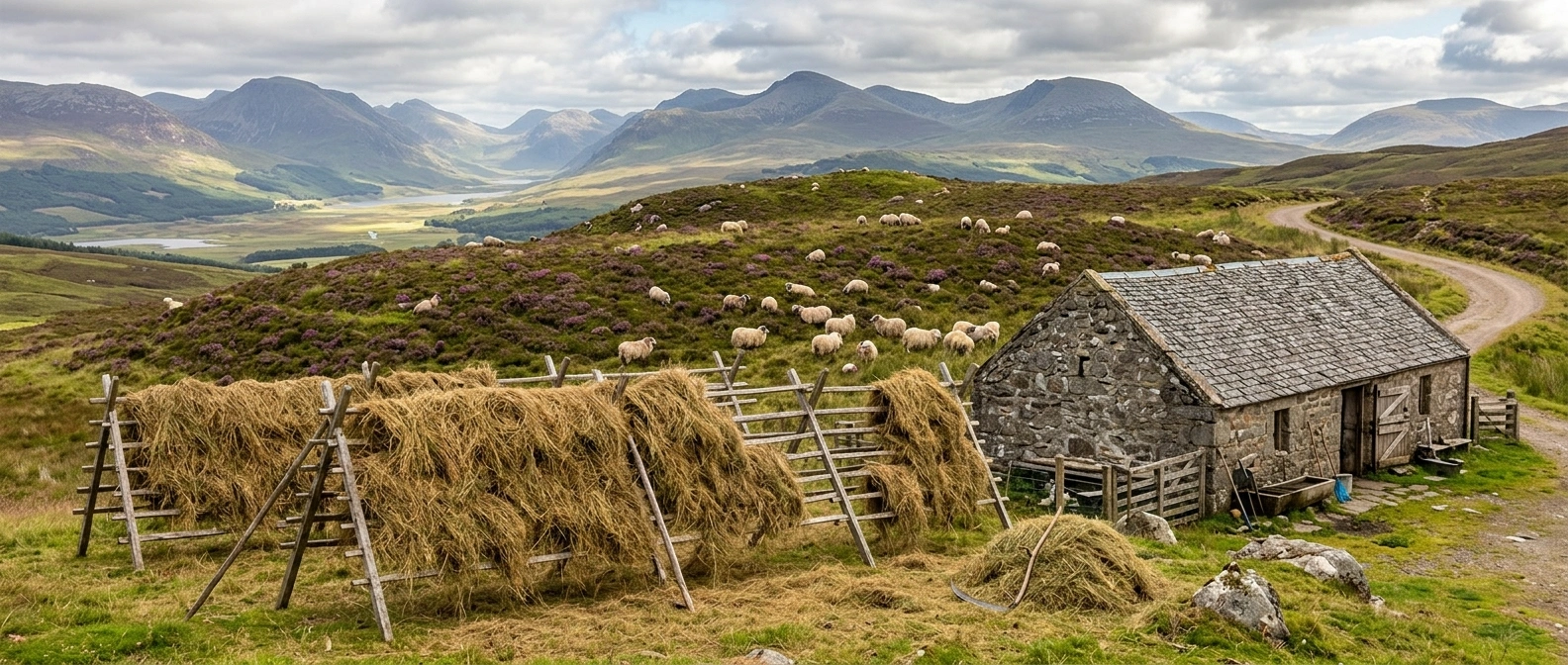
Scythed and dried mountain grassland is the traditional carbon-rich input of this zone. Depending on how short the local season allows, it's cut once or twice a year, then dried on racks or in the open before being stored. What sets it apart from a simple lowland grass cutting is genuine species diversity: an alpine meadow that's never been simplified down for hay production supports a much wider range of grasses, herbs and legumes than an ordinary lawn, and that diversity carries through into a broader spread of nutrients once it's dried and added to a heap.
Once properly cured, dried meadow hay is a reliable, stable carbon-rich material, functioning much like any other dried grass or straw input covered in Chapter 4. It stores well through winter, which matters given how short the active composting window is here, and it can be drawn on steadily rather than all at once.
Livestock Manure
Whatever species is locally kept, whether cattle, sheep, goats, yak, llama or alpaca, its manure is a genuinely valuable nitrogen source for this zone's compost. There's some regional variation in strength, broadly similar in character to the animal-manure guidance for dryland pastoral systems, but tied here specifically to alpine grazing rather than arid herding. Cattle manure is relatively mild and can be used fairly liberally once properly composted, while sheep and goat manure runs a bit more concentrated and should be used with a somewhat lighter hand. Yak, llama and alpaca manure sit broadly within that same range.
Where livestock is stalled or housed over winter, the straw or bedding mixed in with their manure, traditionally cleared out as what's often called "muck", is frequently already close to a good carbon-to-nitrogen ratio by the time it's collected from the barn or byre, making it one of the most convenient single inputs this zone offers.
A Centuries-Old Synergy
The genuine synergy between hay and manure sits at the heart of traditional mountain farming: livestock eat the hay cut from alpine meadows, and in turn produce the manure that, together with that same hay as bedding and carbon, forms the backbone of soil fertility in a system refined over centuries in exactly this kind of environment. Used together and balanced with an activator when a heap needs a boost (see Chapter 8), they're the closest thing this zone has to a complete, self-contained compost system.
Frequently Asked Questions
Why hay and manure instead of seaweed here?
Because seaweed needs coastal access, which most highland and alpine regions simply don't have, while grazing livestock on mountain pasture is a genuinely near-universal tradition across this entire climate zone worldwide. The Alps run dairy cattle on traditional hay meadows, the Andes keep llama, alpaca and sheep, the Himalayas and Tibetan plateau rely on yak, sheep and goats, and the Ethiopian highlands graze cattle and sheep. Wherever you are in this zone, some version of meadow hay and livestock manure is almost certainly the dominant free input available to you.
Is alpine meadow hay actually better than ordinary lowland grass?
Genuinely, yes, in terms of nutrient diversity. A traditional alpine hay meadow supports a much wider range of plant species than a simple lowland grass lawn, since it's never been simplified down to one or two grass varieties, and that diversity carries through into the dried hay as a broader spread of nutrients. Cut once or twice a year depending on how short the season allows, and dried properly, it becomes a reliable carbon-rich material once it's fully cured.
Does the type of livestock matter for the manure's strength?
A little, yes. Cattle manure, whether from Alpine dairy herds or highland cattle elsewhere, is relatively mild and can be used fairly liberally once composted. Sheep and goat manure is somewhat more concentrated, and yak, llama and alpaca manure sit in a broadly similar range. Whatever species is locally kept, the manure is a genuinely valuable nitrogen source, and straw or bedding cleared from stalled winter housing, often called muck, is frequently already close to a good carbon-to-nitrogen ratio by the time it's collected.