
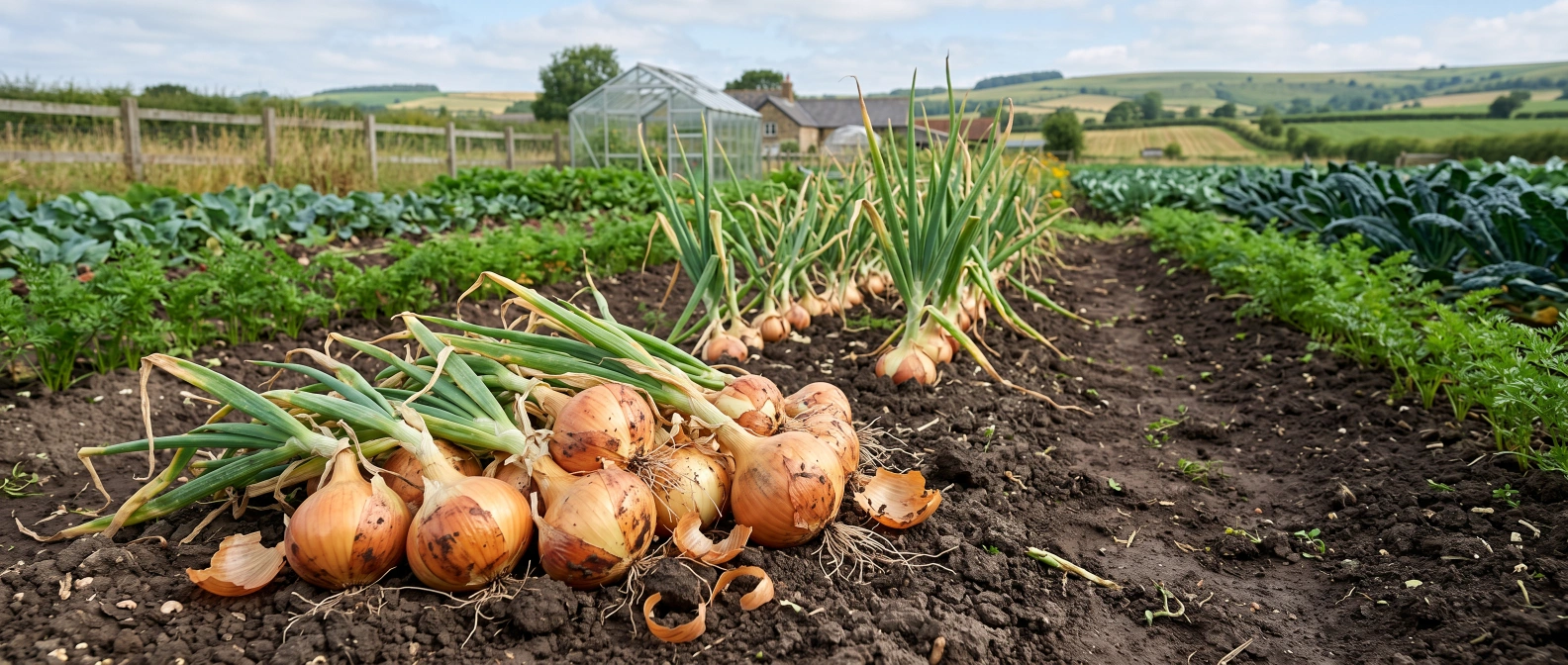
Onion, shallot and spring onion are all the same species -- Allium cepa -- and cross-pollinate with each other if left to flower nearby. Leek and elephant garlic are a second cluster, both Allium ampeloprasum -- yes, despite the name, elephant garlic is genuinely a leek relative, not true garlic. True garlic (Allium sativum) is its own species and, unusually, essentially never flowers in cultivation, so it carries almost no practical cross-pollination risk at all. Welsh onion and chives round out the hub as two genuine multi-year perennials, each its own species with no cross-partner here.
Which allium should you grow?
Alliums are some of the most useful crops in the garden. They flavour almost everything you cook, many keep for months, and they are among the easiest crops to protect from pests. They are about flavour and nutrition more than bulk calories, so most households grow a few rows rather than a field. Which to choose depends on how much effort you want to put in and what you want to do with them.
Best for beginners
Garlic is planted once in autumn and then needs little care, and shallots and spring onions are forgiving too. Chives are almost impossible to fail with.
Best for storage
Onions, shallots and garlic cure and keep for many months with no fridge and no preserving. See our guide to vegetables that store longest.
Stand through winter
Leeks are very hardy and can be lifted as needed right through winter, and autumn-planted garlic simply overwinters in the ground, ready for early summer.
Plant once, harvest for years
Chives and Welsh onions are true perennials that come back every spring. Divide the clumps every few years and you will never need to buy them again.
Quick crops and gap fillers
Spring onions can be ready in around eight weeks and are perfect for squeezing between slower crops or for successional sowings.
A word on onions
Onions look easy but need a long season, a weed-free bed and the right variety for your day length. Starting from sets is the easy route. And note: elephant garlic is a mild leek relative, not true garlic.
Alliums compared
Every crop on this hub side by side. Calories and storage come from the same data as our calculator and change with your climate zone, so pick yours. Calories are for one planted unit, shown underneath each figure, so compare seed with seed and bulb with bulb. Click a crop for its full guide.
| Crop | Months to harvest | Calories per planted unit | Keeps (weeks) | Difficulty | Species |
|---|---|---|---|---|---|
| Onion | 5 | 48per seed | 24 | Moderate | A. cepa |
| Shallot | 5 | 58per seed | 36 | Easy | A. cepa |
| Spring onion | 2 | 16per seed | 1 | Easy | A. cepa |
| Leek | 6 | 244per seed | 3 | Easy | A. ampeloprasum |
| Elephant garlic | 8 | 158per bulb | 18 | Easy | A. ampeloprasum |
| Garlic | 8 | 54per bulb | 20 | Easy | A. sativum |
| Welsh onion | 3 | 54per seed | 1 | Easy | A. fistulosum |
| Chives | 3 | 24per seed | 1 | Easy | A. schoenoprasum |
How alliums grow: what they have in common
Alliums look very different, but they share a few quirks, and most problems come from ignoring them.
Soil and site. They want an open, sunny site and fertile, free-draining soil that is firm rather than fluffy. Dig in compost well ahead of planting, but avoid fresh manure, which makes soft, rot-prone growth. Onions and garlic are shallow-rooted and poor at competing, so weeds are their biggest enemy: keep the bed clean by hoeing and hand-weeding. Our guides to building healthy soil and making your own compost help you prepare.
Sowing and planting. Onions, shallots and garlic are usually grown from sets or cloves pushed into the soil with the tip just showing, though onions and leeks can also be sown from seed. Leeks are transplanted into deep dibbed holes, which blanches the stems and gives long white shafts. Spring onions and chives are sown thinly where they are to grow. Garlic needs a cold spell to form cloves, which is why it is normally planted in autumn in temperate zones.
Day length and timing. Onions form bulbs in response to day length, so a variety must suit your latitude: long-day types for cool northern zones, short-day types for the south and tropics. Water steadily while the bulbs swell, then stop as the tops start to fall over so the bulbs can ripen, and lift on a dry day.
The usual pests and diseases
- Onion fly: maggots tunnel into the base of onions and shallots. Fine mesh from sowing or planting onward keeps the flies out.
- Allium leaf miner: a fly whose larvae tunnel in leeks, onions and garlic, worst in autumn and spring. Cover the crop with fine mesh during the flight periods.
- White rot: the soil-borne fungus that can rule a bed out for years (see below).
- Rust: orange pustules on the leaves of garlic, leeks and chives in damp, humid weather. Space plants well, avoid overfeeding with nitrogen and rotate.
- Downy mildew and neck rot: fungal problems in wet seasons and in stored bulbs. Careful curing and good airflow prevent most of it.
- Thrips: tiny insects that streak the leaves in hot, dry weather. Usually a nuisance rather than a disaster.
Why alliums go wrong
- Bolting: a cold snap or stress after planting. Choose heat-treated sets, plant at the right time and avoid planting too early.
- Small bulbs: crowding, weeds, drought or late planting.
- Soft, thick-necked bulbs: too much nitrogen or fresh manure. These do not store.
- Garlic that does not split into cloves: planted too late or in too warm a spot with no cold spell.
- Rotting in store: bulbs that were not properly cured or were stored damp.
When to sow, plant and harvest alliums
Pick your climate zone to see the sowing (or planting) and harvest months for every allium on this page. It is drawn from the same data as the calculator and shows the main window for each crop. The months are for the northern hemisphere; in the southern hemisphere, shift everything by six months.
| Crop | Jan | Feb | Mar | Apr | May | Jun | Jul | Aug | Sep | Oct | Nov | Dec |
|---|---|---|---|---|---|---|---|---|---|---|---|---|
| Onion | ||||||||||||
| Shallot | ||||||||||||
| Spring onion | ||||||||||||
| Leek | ||||||||||||
| Elephant garlic | ||||||||||||
| Garlic | ||||||||||||
| Welsh onion | ||||||||||||
| Chives |
Rotation and companion planting
Rotation matters more for alliums than for almost any other crop, because of white rot. The spores can sit in the soil for many years, so alliums must never follow each other in the same bed.
Rotation
- Treat the whole family as one group: onion, shallot, garlic, leek and spring onion should never go back to the same bed for at least four years.
- Before alliums: brassicas or a legume crop. The soil is fertile but not freshly manured.
- After alliums: roots or anything else. Alliums leave the soil quite clean of weeds if they were well hoed.
- If white rot appears, stop growing alliums in that bed, and grow chives or Welsh onions elsewhere.
Friendly neighbours
- Carrots: the classic pairing. Onion and leek smells can help to confuse carrot fly, and carrots in turn may deter onion fly.
- Beetroot, lettuce and brassicas grow well beside alliums, and the strong scent can put off cabbage pests.
- Chives and other flowering allium flowers draw bees and hoverflies into the garden.
- Keep apart: peas and beans, which can be stunted by allium neighbours.
Storing and preserving alliums
Alliums are among the easiest crops to keep, as long as you cure them properly first.
Cure, then store. Onions, shallots and garlic need two to three weeks of drying in a single layer somewhere warm, airy and sheltered from rain, until the necks are tight and the skins rustle. Then trim the roots and store them in nets or braided strings, hung in a cool, dry, airy place. Never store them in plastic bags, and check regularly. Any with soft necks should be used first. Our guides to storing food without a fridge and root cellar alternatives show how.
Leave leeks in the ground. They are hardy enough to stand through most winters and can be lifted as needed. In very cold climates lift them and heel them into a trench of soil in a sheltered corner.
Freeze or dry. Onions and leeks can be chopped and frozen raw for cooking, and chives freeze better than they dry, keeping more flavour. Sliced onions also dehydrate well.
Pickle and ferment. Small onions and shallots pickle well, and garlic can be fermented. One safety note: never keep garlic in oil at room temperature, which can allow botulism to develop. Store it in the fridge and use it within days, or freeze it instead.
Saving allium seed: what crosses with what?
Alliums are a genuinely mixed bag for seed-saving. Garlic is never grown from seed at all, and Welsh onions and chives are perennials you simply divide. The bulb onions and leeks are biennials, so the bulbs or plants have to survive winter before they flower. The table shows who crosses with whom. For details, see our pages on onion, shallot, spring onion, leek and chives, and which vegetables cross-pollinate.
| Group (species) | Crops | Crosses with |
|---|---|---|
| Allium cepa | Onion, shallot, spring onion (White Lisbon type) | Each other: the same species |
| Allium ampeloprasum | Leek, elephant garlic | Each other, but not the onion group or true garlic |
| Allium sativum | Garlic | Effectively nothing: grown from cloves and rarely flowers |
| Allium fistulosum | Welsh onion | No partner on this hub (a perennial, divide the clumps) |
| Allium schoenoprasum | Chives | No partner on this hub (a perennial, divide or sow) |
Allium questions, answered
Why do my onions bolt?
Bolting means the onion sends up a flower stalk instead of swelling a bulb, and it is triggered by stress, usually a cold snap after the plants have started growing. Sets planted too early in cold spring weather are the classic culprit, as are very small or very large sets and sudden changes in watering. Plant sets when the soil has warmed a little, choose heat-treated sets if you can, and nip off any flower stalks you see. Bolted onions will not store, so eat them first.
When should I plant garlic?
In most temperate climates, plant garlic cloves in autumn, from October to early December, so they get a cold spell to trigger proper clove formation. In colder zones, plant a few weeks before the ground freezes. Garlic can be planted in early spring instead, but the yield is usually smaller. In warm climates plant in the cool season. Plant the cloves pointed end up, about 2.5 cm below the surface, and do not use supermarket garlic, which may carry disease or be unsuited to your climate.
Should I grow onions from sets or from seed?
Sets (small, partly grown bulbs) are the easiest route. They establish quickly, cope with poor weather better and give a reliable crop, at the cost of a slightly higher risk of bolting and a smaller choice of varieties. Seed is cheaper and gives a wider range of varieties, including the best long-keepers, but it needs an early start indoors, careful weeding and a long season. Beginners should start with sets or with shallots.
Why are my onions small?
The usual causes are crowding, weeds, drought and late planting. Onions have shallow roots and thin leaves that cast little shade, so they are poor at competing with weeds. Space them properly, keep the bed weed-free, water during dry spells while the bulbs are swelling, and plant on time. Poor, compacted or very acidic soil also holds them back, as does fresh manure applied just before planting.
How do I know when onions and garlic are ready, and how do I cure them?
Onions are ready when the tops fall over and begin to yellow, and garlic when the lower leaves have turned brown but a few are still green. Lift on a dry day and leave the bulbs to dry in a single layer somewhere warm, airy and sheltered from rain for two to three weeks, until the necks are tight and the outer skins rustle. Then trim the roots, and store them in nets, or braid them, in a cool, dry, airy place.
What is onion white rot, and can I grow alliums where it has been?
White rot is a soil-borne fungus that rots the roots and bases of onions, garlic, leeks and shallots and leaves a fluffy white mould. It persists in the soil for many years once it arrives, and there is no practical cure. Never grow alliums in an infected bed, and avoid spreading it on boots, tools or soil. Stay vigilant by rotating strictly, buying healthy sets and bulbs from a reliable source and never planting in the same spot back to back.
Which alliums suit your climate?
Most alliums prefer a cool start and a dry finish, but some thrive in the warmth and some need real cold. Pick your zone to see every crop that suits it, ranked by how well it grows there.
How many onions and garlic bulbs do you actually need?
A household can use more alliums than most people expect, and they are the easiest crops to store. The calculator works out how much to grow for your household and climate, and the family-of-four guide shows a worked example.