
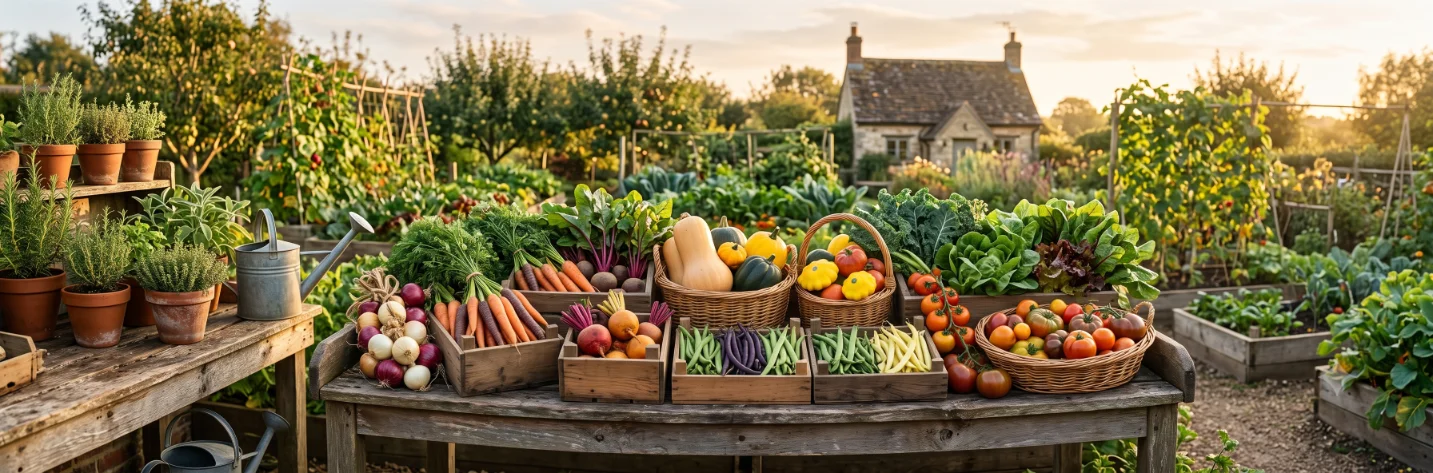
Short answer: every food crop you can grow falls into one of three groups, and each group does a different job. Grains, peas and beans are the staples and high-protein crops: they carry the calories and the protein, and they keep for a year or more. Potatoes, carrots, winter squash, onions and beetroot are the medium-calorie crops: they fill the plate, yield heavily and bridge the seasons. Salad vegetables and leafy greens are the nutritional crops: they supply vitamins, minerals and variety but almost no energy. A plot that feeds people needs all three, in very different proportions.
Last updated 18 November 2026
On This Page
Why Group Crops by Calories?
Most gardening books sort crops by botany: brassicas here, legumes there, roots in another chapter. That is useful for crop rotation and pest control, and this site's crop guides are organised that way. But if the real question is can this plot feed us?, a different sort is more useful: how much food energy does the crop give per kilogram, and how long does it keep?
Sorted that way, the vegetable world splits into three fairly distinct groups. The difference is startling. An adult needs roughly 2,000 calories a day. Here is how much of each crop that takes, using the same figures the calculator uses:
| Crop | Calories per kg | kg for 2,000 kcal |
|---|---|---|
| Lettuce | 150 | 13.3 kg |
| Carrot | 410 | 4.9 kg |
| Potato (maincrop) | 770 | 2.6 kg |
| Wheat | 3,400 | 0.6 kg |
| Broad bean (dried) | 3,410 | 0.6 kg |
Calories per kilogram of harvested crop, from this site's crop database. The grain and bean figures are for the dried, harvested product.
Two thousand calories of wheat is about half a kilogram, a small loaf's worth. The same calories from lettuce would be well over a dozen kilograms, more than anyone could eat in a day. That is not a reason to skip lettuce; it is a reason to be clear about what lettuce is for. Each group has a different job, and the plan only works when each group is given the right amount of space.
Think of it as a division of labour. Group one is the engine: it carries the calories and most of the protein, and it stores for a year or more. Group two is the filler and the bridge: it adds bulk and variety, yields heavily from small areas, and carries you through the winter. Group three is the nutrition and the morale: it keeps the diet healthy and makes the staples worth eating. Remove any one and the system struggles.
Calories per Kilogram, Crop by Crop
Every bar is the calories in one kilogram of harvested crop, from this site's crop database. The longer the bar, the more food energy in every kilogram.
Where the Groups Blur
The three groups are a working framework, not a strict classification. Real crops do not line up neatly, and several sit on the borders. It helps to know which ones:
- Kale (about 490 calories per kilogram) is richer than many roots, yet it is grown as a leafy green and used for nutrition. Treat it as group three.
- Onions (400) and carrots (410) sit right at the line between group two and group three by calorie count. They behave like medium-calorie crops because they store for months and form a base of cooking, so group two is the practical home.
- Brussels sprouts (420) and leeks (610) are similar: more energy than salad, used like vegetables.
- Fresh peas (about 840) and sweet corn (about 860) are denser than most vegetables, but eaten fresh they are not storage staples. Let peas dry, and they move to group one at about 3,400.
- Garlic (about 1,490) is dense per kilogram but is eaten in tiny amounts, so it is a flavouring in practice.
- Winter squash (about 340) is low per kilogram, but each fruit is enormous and keeps for months, so it earns a place among the storage crops.
- Potatoes and sweet potatoes straddle groups one and two, as explained above.
The calculator draws one line through all of this, with crops under 400 calories per kilogram counted as nutritional crops. It is a sensible rule of thumb, but you should use the groups to think with, not as boxes that every crop must fit into.
A Balanced Plot, at a Glance
An illustrative split for a plot meant to carry real food security. Notice how little space the nutritional crops need, and how little of the calories they supply.
Illustrative figures that sit within the ranges in the table below; the remainder of the space goes to paths, fallow beds and rotation gaps. Your own split depends on your climate, household and how much you rely on the garden.
Balancing Your Plot Between the Groups
There is no single correct split, because it depends on your climate, your household and how much you rely on the garden. As a rough starting point for a plot meant to provide real food security:
| Group | Share of growing space | Share of calories | Main job |
|---|---|---|---|
| 1. Staples and protein (grains, peas, beans) | About a quarter to a third | About 40 to 55% | Calories, protein, long storage |
| 2. Medium-calorie (potatoes, roots, squash, onions) | About a third to a half | About 40 to 55% | Heavy yields, bridging the seasons |
| 3. Nutritional (salads and greens) | About a tenth to an eighth | Under 10% | Vitamins, minerals, variety |
These are rules of thumb, not recommendations for any particular household. The shares of space are consistent with the rough guidance on our what vegetables to grow page, which counts the heavy roots such as potatoes with the staples to give "about half or a little more" for the foundation. Group two takes the largest single share of space because its crops yield heavily per square metre and store well, while group one takes less space than its share of calories because grain and pulses are so dense.
How the balance moves:
- A short, cool season shifts weight toward hardy roots, potatoes, oats and barley. See growing food in a short season.
- A hot, dry climate shifts toward drought-tolerant grains and pulses such as sorghum, millet and tepary beans. See growing food in a drought-prone climate.
- A small plot favours group two and group three, because space-hungry grains give poor returns on a few square metres. Beans on supports and potatoes in a small patch stretch furthest.
- A garden that supplements the shops rather than replacing them can take far more of group three and group two, and leave grain to the shops.
- A large plot with a long-term aim of self-sufficiency should lean harder on group one, since that is the group that can be stored for a year and beyond.
To turn the shares into actual areas and plant numbers for your own household, read how much land do I need, and use the calculator.
How Climate Changes What Fills Each Group
The three jobs stay the same everywhere; the crops that do them change with the climate. A crop that is a dependable staple in one zone can be unreliable in another. For example:
- Cool and maritime zones: oats and barley for group one, with field beans and peas; potatoes, swedes, parsnips and kale for groups two and three. See best crops for a temperate maritime climate.
- Continental zones: wheat, maize, beans, winter squash and root crops all do well, with hot summers and cold winters. See temperate continental.
- Mediterranean zones: wheat and chickpeas, plus a long season for tomatoes, peppers and squash. See best crops for a Mediterranean climate.
- Subtropical and tropical zones: maize, sorghum, millet, cowpeas and other pulses for group one; sweet potatoes, cassava and yams for group two; many leafy greens that tolerate heat. See subtropical and tropical.
- Arid zones: drought-tolerant grains and beans, with irrigation-dependent vegetables kept to a small area. See best crops for an arid climate.
- Boreal and alpine zones: short seasons favour hardy roots, potatoes, barley and kale. See boreal and alpine.
The vegetable guides list sowing calendars, yields and storage times for every zone, and each of the eight climate pages shows the crops that suit it.
How the Calculator Uses the Groups
The food calculator works from your household size, your climate zone and the crops you choose. When it divides your calorie target among crops, it treats crops under 400 calories per kilogram as nutritional crops and gives them a small fixed share, while the rest of the calories are shared among the higher-calorie crops. You can choose to favour the crops that deliver the most calories from the least land, or share the calories more evenly, and lock any crop you want to keep fixed.
In effect it is applying the idea on this page: the calorie crops carry the plan, and the nutritional crops are included for their value rather than counted on for energy. If you pick only nutritional crops, the calorie split step warns that they cannot carry your calories and suggests adding grains, potatoes or beans.
Common Mistakes
- Planning a plot that is all group three. Tomatoes, lettuce, courgettes and peppers are the most popular crops and also the lowest in calories. A plot of them looks productive and feeds nobody through a winter.
- Skipping group one entirely. Potatoes alone are not enough: they store for months, not years, and are low in protein. Beans are the easiest way to close the gap.
- Starting with grain. Grain is the most calorie-dense group and the most work. Build a working plot of potatoes, beans, roots and greens first, then add a grain patch.
- Forgetting that storage is part of the plan. A harvest that cannot be dried, cured or stored is a harvest that will be lost. Choose crops for how they keep, and set up somewhere to keep them.
- Ignoring protein. Calories alone do not make a diet. Beans, lentils, peas and eggs (see are chickens worth it?) fill the protein gap.
- Treating the groups as rigid. Use them to check balance, not to decide whether each crop "counts". What matters is that the plot, as a whole, has enough energy, enough protein and enough nutrition.
For the bigger question of whether home-grown food can really carry a household, see can I grow enough food to survive? and can you survive on vegetables alone?
All 18 Resilience Gardening guides in one printable 121-page PDF. See what's inside
Related Guides
Frequently Asked Questions
What are the three groups of food crops?
Group one is the staples and high-protein crops: grains, dried peas and dried beans, with roughly 3,200 to 3,900 calories per kilogram. Group two is the medium-calorie crops: potatoes, sweet potatoes, carrots, beetroot, parsnips, winter squash and onions, mostly between 300 and 1,500 calories per kilogram. Group three is the nutritional crops: salad vegetables, leafy greens and other low-calorie vegetables, mostly under 400 calories per kilogram, grown for vitamins, minerals and variety rather than energy.
Why group crops by calories instead of by plant family?
Because the question that decides whether a garden can feed people is how much food energy each square metre produces and how long it keeps, not whether a crop is a brassica or a legume. Grouping by calorie density tells you what job each crop does in the plan: carrying the calories, bridging the seasons, or supplying nutrition.
Are potatoes a staple or a medium-calorie crop?
By weight they are medium-calorie, at about 770 calories per kilogram, so they sit in group two. But they produce so much food per square metre that in practice they do the work of a staple, which is why many plans count them alongside grains and beans as the foundation of the plot. The honest answer is that they straddle the line.
How much of my plot should each group take?
As a rough starting point for a plot meant to provide real food security: grains, peas and beans together with heavy roots like potatoes take about half or a little more of the growing space, other storage crops like carrots, squash and onions take about a quarter to a third, and nutritional crops take a tenth to an eighth. Treat these as a starting point to adjust for your climate and household.
Can I live on group three vegetables alone?
No. Lettuce is around 150 calories per kilogram, so a person would need roughly 13 kilograms of it a day to reach 2,000 calories. Salads and greens are vital for vitamins and minerals but they cannot carry the energy side of a diet.
Do I need group one crops if I have lots of potatoes?
Potatoes can supply a great deal of energy, but they keep for months rather than years, and they supply little protein. Dried beans and grains add protein, keep for a year or more when stored dry, and make the food supply far more resilient. Most plans use both.
Why do beans and grains go together?
Grains are low in certain essential amino acids that beans supply, and beans are low in others that grains supply. Eaten over the course of a day or two, the two together give a more complete protein than either alone, which is why traditional diets worldwide pair them.
Which group is easiest for a beginner?
Group two and group three give the quickest results: potatoes, carrots, onions, winter squash, kale and lettuce are forgiving and rewarding in a first year. Beans are the easiest group one crop. Grains are rewarding but need more space, plus threshing and milling, so most people add them after the rest of the plan is working.
Which crops sit on the borderline between groups?
Kale (about 490 calories per kilogram), onions (400), carrots (410) and Brussels sprouts (420) sit right around the line between the medium-calorie and nutritional groups. Fresh peas (840), sweet corn (860) and garlic (1,490) are higher than most vegetables but are not storage staples. The groups are a working framework, not a strict rule.
How does the calculator use these groups?
The calculator treats crops under 400 calories per kilogram as nutritional crops, which receive a small fixed share of your plan, and shares the rest of your calories among the higher-calorie crops. You can lock or change individual crops. Start from your climate zone and household size and it works out the numbers.
Does my climate change which crops fill each group?
Yes. The groups stay the same but the crops that fill them change. In cool, wet climates oats, potatoes and kale lead; in hot, dry ones sorghum, millet, cowpeas and sweet potatoes take over. The calorie rankings and best-crops guides for each zone show which crops are strongest in each group where you live.