
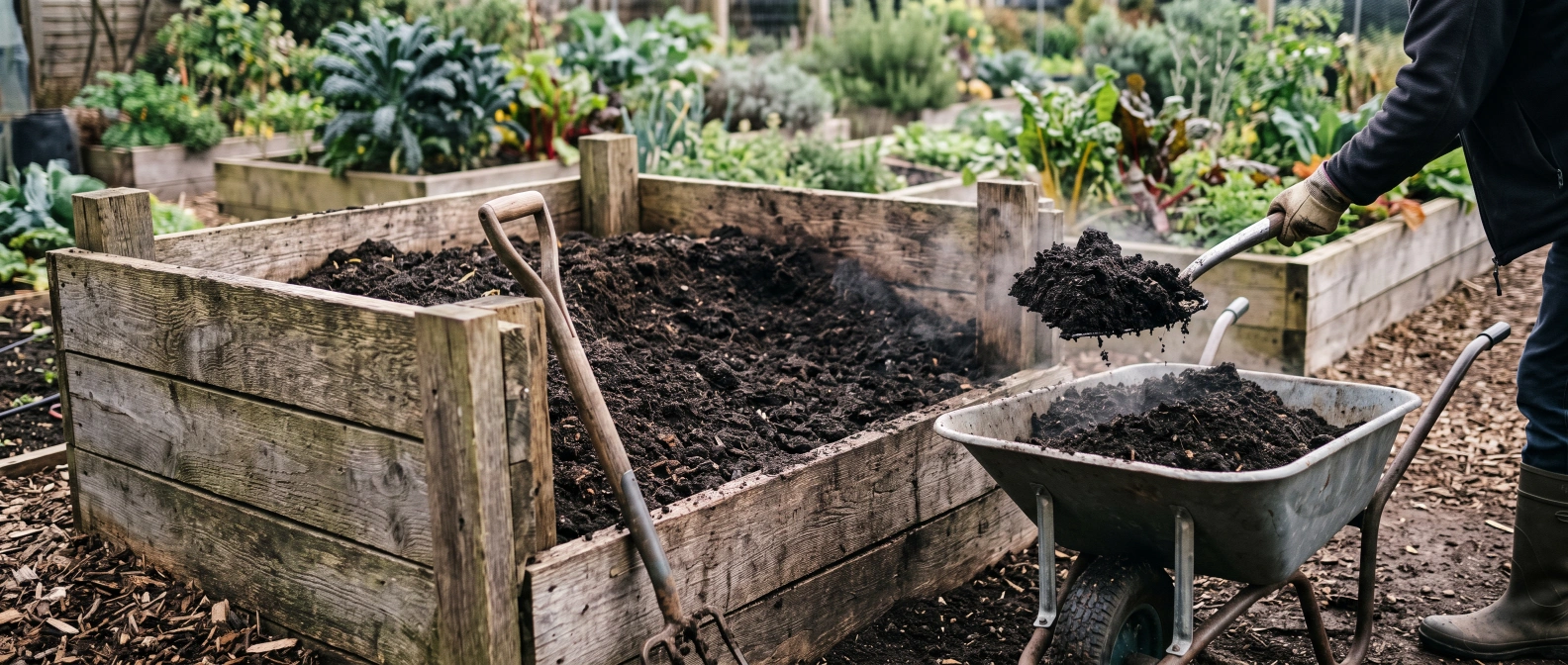
Short answer: build it entirely from what your household and garden already produce. Kitchen scraps, garden trimmings, lawn clippings, fallen leaves, cardboard, and manure if you keep animals -- balanced roughly between nitrogen-rich "green" material and carbon-rich "brown" material, kept appropriately moist, and turned occasionally for air. No bought activator, bin or bagged fertiliser is actually required. Compost is the one source of soil fertility that costs nothing and never runs out, because the inputs are things you already have.
Compost Is Free Fertility, Not a Product to Buy
Garden centres sell compost activators, tumbling bins, and bagged fertiliser, and all of it can be genuinely useful -- but none of it is required. Compost happens because of biology, not brand names: carbon-rich and nitrogen-rich material broken down by microorganisms, with moisture and oxygen keeping the process running. A heap built from kitchen scraps, garden waste, fallen leaves and cardboard, in a roughly 50/50 mix of green and brown material, will compost perfectly well in a simple pile or a homemade enclosure of pallets or chicken wire.
Getting the balance right matters more than any bought input. Too much green material (fresh, wet, nitrogen-rich) and a heap turns slimy, compacted and smelly. Too much brown material (dry, carbon-rich) and it breaks down agonisingly slowly. The practical fix is simple: alternate layers, or mix as you add material, aiming for roughly equal parts by volume rather than by weight, since brown material is usually much lighter.
One thing that genuinely does change the details is climate. The core biology is identical everywhere, but a heap in a cool, wet maritime climate needs protection from excess rain and some insulation to keep working through winter, while the same heap in an arid climate needs the opposite -- deliberate moisture management to stop it drying out and stalling completely. This site's dedicated compost section covers a full method built specifically for each of the 8 climate zones, rather than one generic guide stretched to fit everywhere.
Frequently Asked Questions
How do I make compost without buying anything?
By building a heap entirely from what a household and garden already produce -- kitchen scraps, garden trimmings, lawn clippings, fallen leaves, cardboard and paper, and manure if any animals are kept -- balanced roughly between nitrogen-rich "green" material and carbon-rich "brown" material, kept appropriately moist, and turned occasionally to keep it aerated. No bought activator, bin or fertiliser is actually required for compost to work.
What's the difference between green and brown compost material?
Green material is nitrogen-rich and usually fresh and moist -- kitchen scraps, grass clippings, fresh garden waste -- while brown material is carbon-rich and usually dry -- fallen leaves, cardboard, straw, woody prunings. A heap needs a reasonable balance of both; too much green turns slimy and smelly, too much brown breaks down painfully slowly.
Does compost-making change depending on climate zone?
Yes, genuinely -- the core biology (carbon, nitrogen, moisture, oxygen) is the same everywhere, but what that means in practice changes a lot by climate: a heap in a cool, wet climate needs protection from excess rain and insulation to keep working, while the same heap in an arid climate needs the opposite, active moisture management to stop it drying out and stalling.