
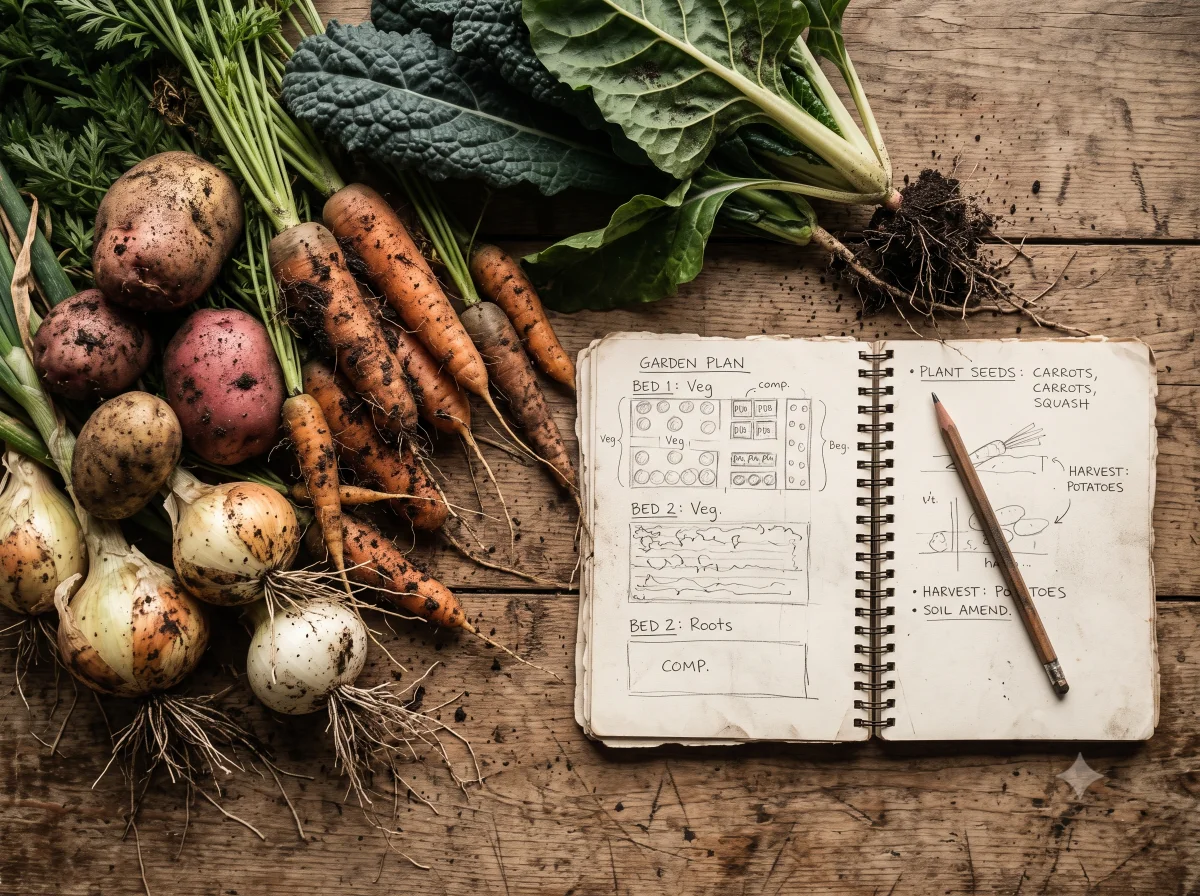
Short answer: potatoes, almost everywhere. They're usually the single highest-calorie crop per square metre of any commonly grown vegetable, with other starchy staples close behind. Crops grown mainly for flavour or nutrition -- tomatoes, peppers, lettuce -- give a fraction of the calories per square metre that a staple does. But the exact ranking shifts by climate zone, since a crop's real yield depends on how well it actually grows where you are, not just its calorie density on paper.
Last updated 5 November 2026
On This Page
All 18 Resilience Gardening guides in one printable 121-page PDF. See what's inside
Calorie Density Isn't the Whole Story
Two numbers determine how many calories a crop delivers per square metre: how many calories it provides per kilogram, and how many kilograms it actually yields from that square metre. A crop can have modest calorie density but still win on this measure by producing a huge amount of bulk -- which is exactly what potatoes do. They're not the most calorie-dense food by weight, but they yield heavily enough per plant to come out on top almost everywhere.
This is also why a generic "best crop" list can mislead. A crop's real yield changes with climate -- the same potato variety planted in a long, warm growing season will out-yield the identical variety in a short, cool one. So while potatoes are the safe general answer, the precise ranking for your own zone can differ, and it's genuinely worth checking rather than assuming.
This site's calorie rankings tool ranks every crop the calculator models by actual calories per square metre, by zone -- a more reliable answer than a generic list.
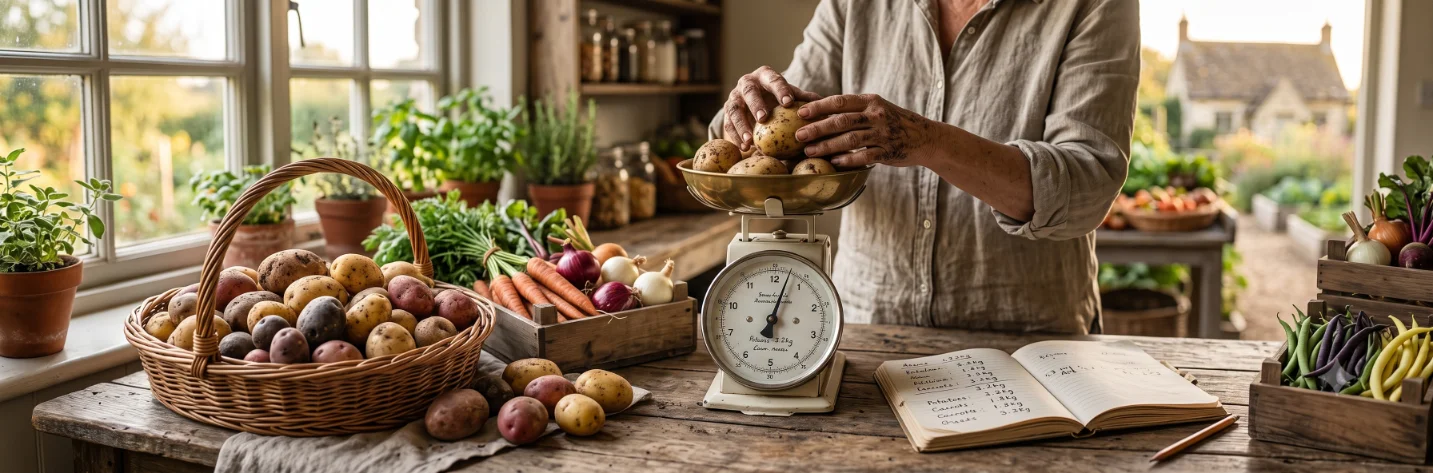
The Crops in Tiers
| Tier | Crops | Role in a plan |
|---|---|---|
| Top: heavy starchy crops | Potatoes, sweet potatoes, Jerusalem artichokes, cassava in the tropics | The foundation of a calorie plan in most zones. |
| High: roots and squash | Parsnips, carrots, beetroot, winter squash | Good yields, good storage, and excellent for filling out the plot. |
| Dense but lower per area: grains and legumes | Wheat, maize, oats, dried beans and peas | Store for years, provide protein, but need more space per calorie. |
| Low: leafy and fruiting crops | Kale, cabbage, tomatoes, peppers, courgettes, lettuce and spinach | Essential for vitamins and variety, not for calories. |
See what vegetables to grow for how these fit together.
What Calories Per Square Metre Does Not Tell You
The number is a very useful starting point, but it leaves things out:
- Protein, fat and vitamins. Potatoes are almost pure carbohydrate. Beans give protein, and greens give vitamins. A plan of only the top-ranked crop would leave gaps. See can you survive on vegetables alone?.
- Storage. A crop that rots in a month is worth less than one that keeps all winter. See vegetables that store longest.
- Labour and processing. Grain must be threshed and milled, while potatoes can be dug and eaten. A crop that looks efficient on paper may cost more work than you can give.
- Risk. Potatoes are at risk from blight, and a poor year hits a single staple hard. Spreading across several crops is safer than chasing the single best number.
- Water and fertility. Thirsty or hungry crops may not suit your site. See drought-prone climate.
- Rotation. You cannot grow potatoes on the same ground every year without trouble.
How Your Zone Changes the Ranking
Yield depends on climate. Some examples from this site's data:
- Sweet potato is a strong performer in warm zones, but it is not viable in the cold boreal zone at all, and is only marginal in a maritime climate.
- Potatoes are viable in most zones, and typically perform best in maritime and continental climates, with lower yields in the arid and boreal zones.
- Wheat, barley and oats yield very differently from zone to zone, and are not viable in the hottest, wettest tropical zone.
- Winter squash can be grown in every zone, but it is only challenging in the cold boreal and alpine zones and yields more in warm, long-season climates.
That is why a generic best-crop list can mislead. Use the calorie rankings for your zone, and see the crop guides for each climate for the full picture.
If You Have a Small Plot
When space is tight, the calories-per-metre figure matters even more. A few ways to make the most of it:
- Put the most calorie-rich crops, potatoes, squash and roots, in the largest share of the space.
- Grow squash and beans upwards on supports, so that the ground beneath can be used.
- Use succession sowing and catch crops, so that no ground is empty for long.
- Choose compact varieties and grow in good, fertile soil, which raises yields.
- Leave the low-calorie crops to a few well-chosen plants, or to containers.
See how much land do I need to find out whether a plot can ever be enough.
Using the Numbers in a Plan
- Work out the calories you need for the household for a year.
- Fill most of that with high-yield staples that suit your zone, using the rankings.
- Add storage and protein crops, such as beans, so the diet is balanced and lasts the winter.
- Add fresh vegetables for nutrition and variety, in the space that is left.
- Check the land. Add up the square metres, and see whether you have enough.
The calculator does this for your household and zone, and how much potato, wheat and rice per person shows the weights involved.
Common Mistakes
- Chasing the single best crop. One staple is a risk, and a diet of one food is poor.
- Comparing calories per kilogram instead of per square metre. Density alone is not the whole story.
- Using yields from another climate. A figure from a warm zone will mislead in a cool one.
- Ignoring storage and processing. A crop must be edible in February, too.
- Dismissing the low-calorie crops. They supply vitamins and variety that staples cannot.
Frequently Asked Questions
What crop gives the most calories per square metre?
Potatoes are usually the single highest-calorie crop per square metre of any commonly grown vegetable, with other starchy staples like sweet potato and some grains close behind -- vegetables grown mainly for flavour or nutrition, like tomatoes, lettuce or peppers, are far behind by comparison. The exact ranking shifts by climate zone, since yield per plant changes with growing conditions.
Does the highest-calorie crop change depending on climate zone?
Yes -- a crop's calorie yield per square metre depends on how well it actually grows in a given climate, so the top performer in a warm, long-season zone isn't necessarily the top performer in a short, cool-season one, even though the crop itself provides the same calories per kilogram everywhere.
Should I only grow the highest-calorie crops?
No -- a diet of nothing but the single highest-calorie crop would leave a household missing vitamins, minerals and dietary variety that no amount of one staple crop can provide, so calorie-dense crops should form the bulk of a growing plan alongside a real range of other vegetables, not replace them entirely.
Which crop gives the most calories per square metre?
Potatoes, in most climates, followed by sweet potatoes where it is warm enough, and other heavy starchy crops. Grains are very calorie-dense but yield less weight per area.
How many calories per square metre does a potato crop give?
Using a typical garden yield of around 3 kilograms per square metre and about 770 calories per kilogram, roughly 2,300 calories per square metre. Real yields vary with climate, variety and care.
Why do lettuce and tomatoes rank so low?
They are mostly water, so a kilogram contains very few calories, and they cannot be stored for long. They are valuable for nutrition, but not for calories.
Is wheat or potato better for calories per square metre?
Potatoes usually give more calories per square metre, because they yield much more weight per area. Wheat is far denser by weight and keeps for years, but yields less per area and needs threshing and milling.
Does climate zone change the best crop?
Yes. Sweet potatoes do well in warm zones but not in cold ones, and potatoes, grains and squash vary in yield from zone to zone. Check the calorie rankings for your own zone.
Should I only grow the highest-calorie crop?
No. One crop leaves gaps in protein, fat and vitamins and is vulnerable to disease. A mix of staples, beans and vegetables is more resilient and more nutritious.
How can I increase calories per square metre?
Build fertile soil, choose high-yielding varieties, grow vertically where possible, use succession planting, and put the most calorie-rich crops in the best ground.
Where can I find the rankings for my zone?
The calorie rankings tool on this site ranks every crop in the calculator for your zone, by calories per square metre and other measures.