
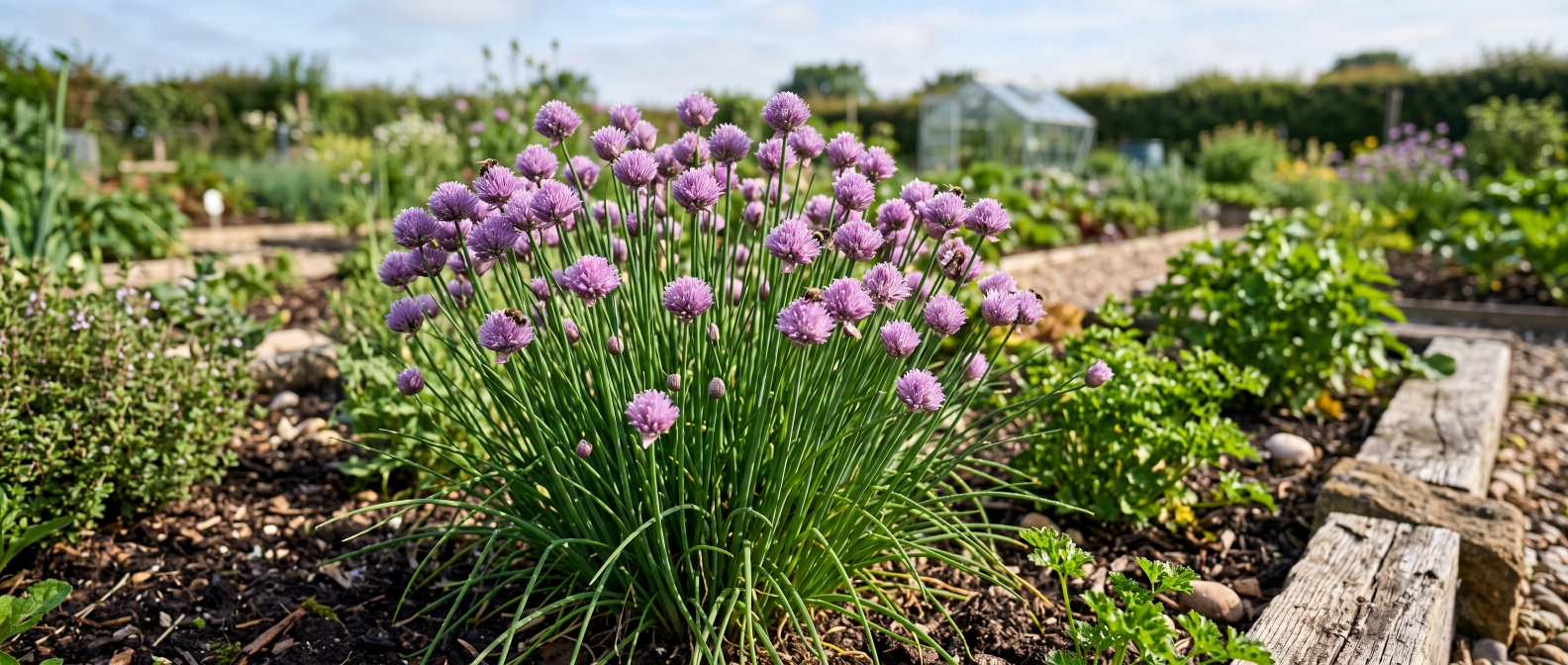
A genuine perennial with a mild onion flavour, per the crop database's own description, harvested by cutting leaves regularly rather than lifting the whole plant. Alongside Welsh onion, it's one of only two true multi-year perennials on this hub -- but it's grown for flavour, not calories, sitting at the very bottom of this whole site's calorie-density range.
Water need
Genuinely tough and drought-tolerant once established -- one of the lowest-maintenance crops on this whole site.
Calories at a glance
300 kcal/kg -- one of the lowest calorie densities this site models; grown purely for flavour and as an easy perennial, not for food security (scale is log-based across all 55 core crops in the calculator).
Temperature Range by Month
Month on the bottom, temperature up the side. The pale green background is what the plant can survive at all -- fatal above or below it, labelled directly on the chart where that applies to your zone. The coral band is its ideal range, and only fades in during the months this zone would actually have the crop in the ground -- reusing the exact same sowing/harvesting data as the calendar further down the page. The blue line is real monthly climate data (not a modelled estimate) for a representative rural/agricultural location in this zone -- a small farming town or agricultural research station rather than a major city, to avoid the warmer bias city weather stations have. For the actual verdict on how well this crop does in your zone, see the badge at the top of the page -- that's based on the site's own researched yield figures, not this chart.
Quick Start: Sowing to Storage
- Sow direct or start in modules. Sow direct or start in modules for transplanting -- chives germinates readily and establishes quickly either way.
- Let clumps establish before heavy picking. Give new plants their first season to establish into a proper clump before harvesting heavily.
- Harvest by cutting, not pulling. Snip leaves a few centimetres above the base with scissors, leaving the growing point intact -- this encourages continuous regrowth through the season.
- Deadhead or let flower for pollinators. Cut off flower heads to keep leaf production going, or leave some to flower -- chive flowers are genuinely popular with pollinators and edible themselves.
- Divide established clumps every few years. Lift and split a clump every 3-4 years once it gets crowded -- this multiplies your stock and keeps plants vigorous.
Sowing & Harvesting Calendar
Pick your zone under "Temperature Range by Month" above and this updates too. Like Welsh onion, the harvest window here runs genuinely wide -- a direct reflection of chives' perennial, cut-and-come-again habit.
Calories & Yield
Tropical, Subtropical and Mediterranean zones tie for the best yield here.
| Climate Zone | Yield per plant | Calories per plant | Viability |
|---|---|---|---|
| Tropical / Humid | 1.5 kg | 450 kcal | Viable -- best yield |
| Subtropical | 1.5 kg | 450 kcal | Viable -- best yield |
| Mediterranean | 1.5 kg | 450 kcal | Viable -- best yield |
| Temperate Maritime | 1.2 kg | 360 kcal | Viable |
| Temperate Continental | 1.2 kg | 360 kcal | Viable |
| Cool / Boreal | 0.48 kg | 144 kcal | Challenging (60% yield) |
| Arid / Semi-Arid | 0.48 kg | 144 kcal | Challenging (60% yield) |
| Highland / Alpine | 0.48 kg | 144 kcal | Challenging (60% yield) |
Figures per established clump per year, from the site's own crop database. Boreal, Arid and Alpine already reflect the 60% penalty applied to challenging zones.
A note on varieties: chives are mostly grown as a single undifferentiated type from seed, with genuinely little named-cultivar diversity in wide circulation -- garlic chives (Allium tuberosum) are a related but distinct crop, not a variety of this one.
Seed Saving -- Quick Guide
Chives is its own species, genuinely distinct from every other allium on this site -- safe to grow and save seed from alongside onion, leek, garlic or shallot without isolation concerns. Different chives varieties will cross with each other if grown close together.
SERVINGS, NOT DAILY CALORIES This works out plate-sized servings of chives from your seed during its fresh harvest window only, not your group's full daily calorie needs -- chives is grown for flavour, not calories. For that, use the main calculator.
Estimated for your selected zone above, using this site's own germination, loss and yield figures for chives -- a helping is a rough herb-scale portion, not a plate-filling side. Treat it as a planning estimate, not a promise.
Storage & Preservation
Fresh-cut chives keep for about a week refrigerated -- but because an established clump is harvestable across most of the year, there's genuinely little need to store much at once.
For longer-term preservation, chopped chives freeze well (best frozen quickly in small portions), and drying is possible too, though it loses much of the fresh flavour that's the whole point of growing this crop.
Growing Chives Without Bought Inputs
Genuinely one of the most trouble-free crops on this entire site -- pests and diseases are rarely a real problem, and some gardeners even use chives as a companion plant, believed to help deter certain pests from nearby crops.
Rust is the main disease worth watching for, the same risk this hub's other alliums face.
Good airflow between plants and avoiding overcrowded clumps are simple, genuinely effective input-free measures.
Frequently Asked Questions
Does chives cross-pollinate with anything else on this site?
No -- chives is its own species, Allium schoenoprasum, genuinely distinct from every other allium this site covers: onion, shallot and spring onion (Allium cepa), Welsh onion (Allium fistulosum), leek and elephant garlic (Allium ampeloprasum), and garlic (Allium sativum). It has no cross-pollination partner here at all.
Is chives a good calorie crop?
No, and it isn't grown for that reason. At around 300 kcal per kg, chives is one of the lowest-calorie crops this site models -- it earns its place for flavour, as a genuinely easy perennial herb, not as a food-security calorie source.
Is chives really a perennial like Welsh onion?
Yes -- the crop database confirms it directly. Alongside Welsh onion, chives is one of only two genuine multi-year perennials on this whole hub, and it's viable in every zone this site models, even if reduced in the coldest three.