
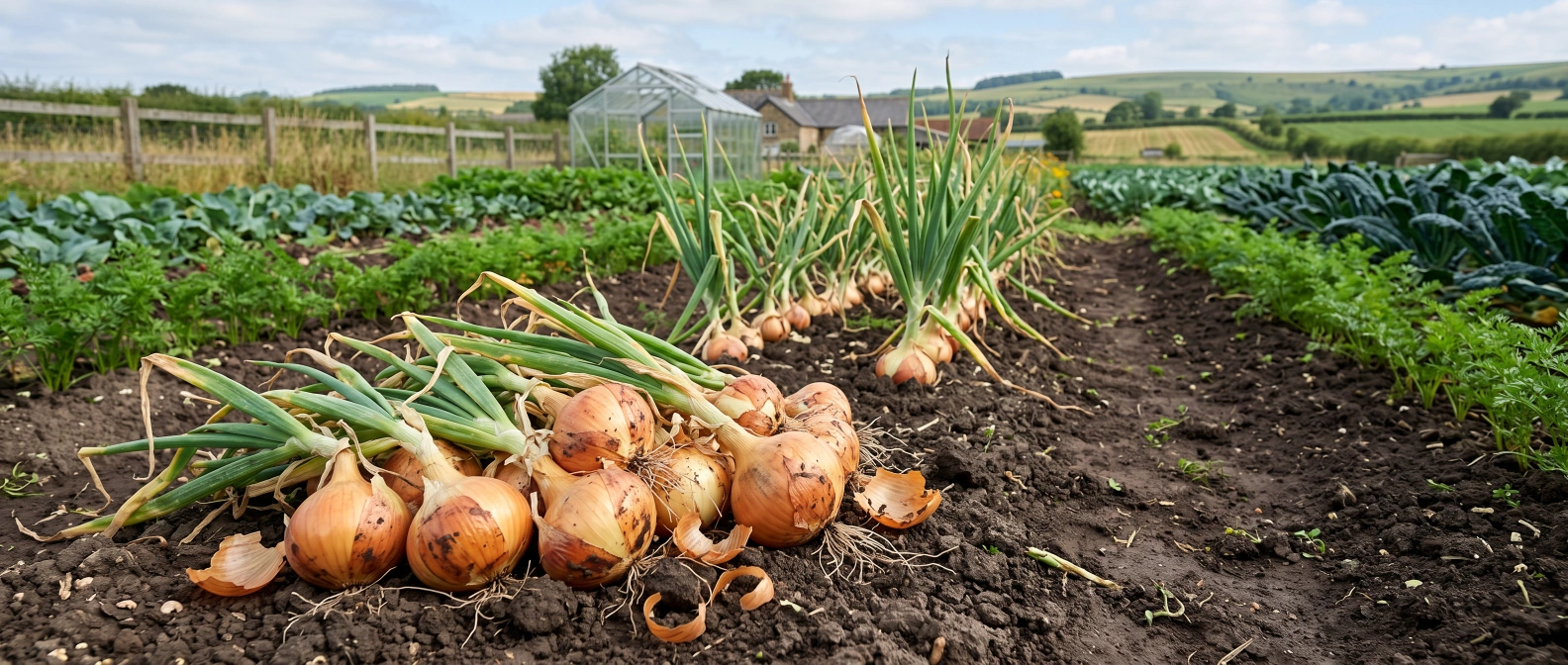
Onion is the reference crop for this whole category -- shallot and this site's spring onion are both the same species and will cross-pollinate with onion if left to flower nearby, something no crop in Root Vegetables had to deal with. Its real strength for self-sufficiency isn't calories but storage: dried and hung properly, a single crop of onions stretches through most of winter without needing a root cellar or any power at all.
Water need
Needs consistent moisture while bulbing, then a deliberately dry spell as the tops fall to cure properly for storage.
Calories at a glance
400 kcal/kg -- similar in scale to carrot and swede (scale is log-based across all 55 crops in the calculator).
Temperature Range by Month
Month on the bottom, temperature up the side. The pale green background is what the plant can survive at all -- fatal above or below it, labelled directly on the chart where that applies to your zone. The coral band is its ideal range, and only fades in during the months this zone would actually have the crop in the ground -- reusing the exact same sowing/harvesting data as the calendar further down the page. The blue line is real monthly climate data (not a modelled estimate) for a representative rural/agricultural location in this zone -- a small farming town or agricultural research station rather than a major city, to avoid the warmer bias city weather stations have. For the actual verdict on how well this crop does in your zone, see the badge at the top of the page -- that's based on the site's own researched yield figures, not this chart.
Quick Start: Sowing to Storage
- Start under cover or sow direct. For the biggest bulbs, start seed under cover in January or February and transplant out once frost risk has passed; direct sowing later in spring works too but tends to give smaller bulbs by autumn.
- Keep weed-free while young. Onion's narrow, upright leaves compete poorly with weeds -- hand-weed regularly while plants are small, since a choked bed checks bulb growth badly.
- Stop watering as the tops begin to fall. This is the natural signal bulbs are maturing -- easing off water at this point helps the outer skins dry and toughen ready for storage.
- Lift once most of the tops have fallen over. Ease bulbs out of the ground rather than pulling by the leaves, and lift the whole bed within a week or two of most tops going over.
- Cure and store. Dry bulbs thoroughly in a single layer somewhere warm and airy for one to two weeks, then store in a cool, dry, well-ventilated place -- hung in nets or plaited -- where they'll keep for months.
Sowing & Harvesting Calendar
Pick your zone under "Temperature Range by Month" above and this updates too. The Sow row: green is the normal safe sowing window, amber is pushing the season by roughly a month either side, blue is an even earlier under-glass start -- onion is one of the crops on this site where starting under glass genuinely matters for bulb size, not just season extension. The Harvest row shows the main lifting window -- onion doesn't get the striped living-larder tail some other crops here do, since it's dried and stored rather than left in the ground.
Calories & Yield
Onion is a moderate calorie crop at about 400 kcal per kg -- similar in scale to carrot and swede. Subtropical and Mediterranean zones give the best yields here.
| Climate Zone | Yield per plant | Calories per plant | Viability |
|---|---|---|---|
| Tropical / Humid | 0.1 kg | 40 kcal | Viable |
| Subtropical | 0.15 kg | 60 kcal | Viable -- best yield |
| Mediterranean | 0.15 kg | 60 kcal | Viable -- best yield |
| Temperate Maritime | 0.12 kg | 48 kcal | Viable |
| Temperate Continental | 0.12 kg | 48 kcal | Viable |
| Cool / Boreal | 0.1 kg | 40 kcal | Viable |
| Arid / Semi-Arid | 0.08 kg | 32 kcal | Viable |
| Highland / Alpine | 0.1 kg | 40 kcal | Viable |
Figures per plant sown, from the site's own crop database. Onion is viable in every one of this site's eight zones -- one of very few crops that can claim that.
Varieties Worth Knowing
Onion varieties trade off sweetness against storage life -- the sweetest types rarely keep as long as a firmer, stronger-flavoured storage onion. All the varieties below are open-pollinated (OP), meaning seed saved from them breeds true and is worth keeping under this site's seed-saving approach; none are F1 hybrids.
Seed Saving -- Quick Guide
Onion crosses with shallot -- both Allium cepa -- and with any spring onion variety that's actually a young bulb onion rather than a true bunching type. It's biennial, and the seed is shorter-lived than most on this site.
SERVINGS, NOT DAILY CALORIES This works out plate-sized servings of onion from your seed during its fresh harvest window only, not your group's full daily calorie needs. For that, use the main calculator.
BIENNIAL Onion is a biennial, not an annual -- it doesn't produce seed in its first year. Bulbs grow through year one, a few overwintered bulbs flower and set seed in year two, and that seed is only ready to sow in year three. If you're starting from scratch with no ongoing seed supply, that means having enough seed on hand for both year one's and year two's sowing up front. Plan for roughly double the seed quantity below if that's your situation.
Estimated for your selected zone above, using this site's own germination, loss and yield figures for onion -- a helping is roughly what you'd put on a plate as part of a meal with other veg. Treat it as a planning estimate, not a promise.
Storage & Preservation
The site's own crop data models onion as a dry-storage crop, not a living larder -- the bulbs are cured (dried thoroughly for a week or two somewhere warm and airy) then hung in nets or plaited in a cool, dry, well-ventilated place.
Properly cured and stored this way, onion keeps for up to around 6 months with no power and no root cellar needed -- one of the most genuinely low-effort long-term storage crops on this site.
Growing Onions Without Bought Inputs
Onion fly is the main pest to watch for -- its larvae tunnel into the base of the bulb, and onion white rot, a soil-borne fungus, is the main disease risk, persisting in soil for years once established.
Fine mesh from sowing or transplanting onward excludes onion fly without any spray needed.
Crop rotation matters more here than for most crops -- once white rot is established in a bed, alliums can't be grown there safely for many years, so never repeat onion, leek, shallot or spring onion in the same spot back to back.
Onion's own scent is a useful companion-planting tool elsewhere in the garden -- widely used to help mask carrot from carrot fly, among other pairings.
Frequently Asked Questions
Does onion cross-pollinate with the other alliums on this site?
With two of them, yes. Shallot and this site's spring onion (a White Lisbon-type bunching onion) are both Allium cepa -- the same species as bulb onion -- and cross freely if flowering nearby. Leek (Allium ampeloprasum) is a different species and doesn't cross with onion at all.
Why doesn't onion get left in the ground like leek or parsnip?
Because it doesn't store that way well -- onion's real strength is drying down and hanging in a cool, dry place, which keeps it for months without needing garden space or digging through winter. Leaving onion bulbs in wet ground risks rot rather than extending the harvest.
How cold and hot can onion survive?
Roughly -6°C to 29°C once established, though young seedlings are more frost-tender than mature plants. Prolonged spells below about 10°C can trigger bolting instead of proper bulb growth, and heat stress sets in above roughly 29°C.
Can I save seed from a supermarket onion?
Not reliably -- most supermarket onions are F1 hybrids, and seed saved from them won't grow true to type. Start from an open-pollinated variety if seed saving is the goal.
Is onion a good calorie crop for self-sufficiency?
Moderate -- around 400 kcal per kg, similar in scale to carrot and swede. Its real value is as a flavour base and a long-storing staple that stretches other food through winter, not a calorie crop on its own.
Do I need pesticides to grow onions?
No. Onion fly and onion white rot are the two real risks, and crop rotation plus a fine mesh barrier at sowing handle most of it without any bought spray. Alliums are also widely used as companion plants to help protect other crops from pests.