
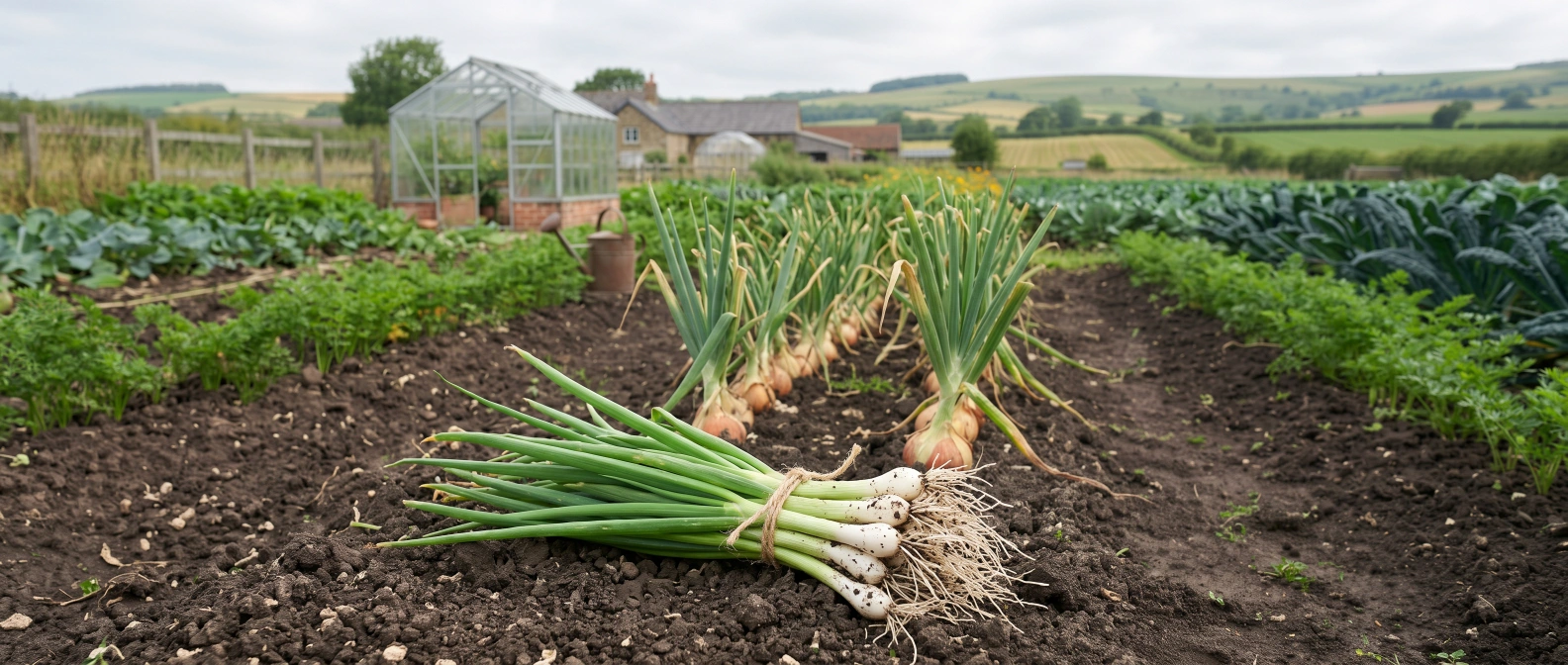
"Spring onion" is a name that covers two genuinely different plants, and it matters which one you're growing: this site models White Lisbon, a true bunching type that's the same species as bulb onion and shallot (Allium cepa), not the unrelated Welsh onion some growers mean by the same name. Sown thickly and pulled at 8-12 weeks, it's the fast, fresh-eating member of this category -- more like radish or turnip in role than like onion or leek.
Water need
Consistent moisture keeps growth steady and the texture mild -- drying out toughens the leaves and sharpens the flavour.
Calories at a glance
320 kcal/kg -- the lowest of any allium on this site, reflecting how little bulk a young, thinly-grown plant carries (scale is log-based across all 55 crops in the calculator).
Temperature Range by Month
Month on the bottom, temperature up the side. The pale green background is what the plant can survive at all -- fatal above or below it, labelled directly on the chart where that applies to your zone. The coral band is its ideal range, and only fades in during the months this zone would actually have the crop in the ground -- reusing the exact same sowing/harvesting data as the calendar further down the page. The blue line is real monthly climate data (not a modelled estimate) for a representative rural/agricultural location in this zone -- a small farming town or agricultural research station rather than a major city, to avoid the warmer bias city weather stations have. For the actual verdict on how well this crop does in your zone, see the badge at the top of the page -- that's based on the site's own researched yield figures, not this chart.
Quick Start: Sowing to Harvest
- Sow thickly, direct. Sow seed direct and fairly thickly -- unlike bulb onion, spring onion is meant to stay slender, and a dense row of thin plants is exactly what you want.
- Sow again every few weeks. Repeat sowings every 3-4 weeks through your zone's sowing window to keep a continuous supply coming, the same succession approach as radish and turnip.
- Keep watering even. Consistent moisture keeps growth steady and the texture mild -- drying out toughens the leaves and can push flavour towards overly sharp.
- Pull at 8-12 weeks. Harvest once bulbs are pencil to finger width, well before they'd swell into a true onion -- the whole point of a bunching variety is picking it young.
- Eat fresh. Spring onion doesn't store the way bulb onion or shallot do -- pull only what you need and eat it within days for the best flavour and texture.
Sowing & Harvesting Calendar
Pick your zone under "Temperature Range by Month" above and this updates too. The Sow row: green is the normal safe sowing window, amber is pushing the season by roughly a month either side. Spring onion has one of the widest sowing windows of any crop on this site, wide enough for many successive batches within it. The Harvest row shows the main pulling window -- spring onion doesn't get the striped living-larder tail some other crops here do, since it's eaten fresh within days of pulling.
Calories & Yield
Spring onion is the lowest calorie density allium on this site at about 320 kcal per kg. Subtropical and Mediterranean zones give the best yields here -- but with a crop this fast, total output per year from repeated sowings matters far more than any single yield figure.
| Climate Zone | Yield per plant | Calories per plant | Viability |
|---|---|---|---|
| Tropical / Humid | 0.05 kg | 16 kcal | Viable |
| Subtropical | 0.06 kg | 19.2 kcal | Viable -- best yield |
| Mediterranean | 0.06 kg | 19.2 kcal | Viable -- best yield |
| Temperate Maritime | 0.05 kg | 16 kcal | Viable |
| Temperate Continental | 0.05 kg | 16 kcal | Viable |
| Cool / Boreal | 0.04 kg | 12.8 kcal | Viable |
| Arid / Semi-Arid | 0.03 kg | 9.6 kcal | Viable |
| Highland / Alpine | 0.04 kg | 12.8 kcal | Viable |
Figures per plant sown, from the site's own crop database. Spring onion is viable in every one of this site's eight zones.
Varieties Worth Knowing
Spring onion varieties don't differ hugely -- mostly a question of stem colour and how slow the plant is to start bulbing. Both below are open-pollinated (OP), meaning seed saved from them breeds true and is worth keeping under this site's seed-saving approach; neither is an F1 hybrid.
Seed Saving -- Quick Guide
Whether spring onion crosses with onion and shallot depends on which species yours is -- true bunching types (Allium fistulosum) don't, but varieties that are really just young bulb onion (Allium cepa) do. Check your variety before assuming either way.
SERVINGS, NOT DAILY CALORIES This works out plate-sized servings of spring onion from your seed during its fresh harvest window only, not your group's full daily calorie needs. For that, use the main calculator.
BIENNIAL Spring onion is a biennial, not an annual, though it's almost always pulled and eaten within 8-12 weeks long before that shows. Left to grow on, plants overwinter and flower to set seed in year two, and that seed is only ready to sow in year three. If you're starting from scratch with no ongoing seed supply, that means having enough seed on hand for both year one's and year two's sowing up front. Plan for roughly double the seed quantity below if that's your situation.
Estimated for your selected zone above, using this site's own germination, loss and yield figures for spring onion -- a helping is roughly what you'd put on a plate as part of a meal with other veg. Treat it as a planning estimate, not a promise.
Storage & Preservation
Unlike onion or shallot, spring onion isn't described as a storage crop in the site's own crop data at all -- it's grown to be pulled young and eaten fresh, typically within days.
For anything closer to genuine storage, grow bulb onion or shallot instead -- spring onion's role here is fast, fresh variety through the growing season, not a winter staple.
Growing Spring Onion Without Bought Inputs
Spring onion shares onion fly risk with this site's other alliums, though its short time in the ground and thick sowing pattern make it a less attractive target than a full-season bulb onion crop.
Fine mesh from sowing onward is the simplest input-free defence where onion fly is a known problem locally.
Crop rotation still matters against onion white rot -- treat spring onion as part of the same allium rotation group as onion, leek and shallot, not a separate crop that can be squeezed in anywhere.
Frequently Asked Questions
Is spring onion a different species from bulb onion?
Not the type this site models. "Spring onion" can mean two different things: a true bunching type like White Lisbon, which is Allium cepa (the same species as bulb onion), or Welsh onion, which is the genuinely different species Allium fistulosum. This site's crop data specifically names White Lisbon, so it's the Allium cepa type -- meaning it cross-pollinates with onion and shallot.
How is spring onion different from just pulling a bulb onion early?
Mainly by variety choice and spacing. Bunching types like White Lisbon are bred and sown thickly to stay slender rather than swell into a large bulb, and are harvested at 8-12 weeks rather than left to mature all season. You could pull an ordinary bulb onion young for a similar effect, but a dedicated bunching variety gives more consistent results.
Does spring onion cross-pollinate with onion or shallot?
Yes -- all three are Allium cepa and cross freely if left to flower nearby. In practice this rarely matters for spring onion specifically, since it's almost always pulled and eaten within weeks, long before it would ever flower.
How cold and hot can spring onion survive?
Roughly -15°C to 29°C -- White Lisbon in particular is a genuinely cold-hardy variety, tolerating light frost with ease. Given its short time in the ground, heat and cold extremes matter less here than for slower crops, since a poorly timed sowing is simply resown a few weeks later.
Is spring onion a good calorie crop for self-sufficiency?
No -- at around 320 kcal per kg and picked young, it contributes very little bulk. Its value is speed, succession cropping and fresh eating through the season, the same role radish and turnip play among the root vegetables.