
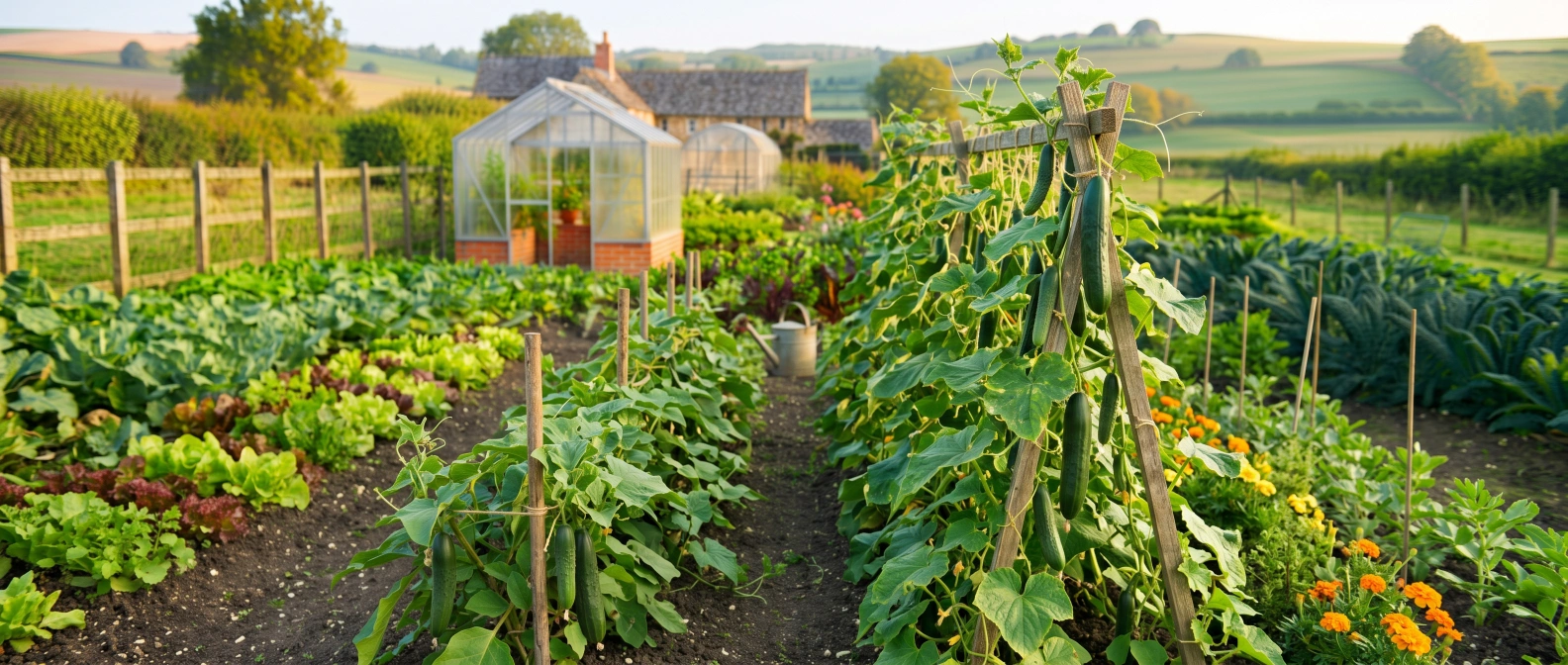
Cucumber has a genuine flower oddity for this site: individual flowers are either male or female, both on the same plant, rather than the simple two-in-one flowers most crops here have. Despite sharing a plant family with squash and pumpkin, cucumber is a different genus and doesn't cross with either -- its real cross-partner risk is only other cucumber varieties. The crop database's own advice splits cleanly by growing method: ridge types for cooler outdoor zones, greenhouse types for the higher yields protection buys.
Water need
Consistent moisture is essential for good fruit shape and flavour -- irregular watering causes bitter, misshapen fruit.
Calories at a glance
150 kcal/kg -- one of the lowest-calorie crops on this entire site (scale is log-based across all 55 crops in the calculator).
Temperature Range by Month
Month on the bottom, temperature up the side. The pale green background is what the plant can survive at all -- fatal above or below it, labelled directly on the chart where that applies to your zone. The coral band is its ideal range, and only fades in during the months this zone would actually have the crop in the ground -- reusing the exact same sowing/harvesting data as the calendar further down the page. The blue line is real monthly climate data (not a modelled estimate) for a representative rural/agricultural location in this zone -- a small farming town or agricultural research station rather than a major city, to avoid the warmer bias city weather stations have. For the actual verdict on how well this crop does in your zone, see the badge at the top of the page -- that's based on the site's own researched yield figures, not this chart.
Quick Start: Sowing to Harvest
- Start under cover. Sow seed under cover in spring -- cucumber germinates poorly in cold soil and benefits from a warm start indoors before planting out.
- Choose ridge types for outdoor maritime growing. Ridge (outdoor) cucumber varieties tolerate cooler, more changeable conditions better than greenhouse types -- choose them for an outdoor crop in a maritime zone.
- Plant out only once frost risk has fully passed. Cucumber has very little cold tolerance -- wait until night temperatures are reliably well above freezing before planting outdoors.
- Keep watering even. Consistent moisture is essential for good fruit shape and flavour -- irregular watering causes bitter, misshapen fruit.
- Harvest young and often. Pick fruit while still young and firm -- regular picking encourages the plant to keep producing, while leaving fruit to over-mature on the vine slows down new growth.
Sowing & Harvesting Calendar
Pick your zone under "Temperature Range by Month" above and this updates too. Notice Boreal shows no window at all -- this site's own yield data marks cucumber as not viable there even under cover.
Calories & Yield
Cucumber is the lowest calorie density crop in this category at about 150 kcal per kg. Subtropical and Mediterranean zones give the best yields here.
| Climate Zone | Yield per plant | Calories per plant | Viability |
|---|---|---|---|
| Tropical / Humid | 2.0 kg | 300 kcal | Viable |
| Subtropical | 3.0 kg | 450 kcal | Viable -- best yield |
| Mediterranean | 3.0 kg | 450 kcal | Viable -- best yield |
| Temperate Maritime | 0.9 kg | 135 kcal | Viable -- challenging (60% yield) |
| Temperate Continental | 2.5 kg | 375 kcal | Viable |
| Cool / Boreal | -- | -- | Not viable |
| Arid / Semi-Arid | 2.0 kg | 300 kcal | Viable |
| Highland / Alpine | -- | -- | Not viable |
Figures per plant, from the site's own crop database. Maritime's yield already reflects the 60% penalty the calculator applies where the zone is rated "challenging" rather than fully viable. Highland/Alpine shows a real yield figure of 0 in the crop database despite being marked "challenging" rather than "not viable" -- effectively not a realistic option there either.
Varieties Worth Knowing
Cucumber varieties split into slicing types for fresh eating and smaller pickling types, plus some genuinely different niche shapes. All the varieties below are open-pollinated (OP), meaning seed saved from them breeds true and is worth keeping under this site's seed-saving approach; none are F1 hybrids.
Seed Saving -- Quick Guide
Cucumber crosses with other cucumber varieties, but not with melon, squash or pumpkin -- despite the family resemblance, they're different genera entirely. Insect-pollinated, with separate male and female flowers on the same plant.
SERVINGS, NOT DAILY CALORIES This works out plate-sized servings of cucumber from your seed during its fresh harvest window only, not your group's full daily calorie needs. For that, use the main calculator.
Estimated for your selected zone above, using this site's own germination, loss and yield figures for cucumber -- a helping is roughly what you'd put on a plate as part of a meal with other veg. Treat it as a planning estimate, not a promise.
Storage & Preservation
Cucumber isn't described as a storage crop in the site's own crop data -- it's grown to be picked young and eaten fresh, since quality drops quickly once fruit over-matures on the vine.
For banking a surplus, pickling is the classic route -- turning a fresh, short-lived crop into something genuinely shelf-stable for months, whether as traditional fermented pickles or a simple vinegar brine.
Growing Cucumber Without Bought Inputs
Powdery mildew is the main disease risk, showing as a white, dusty coating on the leaves, worsened by dry roots combined with humid air.
Consistent watering at the roots (not overhead) is the main input-free defence against powdery mildew -- keeping the roots evenly moist reduces the plant stress that lets it take hold.
Good airflow between plants, especially under cover, further reduces the humid conditions mildew needs.
Frequently Asked Questions
Does cucumber have separate male and female flowers?
Yes -- cucumber is monoecious, meaning individual flowers are either male or female, but both appear on the same plant. This is a genuine oddity compared to most crops on this site, which have flowers containing both parts together. It's still self-compatible overall since one plant carries both sexes, but pollen still needs to move between the separate flowers, usually by insect.
Does cucumber cross-pollinate with squash or pumpkin?
No -- despite sharing the same plant family (Cucurbitaceae), cucumber (Cucumis) is a different genus from squash and pumpkin (Cucurbita), and different genera don't cross. Cucumber does cross readily with other cucumber varieties, though.
How cold and hot can cucumber survive?
Roughly 0°C to 35°C, though cucumber has very little cold tolerance in practice -- light frost is usually fatal, and even temperatures in the low single digits above freezing can damage young plants. Growth slows below about 10°C well before that survivable floor.
Why does the crop database recommend ridge cucumbers for maritime zones?
Ridge (outdoor) cucumber types are bred to be more tolerant of cooler, more changeable conditions than greenhouse types, making them the more reliable outdoor choice in a maritime climate -- though the crop database is clear that greenhouse cucumbers still give notably higher yields where protection is available.
Is cucumber a good calorie crop for self-sufficiency?
No -- at around 150 kcal per kg it's one of the lowest-calorie crops on this site. Its value is fresh eating, hydration and volume through the growing season, not calories.