
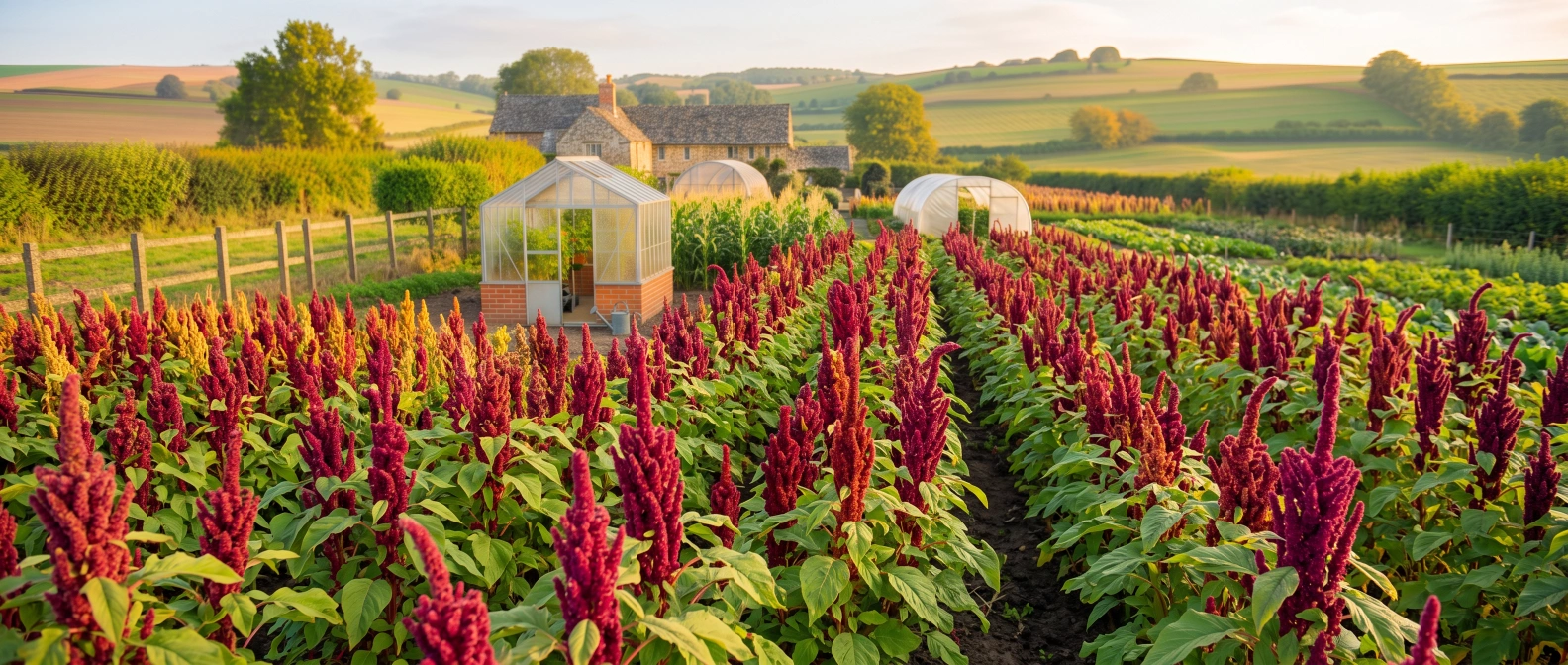
Amaranth genuinely earns its keep twice from one planting: pick young leaves as a spinach substitute through the season, then let the same plants mature for a genuine grain harvest in autumn. Its real seed-saving risk isn't another crop on this site but a wild relative -- wild-type amaranth is a common weed that several grain species will cross with readily, the same shape of problem as wild carrot elsewhere on this site.
Water need
Genuinely drought-tolerant and wind-tolerant once established -- part of what makes it such a low-fuss crop across a wide range of zones.
Calories at a glance
3,710 kcal/kg -- one of the most calorie-dense crops on this entire site, and a complete protein besides (scale is log-based across all 55 crops in the calculator).
Temperature Range by Month
Month on the bottom, temperature up the side. The pale green background is what the plant can survive at all -- fatal above or below it, labelled directly on the chart where that applies to your zone. The coral band is its ideal range, and only fades in during the months this zone would actually have the crop in the ground -- reusing the exact same sowing/harvesting data as the calendar further down the page. The blue line is real monthly climate data (not a modelled estimate) for a representative rural/agricultural location in this zone -- a small farming town or agricultural research station rather than a major city, to avoid the warmer bias city weather stations have. For the actual verdict on how well this crop does in your zone, see the badge at the top of the page -- that's based on the site's own researched yield figures, not this chart.
Quick Start: Sowing to Storage
- Sow direct once it's genuinely warm. Sow direct once frost risk has fully passed and the soil has warmed -- amaranth is a genuine warm-season crop with very little cold tolerance while young.
- Thin to final spacing. Thin seedlings once established, leaving enough room for plants to bulk up their eventual seed heads.
- Harvest young leaves through the season. Pick young leaves as a spinach substitute through summer -- this doesn't stop the same plants going on to produce grain later.
- Let a portion mature for grain. Leave some plants unpicked (or stop picking leaves partway through the season) so they can put full energy into their seed heads for an autumn grain harvest.
- Harvest, thresh and store dry. Cut seed heads once dry, thresh to release the tiny seeds, winnow to remove chaff, then store dry -- properly stored amaranth grain keeps for years.
Sowing & Harvesting Calendar
Pick your zone under "Temperature Range by Month" above and this updates too. Every zone shows a genuine window here -- amaranth is one of very few crops on this site viable everywhere it models, alongside quinoa and winter squash.
Calories & Yield
Amaranth is a genuine staple grain at about 3,710 kcal per kg -- and that's before counting the leaf harvest that comes from the same planting. Subtropical and Mediterranean zones give the same best yield here.
| Climate Zone | Yield per plant | Calories per plant | Viability |
|---|---|---|---|
| Tropical / Humid | 0.07 kg | 259.7 kcal | Viable |
| Subtropical | 0.09 kg | 333.9 kcal | Viable -- best yield |
| Mediterranean | 0.09 kg | 333.9 kcal | Viable -- best yield |
| Temperate Maritime | 0.08 kg | 296.8 kcal | Viable |
| Temperate Continental | 0.08 kg | 296.8 kcal | Viable |
| Cool / Boreal | 0.05 kg | 185.5 kcal | Viable |
| Arid / Semi-Arid | 0.06 kg | 222.6 kcal | Viable |
| Highland / Alpine | 0.06 kg | 222.6 kcal | Viable |
Figures per plant sown, from the site's own crop database -- grain only, not counting the additional leaf harvest the same plants provide through the season. Amaranth is viable in every one of this site's eight zones.
Varieties Worth Knowing
Grain amaranth varieties differ mainly in seed and plant colour, plus how they've traditionally been used. Both below are open-pollinated (OP), meaning seed saved from them breeds true and is worth keeping under this site's seed-saving approach; neither is an F1 hybrid.
Seed Saving -- Quick Guide
Amaranth is wind-pollinated and outcrosses readily -- but the real risk isn't another cultivated variety, it's weedy pigweed relatives, extremely common in most gardens, quietly crossing with your crop before you notice they're there.
SERVINGS, NOT DAILY CALORIES This works out plate-sized servings of amaranth from your seed during its fresh harvest window only, not your group's full daily calorie needs. For that, use the main calculator.
Estimated for your selected zone above, using this site's own germination, loss and yield figures for amaranth -- a helping is roughly what you'd put on a plate as part of a meal with other veg. Treat it as a planning estimate, not a promise.
Storage & Preservation
The site's own crop data points to the classic dry-grain route for the seed harvest: thresh, winnow and store dry.
Kept cool, dry and pest-proof, amaranth grain keeps for years -- a genuinely long-term storable staple. The leaf harvest, by contrast, is eaten fresh through the season like any other leafy green.
Growing Amaranth Without Bought Inputs
Amaranth is a genuinely trouble-free crop at garden scale, with few serious pests or diseases -- some sources treat wild amaranth as a weed precisely because cultivated types share that same toughness.
Birds can target ripening seed heads, the same risk as quinoa.
Netting over ripening seed heads is a simple, genuinely effective input-free defence against birds.
Frequently Asked Questions
Can amaranth really be eaten as both a leaf and a grain crop?
Yes -- the site's own crop data describes it as dual purpose: harvest young leaves through the season the same way you would spinach, then let the plant mature and harvest the seed heads for grain in autumn. Both uses come from the same planting.
Does amaranth cross-pollinate with quinoa?
No -- despite both being grown as similar-looking "pseudocereals," amaranth (Amaranthus) and quinoa (Chenopodium) are different genera and don't cross. Amaranth's real cross-pollination risk is with other amaranth, cultivated and wild.
Is wild amaranth a genuine seed-saving risk?
Yes, genuinely -- wild-type amaranth is a common weed across many regions, and several of the main grain amaranth species will readily cross with it if it's flowering nearby. This is the same shape of problem as wild carrot or wild salsify elsewhere on this site: remove flowering wild amaranth within isolation distance before it sets seed if you're saving seed from a named variety.
How cold and hot can amaranth survive?
Roughly 0°C to 38°C, with essentially no frost tolerance for young plants, though mature plants can survive the first light frost of autumn. It's a genuinely warm-season, heat-loving crop, using the same efficient C4 photosynthesis as maize.
Is amaranth a good calorie crop for self-sufficiency?
Yes -- at around 3,710 kcal per kg it's one of the most calorie-dense crops on this entire site, and as a complete protein with an edible leaf crop built in too, it offers genuine dual value from one planting.