
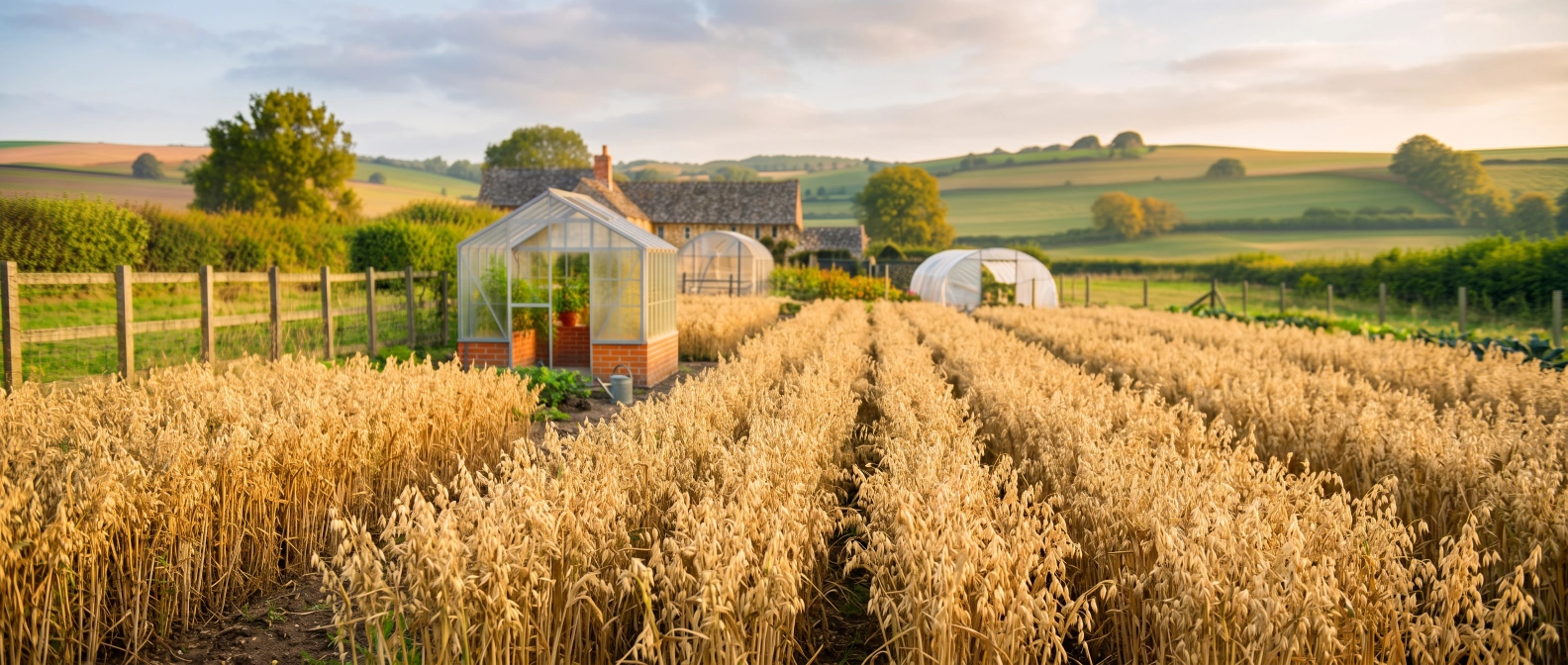
Oats is the most maritime-tolerant grain on this site -- historically the staple of exactly the cool, damp, changeable climates where wheat struggles -- and it's genuinely low-risk for seed saving, self-pollinating like the rest of this site's cereals. At around 3,350 kcal per kg and nutritionally complete as porridge, it's a real staple grain, not just a supplementary crop.
Water need
More tolerant of damp conditions than wheat or barley -- part of why it suits maritime climates so well.
Calories at a glance
3,350 kcal/kg -- one of the most calorie-dense crops on this entire site (scale is log-based across all 55 crops in the calculator).
Temperature Range by Month
Month on the bottom, temperature up the side. The pale green background is what the plant can survive at all -- fatal above or below it, labelled directly on the chart where that applies to your zone. The coral band is its ideal range, and only fades in during the months this zone would actually have the crop in the ground -- reusing the exact same sowing/harvesting data as the calendar further down the page. The blue line is real monthly climate data (not a modelled estimate) for a representative rural/agricultural location in this zone -- a small farming town or agricultural research station rather than a major city, to avoid the warmer bias city weather stations have. For the actual verdict on how well this crop does in your zone, see the badge at the top of the page -- that's based on the site's own researched yield figures, not this chart.
Quick Start: Sowing to Storage
- Sow for your zone's window. Sow in autumn in milder zones or spring in cooler ones, following your zone's own sowing window -- oats is more forgiving of timing than wheat but still benefits from matching local conditions.
- Sow into a reasonably prepared bed. Broadcast or drill seed into a weed-free bed -- oats establishes readily but still benefits from a clean start.
- Let it grow largely unattended through the season. Like wheat, oats needs relatively little ongoing input once established.
- Harvest, stook and thresh. Cut the ripe crop, stook to finish drying, then thresh to separate the grain from the straw.
- Store dry. Once thoroughly dried, store grain in a cool, dry, pest-proof container -- properly stored oats keeps for years.
Sowing & Harvesting Calendar
Pick your zone under "Temperature Range by Month" above and this updates too. Notice Tropical and Arid show no window at all -- this site's own yield data marks oats as not viable in either.
Calories & Yield
Oats is a genuine staple grain at about 3,350 kcal per kg. Maritime zones give the best yield ratio here -- the crop database's own data bearing out oats' reputation as the maritime grain.
| Climate Zone | Yield ratio | Calories per kg planted | Viability |
|---|---|---|---|
| Tropical / Humid | -- | -- | Not viable |
| Subtropical | 7× | 23,450 kcal | Viable |
| Mediterranean | 15× | 50,250 kcal | Viable |
| Temperate Maritime | 25× | 83,750 kcal | Viable -- best yield |
| Temperate Continental | 18× | 60,300 kcal | Viable |
| Cool / Boreal | 15× | 50,250 kcal | Viable |
| Arid / Semi-Arid | -- | -- | Not viable |
| Highland / Alpine | 11× | 36,850 kcal | Viable |
Figures per kg of seed grain sown, from the site's own crop database -- a yield ratio, since oats is sown by weight rather than as individual plants.
Varieties Worth Knowing
Oats have fewer named heirlooms in wide circulation than wheat or maize, but a couple of long-established varieties stand out. Both below are open-pollinated (OP), meaning seed saved from them breeds true and is worth keeping under this site's seed-saving approach; neither is an F1 hybrid.
Seed Saving -- Quick Guide
Oats are cleistogamous -- flowers self-pollinate before they even open -- so different varieties can be grown right next to each other with very low crossing risk.
SERVINGS, NOT DAILY CALORIES This works out plate-sized servings of oats from your seed during its fresh harvest window only, not your group's full daily calorie needs. For that, use the main calculator.
Estimated for your selected zone above, using this site's own germination, loss and yield figures for oats -- a helping is roughly what you'd put on a plate as part of a meal with other veg. Treat it as a planning estimate, not a promise.
Storage & Preservation
The site's own crop data describes the classic route: stook and thresh, then store the dried grain -- the same method as wheat, just a more maritime-tolerant crop underneath.
Kept cool, dry and pest-proof, oat grain keeps for years -- a genuinely long-term storable staple, and nutritionally complete on its own as porridge if needed.
Growing Oats Without Bought Inputs
Oats is a relatively trouble-free crop at garden scale -- crown rust (orange-brown pustules on leaves, similar to wheat rust) is the main risk, worsened by humid, still conditions.
Choosing resistant varieties where rust is a known local problem is the most effective input-free defence available.
Crop rotation alongside wheat and barley reduces soil-borne disease build-up the same way it does for the site's other cereals.
Frequently Asked Questions
Does oats cross-pollinate with wheat or barley?
No -- oats is a different genus from wheat and barley, and is itself strongly self-pollinating with very low natural outcrossing. It's one of the lowest-risk crops on this site for seed saving.
Why is oats described as the most maritime-tolerant grain on this site?
Because oats genuinely handles the cool, damp, changeable conditions typical of a maritime climate better than wheat or barley do -- it's historically the staple grain of exactly those regions, and the crop database's own yield figures bear that out with oats' best zone being Maritime rather than Mediterranean or Continental.
How cold and hot can oats survive?
Roughly -15°C to 32°C, genuinely cold-hardy for a grain, though most plants are killed below about -15°C. Heat above roughly 32°C stresses the crop and reduces yield, since oats is fundamentally a cool-season plant.
Why isn't oats viable in Tropical or Arid zones on this site?
Oats is a cool-season crop that struggles with sustained heat, ruling out Tropical zones outright, and it also needs more consistent moisture than genuine aridity provides, ruling out Arid zones for a different reason.
Is oats a good calorie crop for self-sufficiency?
Yes -- at around 3,350 kcal per kg it's one of the most calorie-dense crops on this entire site, and as a nutritionally complete porridge grain it's a genuine staple rather than a supplementary crop.