
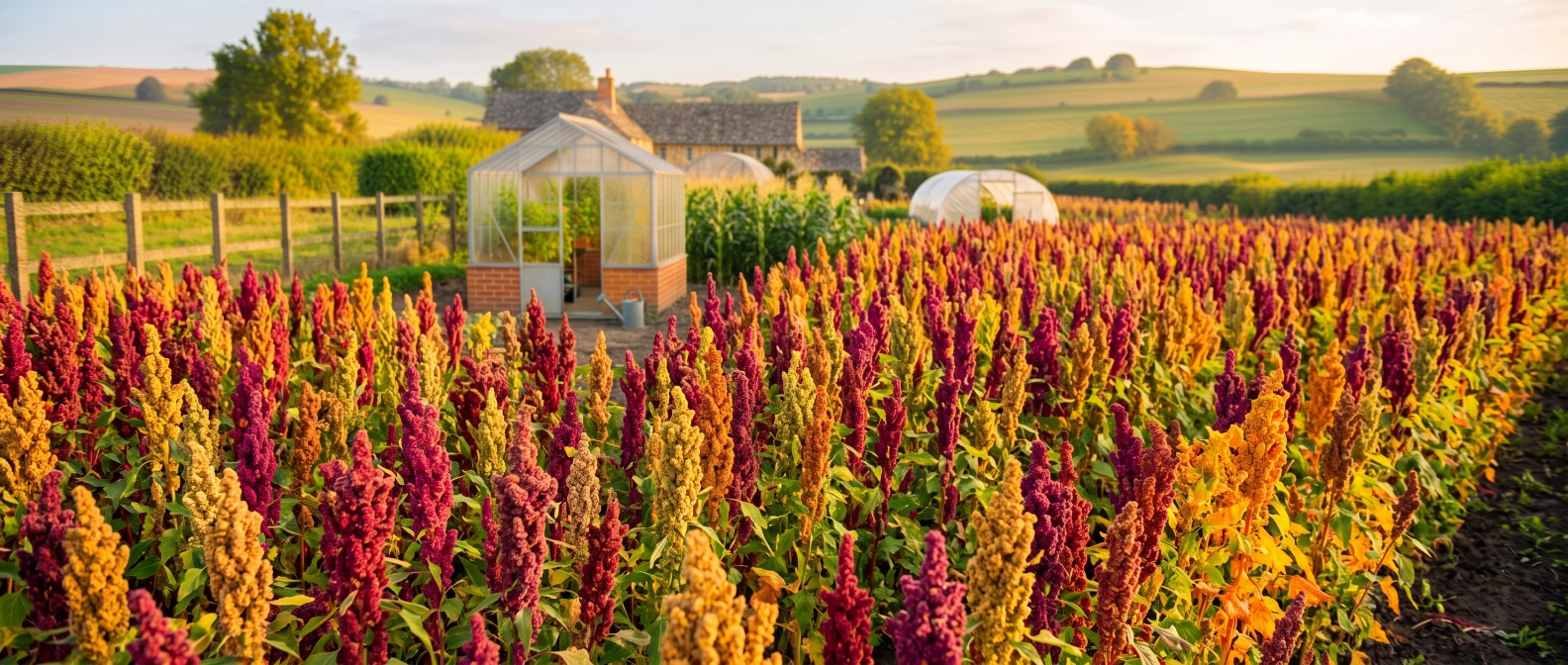
Quinoa's real adaptability shows up in the data: it's one of very few crops on this site with a genuine yield in all eight zones, a legacy of thousands of years bred across the huge range of Andean altitudes and climates. Its one real processing quirk is the bitter saponin coating on every seed, a natural pest deterrent that needs washing off before the grain is palatable -- skip that step and the whole batch tastes soapy.
Water need
Genuinely drought-tolerant once established, a legacy of its Andean high-altitude origins -- part of why it copes with such a wide range of zones.
Calories at a glance
3,680 kcal/kg -- one of the most calorie-dense crops on this entire site, and a complete protein besides (scale is log-based across all 55 crops in the calculator).
Temperature Range by Month
Month on the bottom, temperature up the side. The pale green background is what the plant can survive at all -- fatal above or below it, labelled directly on the chart where that applies to your zone. The coral band is its ideal range, and only fades in during the months this zone would actually have the crop in the ground -- reusing the exact same sowing/harvesting data as the calendar further down the page. The blue line is real monthly climate data (not a modelled estimate) for a representative rural/agricultural location in this zone -- a small farming town or agricultural research station rather than a major city, to avoid the warmer bias city weather stations have. For the actual verdict on how well this crop does in your zone, see the badge at the top of the page -- that's based on the site's own researched yield figures, not this chart.
Quick Start: Sowing to Storage
- Sow direct once frost risk has passed. Sow direct once the soil has warmed and hard frost is unlikely -- quinoa tolerates light frost but not a genuine hard freeze while young.
- Thin to final spacing. Thin seedlings once they're established, giving each plant enough room to bulk up its seed head.
- Let it grow largely unattended through the season. Quinoa needs relatively little ongoing input once established, similar to the site's other grains.
- Harvest once the seed heads dry and rattle. Cut seed heads once they've dried and the seeds rattle inside -- picking too early gives immature, poorly-storing seed.
- Thresh, winnow and store dry. Rub or thresh seed heads to release the grain, winnow to remove chaff, then store dry -- the bitter saponin coating is washed off at cooking time, not during storage.
Sowing & Harvesting Calendar
Pick your zone under "Temperature Range by Month" above and this updates too. Every zone shows a genuine window here -- quinoa is one of very few crops on this site viable everywhere it models, alongside winter squash.
Calories & Yield
Quinoa is a genuine staple grain at about 3,680 kcal per kg. Subtropical and Mediterranean zones give the same best yield here.
| Climate Zone | Yield per plant | Calories per plant | Viability |
|---|---|---|---|
| Tropical / Humid | 0.06 kg | 220.8 kcal | Viable |
| Subtropical | 0.08 kg | 294.4 kcal | Viable -- best yield |
| Mediterranean | 0.08 kg | 294.4 kcal | Viable -- best yield |
| Temperate Maritime | 0.07 kg | 257.6 kcal | Viable |
| Temperate Continental | 0.07 kg | 257.6 kcal | Viable |
| Cool / Boreal | 0.04 kg | 147.2 kcal | Viable |
| Arid / Semi-Arid | 0.05 kg | 184 kcal | Viable |
| Highland / Alpine | 0.05 kg | 184 kcal | Viable |
Figures per plant sown, from the site's own crop database. Quinoa is viable in every one of this site's eight zones.
Varieties Worth Knowing
Quinoa varieties differ in seed colour and which climate they were originally bred for. Both below are open-pollinated (OP), meaning seed saved from them breeds true and is worth keeping under this site's seed-saving approach; neither is an F1 hybrid.
Seed Saving -- Quick Guide
Quinoa is mostly self-pollinating, but not as fully self-contained as wheat or barley -- wind can carry some pollen between plants, so different varieties grown close together will drift over time.
SERVINGS, NOT DAILY CALORIES This works out plate-sized servings of quinoa from your seed during its fresh harvest window only, not your group's full daily calorie needs. For that, use the main calculator.
Estimated for your selected zone above, using this site's own germination, loss and yield figures for quinoa -- a helping is roughly what you'd put on a plate as part of a meal with other veg. Treat it as a planning estimate, not a promise.
Storage & Preservation
The site's own crop data points to the classic dry-grain route: thresh, winnow and store dry -- the bitter saponin coating is washed off at cooking time, not before storage, so unwashed grain stores exactly like any other dry seed.
Kept cool, dry and pest-proof, quinoa grain keeps for years -- a genuinely long-term storable staple, and one that happens to be a complete protein besides.
Growing Quinoa Without Bought Inputs
Quinoa is a genuinely trouble-free crop at garden scale -- its own bitter saponin coating acts as a natural pest deterrent on the growing plant, which is part of why it needs so little active protection.
Birds can be a real nuisance around ripening seed heads, since the visible grain is an obvious target once it's dried and rattling.
Netting over ripening seed heads is a simple, genuinely effective input-free defence against birds.
Frequently Asked Questions
Why does quinoa need washing before eating?
Because the seed coat naturally contains saponins, bitter-tasting compounds that also act as a natural pest deterrent on the growing plant. A thorough rinse before cooking removes enough of them to make the grain palatable -- skip it and the batch tastes distinctly soapy and bitter.
Does quinoa cross-pollinate with amaranth or other crops on this site?
No -- despite both being grown as "pseudocereals" and having a superficially similar look, quinoa (Chenopodium) and amaranth (Amaranthus) are different genera and don't cross. Quinoa's own crossing risk is with other quinoa plants, and it's mostly self-pollinating with a modest natural outcrossing rate.
How cold and hot can quinoa survive?
Roughly -4°C to 35°C for most cultivars, with light frost tolerated reasonably well, though some cold-hardy Andean varieties handle much lower temperatures in the vegetative stage. Heat above about 35°C causes real stress, and pollen can go sterile at high temperatures during flowering specifically.
Why is quinoa viable in every zone this site models?
Quinoa is a genuinely adaptable crop, bred across a huge range of Andean altitudes and climates over thousands of years -- that history shows up here as one of very few crops on this site with a real, if modest, yield in all eight zones rather than being ruled out anywhere entirely.
Is quinoa a good calorie crop for self-sufficiency?
Yes -- at around 3,680 kcal per kg it's one of the most calorie-dense crops on this entire site, and as a complete protein it's genuinely nutritionally valuable, not just calorie-dense.