
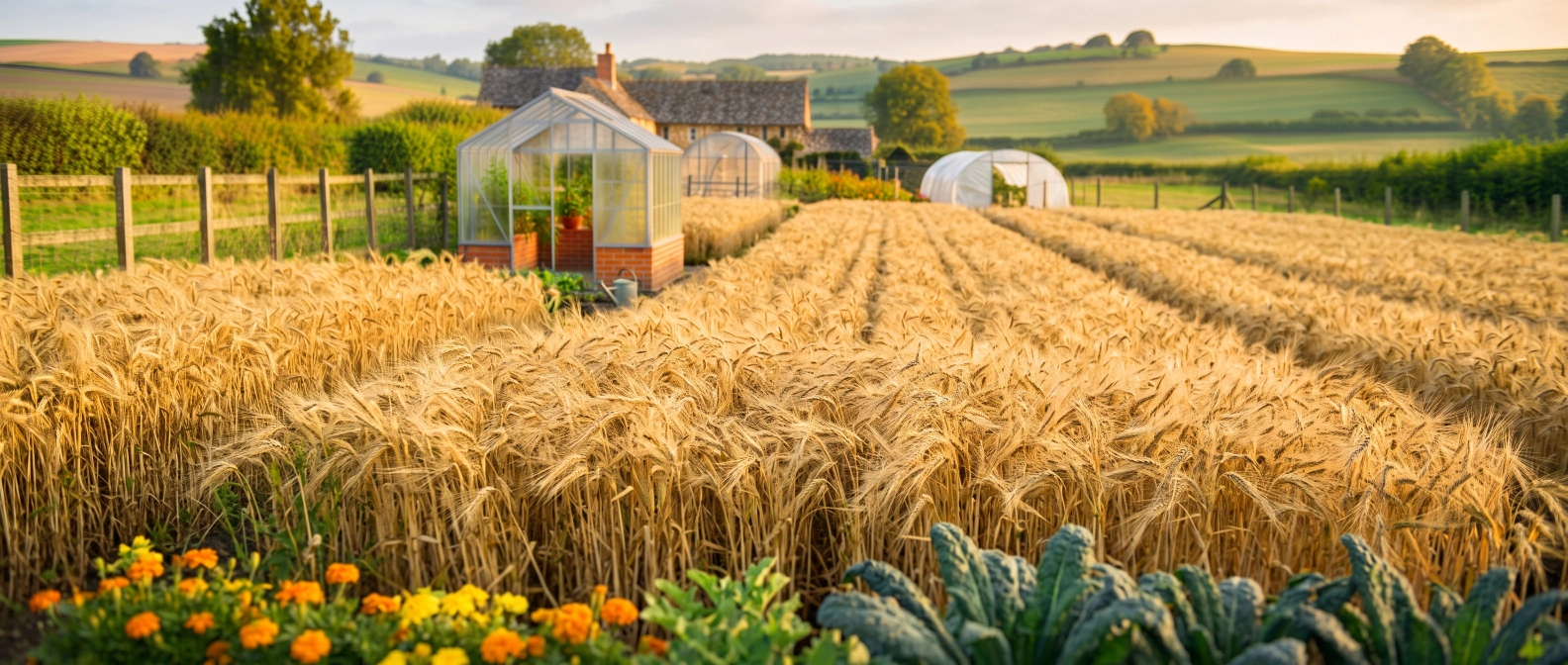
Wheat is one of the lowest-risk crops on this whole site for seed saving -- it self-pollinates before its flowers even fully open, keeping outcrossing below 1% in practice. Its yield here is shown as a ratio rather than kg per plant, since wheat is sown by weight of seed grain, not counted plant by plant -- the same convention already established on the Potato page. At around 3,400 kcal per kg, it's also one of the most calorie-dense crops on this entire site.
Water need
Genuinely low-input once established -- wheat needs relatively little ongoing watering compared to most vegetable crops on this site.
Calories at a glance
3,400 kcal/kg -- one of the most calorie-dense crops on this entire site (scale is log-based across all 55 crops in the calculator).
Temperature Range by Month
Month on the bottom, temperature up the side. The pale green background is what the plant can survive at all -- fatal above or below it, labelled directly on the chart where that applies to your zone. The coral band is its ideal range, and only fades in during the months this zone would actually have the crop in the ground -- reusing the exact same sowing/harvesting data as the calendar further down the page. The blue line is real monthly climate data (not a modelled estimate) for a representative rural/agricultural location in this zone -- a small farming town or agricultural research station rather than a major city, to avoid the warmer bias city weather stations have. For the actual verdict on how well this crop does in your zone, see the badge at the top of the page -- that's based on the site's own researched yield figures, not this chart.
Quick Start: Sowing to Storage
- Choose winter or spring sowing for your zone. Winter wheat is sown in autumn and needs a genuine cold spell to develop properly; spring wheat is sown once the soil has warmed and skips that requirement -- pick whichever matches your zone's own sowing window.
- Sow into a well-prepared bed. Broadcast or drill seed into a reasonably fine, weed-free bed -- wheat doesn't compete well with weeds while establishing.
- Let it grow largely unattended through the season. Wheat needs relatively little ongoing input once established -- the main task is simply waiting through to ripeness.
- Harvest, stook and thresh. Cut the ripe crop, stook (stand sheaves upright to finish drying) for a week or two, then thresh to separate the grain from the straw.
- Store dry. Once thoroughly dried, store grain in a cool, dry, pest-proof container -- properly stored wheat keeps for years.
Sowing & Harvesting Calendar
Pick your zone under "Temperature Range by Month" above and this updates too. Notice Tropical shows no window at all -- this site's own yield data marks wheat as not viable there, and several zones show an autumn sowing window rather than spring, reflecting winter wheat's need for a genuine cold spell.
Calories & Yield
Wheat is a genuine staple grain at about 3,400 kcal per kg. Continental zones give the best yield ratio here, and it isn't viable at all in Tropical.
| Climate Zone | Yield ratio | Calories per kg planted | Viability |
|---|---|---|---|
| Tropical / Humid | -- | -- | Not viable |
| Subtropical | 12× | 40,800 kcal | Viable |
| Mediterranean | 22× | 74,800 kcal | Viable |
| Temperate Maritime | 20× | 68,000 kcal | Viable |
| Temperate Continental | 25× | 85,000 kcal | Viable -- best yield |
| Cool / Boreal | 12× | 40,800 kcal | Viable |
| Arid / Semi-Arid | 8× | 27,200 kcal | Viable |
| Highland / Alpine | 8× | 27,200 kcal | Viable |
Figures per kg of seed grain sown, from the site's own crop database -- a yield ratio, since wheat is sown by weight rather than as individual plants.
Varieties Worth Knowing
Wheat varieties differ in when they're sown (spring vs winter), hardiness, and baking quality. All the varieties below are open-pollinated (OP), meaning seed saved from them breeds true and is worth keeping under this site's seed-saving approach; none are F1 hybrids.
Seed Saving -- Quick Guide
Wheat is cleistogamous -- flowers self-pollinate before they even open. Bread wheat, spelt, durum, emmer and einkorn are all technically different species and rarely cross even grown side by side.
SERVINGS, NOT DAILY CALORIES This works out plate-sized servings of wheat from your seed during its fresh harvest window only, not your group's full daily calorie needs. For that, use the main calculator.
Estimated for your selected zone above, using this site's own germination, loss and yield figures for wheat -- a helping is roughly what you'd put on a plate as part of a meal with other veg. Treat it as a planning estimate, not a promise.
Storage & Preservation
The site's own crop data describes the classic route: stook and thresh, then store the dried grain -- no living-larder or dry-bulb model here, just genuine long-term dry grain storage.
Kept cool, dry and pest-proof, wheat grain keeps for years, matching its own seed viability figures -- among the most genuinely long-term storable staples on this site.
Growing Wheat Without Bought Inputs
Wheat is a relatively trouble-free crop at garden scale -- rust (a fungal disease showing as orange-brown pustules on leaves and stems) is the main risk to watch for, worsened by humid, still conditions.
Choosing resistant varieties where rust is a known local problem is the most effective input-free defence available.
Crop rotation reduces soil-borne disease build-up the same way it does for every other crop on this site -- avoid growing wheat, oats or barley in the same spot repeatedly.
Frequently Asked Questions
Does wheat cross-pollinate with other grains on this site?
Essentially no -- wheat is strongly self-pollinating, shedding its own pollen before the flower even fully opens, which keeps outcrossing rates below 1% in practice. It's also a different genus from oats, barley and maize, so it wouldn't cross with them regardless.
Why is wheat's yield shown as a multiplication ratio instead of kg per plant?
Because wheat is sown as seed grain by weight, not as individual plants -- the crop database's own unit for wheat is "kg seed grain," so the honest way to express yield is how many kilograms come back for every kilogram sown, the same convention already used for potato's seed tubers.
How cold and hot can wheat survive?
Roughly -10°C to 32°C, with real frost tolerance once established -- leaves can survive down to -8°C to -10°C with some tip burn. Winter wheat varieties specifically need a sustained cold spell to trigger proper development, while heat above about 32°C causes real stress and lowers yield.
Why isn't wheat viable in Tropical zones on this site?
Wheat is a genuinely temperate crop that needs a real seasonal temperature swing to grow well, and many varieties specifically need a sustained cold period to develop properly -- conditions a Tropical zone simply doesn't provide.
Is wheat a good calorie crop for self-sufficiency?
Yes -- at around 3,400 kcal per kg it's one of the most calorie-dense crops on this entire site, and combined with a genuinely good yield ratio in the right zone, it's a real staple grain rather than a supplementary crop.