
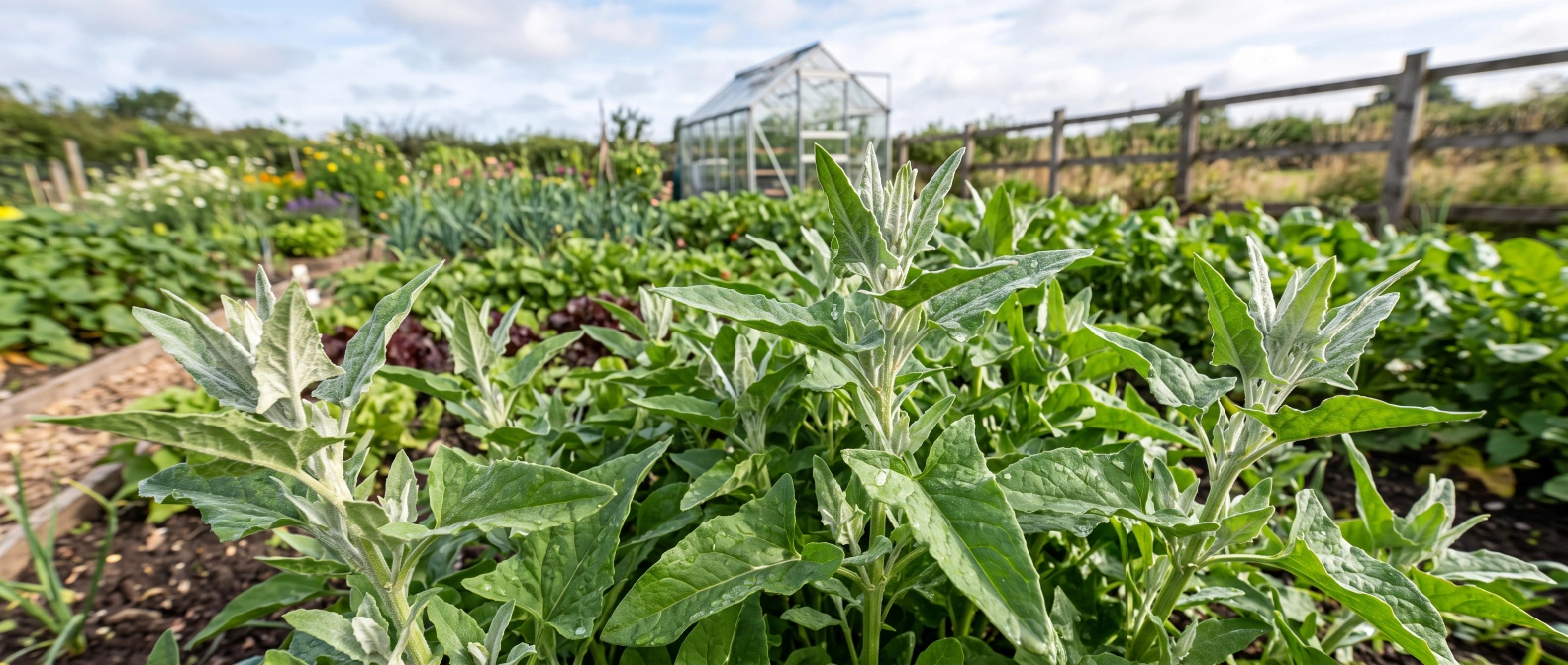
Genuinely two crops in one, per the crop database's own description: young shoots like asparagus, leaves like spinach. A hardy perennial that, alongside sorrel, is one of only two multi-year perennials on this hub -- plant once, and it keeps producing both harvests for years.
Water need
Genuinely tough and drought-tolerant once established -- deep perennial roots help it cope with dry spells that would stress annual leafy greens.
Calories at a glance
200 kcal/kg -- grown for its genuine dual harvest and low-maintenance perennial habit rather than raw calorie density (scale is log-based across all 55 core crops in the calculator).
Temperature Range by Month
Month on the bottom, temperature up the side. The pale green background is what the plant can survive at all -- fatal above or below it, labelled directly on the chart where that applies to your zone. The coral band is its ideal range, and only fades in during the months this zone would actually have the crop in the ground -- reusing the exact same sowing/harvesting data as the calendar further down the page. The blue line is real monthly climate data (not a modelled estimate) for a representative rural/agricultural location in this zone -- a small farming town or agricultural research station rather than a major city, to avoid the warmer bias city weather stations have. For the actual verdict on how well this crop does in your zone, see the badge at the top of the page -- that's based on the site's own researched yield figures, not this chart.
Quick Start: Sowing to Storage
- Sow direct or start in modules. Sow direct or start in modules for transplanting -- give plants time to establish, since this is a genuine long-lived perennial.
- Don't harvest hard in the first year. Let plants establish through their first year without heavy picking -- this builds the root reserves that support years of future harvests.
- Harvest young shoots like asparagus in spring. Once established, cut young emerging shoots in spring while still tender, cooked and eaten the same way as asparagus spears.
- Harvest leaves like spinach through the season. After the spring shoot harvest, pick leaves regularly through summer and into autumn, used the same way as spinach.
- Let the plant rest into autumn. Stop heavy picking by late season so the plant can build reserves for next year's growth -- the same living-larder logic as asparagus.
Sowing & Harvesting Calendar
Pick your zone under "Temperature Range by Month" above and this updates too. Arid shows no window at all -- one of the few zones where this otherwise tough perennial genuinely struggles.
Calories & Yield
Tropical, Subtropical and Mediterranean zones tie for the best yield here, and the crop simply isn't viable in Arid conditions.
| Climate Zone | Yield per plant | Calories per plant | Viability |
|---|---|---|---|
| Tropical / Humid | 2.0 kg | 400 kcal | Viable -- best yield |
| Subtropical | 2.0 kg | 400 kcal | Viable -- best yield |
| Mediterranean | 2.0 kg | 400 kcal | Viable -- best yield |
| Temperate Maritime | 1.5 kg | 300 kcal | Viable |
| Temperate Continental | 1.5 kg | 300 kcal | Viable |
| Cool / Boreal | 0.6 kg | 120 kcal | Challenging (60% yield) |
| Arid / Semi-Arid | -- | -- | Not viable |
| Highland / Alpine | 0.6 kg | 120 kcal | Challenging (60% yield) |
Figures per established plant per year, from the site's own crop database. Boreal and Alpine already reflect the 60% penalty applied to challenging zones.
A note on varieties: Good King Henry is a perennial grown as a single undifferentiated type -- real named-cultivar diversity is genuinely thin.
Seed Saving -- Quick Guide
Good King Henry is wind-pollinated, but since most gardeners grow a single unnamed strain rather than multiple varieties, crossing is largely a non-issue in practice -- the real task is harvesting seed heads before birds or weather scatter them.
SERVINGS, NOT DAILY CALORIES This works out plate-sized servings of good king henry from your seed during its fresh harvest window only, not your group's full daily calorie needs. For that, use the main calculator.
Estimated for your selected zone above, using this site's own germination, loss and yield figures for good king henry -- a helping is roughly what you'd put on a plate as part of a meal with other veg. Treat it as a planning estimate, not a promise.
Storage & Preservation
Fresh shoots and leaves keep for about a week refrigerated -- similar to asparagus and spinach respectively, the two crops it substitutes for.
For longer-term preservation, both the spring shoots and the summer leaves blanch and freeze well, extending usable stock well beyond each harvest window.
Growing Good King Henry Without Bought Inputs
Genuinely one of the toughest, most trouble-free perennials on this site once established, needing minimal ongoing attention.
Slugs on young growth are the main pest to watch, especially on emerging spring shoots.
Hand-picking slugs at dusk around emerging shoots is a simple, genuinely effective input-free measure.
Frequently Asked Questions
Is Good King Henry really both an asparagus and a spinach substitute?
Genuinely, yes -- the crop database describes exactly this: young shoots like asparagus, leaves like spinach. In spring, young emerging shoots are harvested and cooked much like asparagus spears; the same plant's leaves are then picked through the rest of the season and used like spinach.
Does Good King Henry cross-pollinate with orache or chard?
No -- despite all three sharing the broader Amaranthaceae family, Good King Henry is its own genus, Blitum, genuinely distinct from orache (Atriplex) and chard/beetroot (Beta). Different genera don't cross under ordinary garden conditions.
Is Good King Henry really a perennial?
Yes -- the crop database confirms it: hardy perennial. Alongside sorrel, it's one of only two genuine multi-year perennials on this whole hub, coming back reliably year after year once established, rather than needing resowing.