
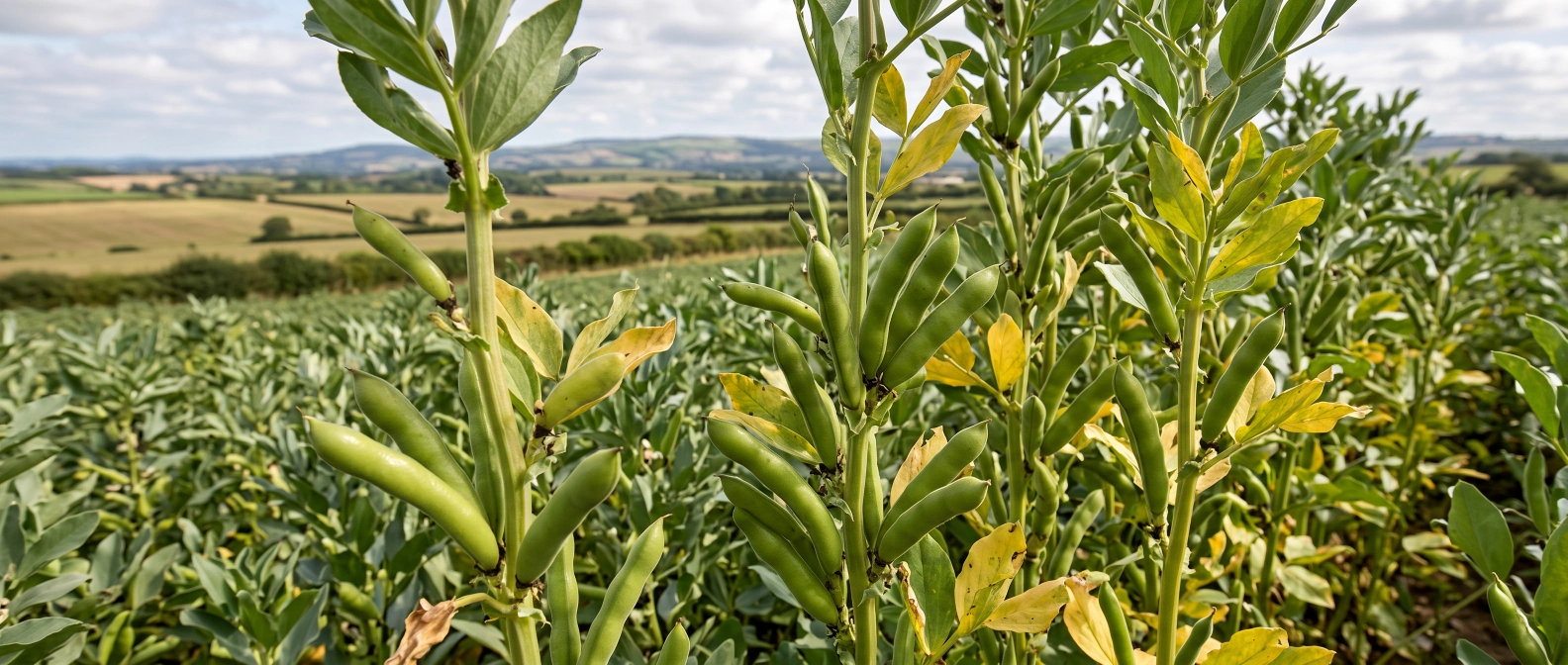
Per the crop database: a larger scale field variety of broad bean, with higher yield per area. Field bean (Vicia faba) is nominally self-pollinating but, exactly like broad bean, is heavily bee-visited in practice -- documented outcrossing rates of 5-60% depending on variety, environment and whether a natural barrier is present. Because field bean and broad bean are genuinely the same species, they can cross-pollinate with each other, not just within their own variety group. Fixes nitrogen. canStoreInGround = False -- this is a dried-seed storage crop, not a living-larder root.
Water need
Reasonably drought-tolerant once established, but even moisture while flowering and podding improves the set -- same profile as broad bean.
Calories at a glance
3,410 kcal/kg dried -- in the same league as wheat and the site's other dried pulses (scale is log-based across all 55 crops in the calculator).
Temperature Range by Month
Month on the bottom, temperature up the side. The pale green background is what the plant can survive at all -- fatal above or below it, labelled directly on the chart where that applies to your zone. The coral band is its ideal range, and only fades in during the months this zone would actually have the crop in the ground -- reusing the exact same sowing/harvesting data as the calendar further down the page. The blue line is real monthly climate data (not a modelled estimate) for a representative rural/agricultural location in this zone -- a small farming town or agricultural research station rather than a major city, to avoid the warmer bias city weather stations have. For the actual verdict on how well this crop does in your zone, see the badge at the top of the page -- that's based on the site's own researched yield figures, not this chart.
Quick Start: Sowing to Drying
- Sow direct. Sow seed direct where it's going to grow -- like broad bean, field bean's long taproot resents disturbance, so it doesn't transplant well. Overwinter sowing is possible in mild zones for an earlier, hardier crop.
- Space for its larger field-scale habit. Field bean is bred for area yield rather than individual plant size, so follow seed packet spacing closely rather than gardening it like broad bean.
- Pinch out tops once pods have set. Removing the soft growing tip once the lowest pods have set diverts energy into pod-filling and removes the part of the plant black bean aphid targets most.
- Leave pods on the plant to dry fully. For dried storage, don't pick pods young -- leave them on the plant until they've turned black and papery and the beans inside rattle.
- Shell and finish drying indoors. Shell the dried pods and spread the beans out somewhere warm and airy for a final week of drying before storing in an airtight container.
Sowing & Harvesting Calendar
Pick your zone under "Temperature Range by Month" above and this updates too. Field bean is at least viable in every zone on this site, unlike garden broad bean which isn't viable in Tropical at all -- a genuine difference between the two varieties despite being the same species.
Calories & Yield
Field bean is a genuine calorie staple when dried at 3,410 kcal per kg -- in the same league as wheat. Mediterranean gives the best yield here, and per-plant yield is noticeably higher across the board than garden broad bean's, reflecting its field-variety breeding.
| Climate Zone | Yield per plant | Calories per plant | Viability |
|---|---|---|---|
| Tropical / Humid | 4.0 kg | 13640 kcal | Viable |
| Subtropical | 4.0 kg | 13640 kcal | Viable |
| Mediterranean | 4.5 kg | 15345 kcal | Viable -- best yield |
| Temperate Maritime | 3.5 kg | 11935 kcal | Viable |
| Temperate Continental | 4.0 kg | 13640 kcal | Viable |
| Cool / Boreal | 1.2 kg | 4092 kcal | Challenging (60% yield) |
| Arid / Semi-Arid | 1.5 kg | 5115 kcal | Challenging (60% yield) |
| Highland / Alpine | 1.2 kg | 4092 kcal | Challenging (60% yield) |
Figures per plant sown, dried weight, from the site's own crop database. Boreal, Arid and Alpine already reflect the 60% penalty applied to challenging zones.
Varieties Worth Knowing
Field bean varieties (the same species as broad bean, but grown and bred more for a bulk field crop than fresh eating) differ mainly in how they're used -- as a grain crop or as a soil-building cover crop. Both below are open-pollinated (OP), meaning seed saved from them breeds true and is worth keeping under this site's seed-saving approach; neither is an F1 hybrid.
Seed Saving -- Quick Guide
Fava/field bean crosses with garden broad bean -- the same species (Vicia faba), just a field-scale variety group. It's biennial-shaped: plant, overwinter, flower and set seed the following year.
SERVINGS, NOT DAILY CALORIES This works out plate-sized servings of fava bean from your seed during its fresh harvest window only, not your group's full daily calorie needs. For that, use the main calculator.
Estimated for your selected zone above, using this site's own germination, loss and yield figures for fava bean -- a helping is roughly what you'd put on a plate as part of a meal with other veg. Treat it as a planning estimate, not a promise.
Storage & Preservation
Field bean is grown here specifically for dried storage, not fresh eating -- pods are left on the plant until fully dry, then shelled and given a final week of airing indoors before going into an airtight container.
Stored this way in a cool, dry place, dried field beans keep for a genuinely long time -- years rather than months, the same storage league as wheat, oats and this site's other dried staples.
Growing Field Beans Without Bought Inputs
Black bean aphid is the main pest to watch for, exactly as with broad bean -- it clusters thickly on soft growing tips, and heavy infestations can weaken the whole plant.
Pinching out the growing tips once the lowest pods have set is the single most effective input-free defence -- it removes exactly the soft new growth aphids target, and diverts the plant's energy into filling pods instead.
Field bean fixes its own nitrogen via bacteria in root nodules, genuinely improving the soil for whatever's grown there next -- factor that into a wider rotation plan, not just a calorie one.
Frequently Asked Questions
Is field bean the same plant as broad bean?
Yes, genuinely the same species -- both are Vicia faba. Per the crop database, this entry is a larger-scale field variety of broad bean with higher yield per area, distinct from the garden-scale broad bean already covered on this site, but not a different plant.
Can field bean and broad bean cross-pollinate?
Yes -- because they're the same species, field bean and broad bean can genuinely cross with each other, not just within their own variety group. Growing both nearby without isolation risks losing the traits that separate a field variety from a garden one.
Why does field bean yield more per plant than broad bean on this site?
It's bred as a larger-scale field variety with higher yield per area, per the crop database's own description -- that's a genuine varietal difference in productivity, not an error in the figures, even though both crops are the same species.