
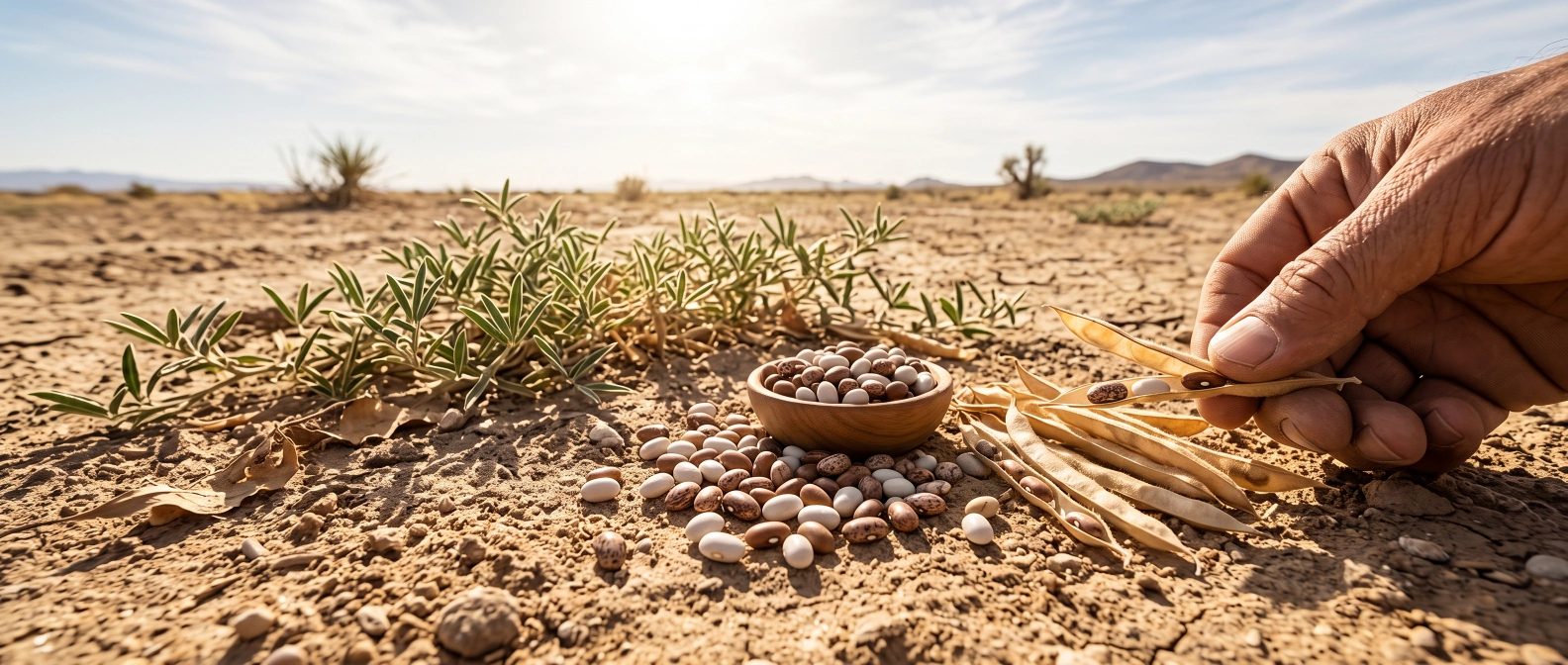
Tepary bean is genuinely extremely drought tolerant, per the crop database's own description -- a small-seeded bean bred over centuries in the US Southwest and Mexico to crop reliably in true desert conditions. It's a distinct species from the common bean cluster (kidney, black, pinto, navy, cannellini, plus this site's Borlotti/Haricot and French bean), so it doesn't cross with any of them, and it's self-pollinating with low outcrossing.
Water need
Extremely drought tolerant per the crop database -- one of the most water-frugal beans on this entire site.
Calories at a glance
3,430 kcal/kg dried -- a genuine calorie staple, in the same league as the site's other dried pulses (scale is log-based across all 55 core crops in the calculator).
Temperature Range by Month
Month on the bottom, temperature up the side. The pale green background is what the plant can survive at all -- fatal above or below it, labelled directly on the chart where that applies to your zone. The coral band is its ideal range, and only fades in during the months this zone would actually have the crop in the ground -- reusing the exact same sowing/harvesting data as the calendar further down the page. The blue line is real monthly climate data (not a modelled estimate) for a representative rural/agricultural location in this zone -- a small farming town or agricultural research station rather than a major city, to avoid the warmer bias city weather stations have. For the actual verdict on how well this crop does in your zone, see the badge at the top of the page -- that's based on the site's own researched yield figures, not this chart.
Quick Start: Sowing to Drying
- Sow direct once the soil is warm. Sow seed direct after the soil has genuinely warmed -- tepary bean is a warm-season desert crop and won't germinate well in cold ground.
- Water sparingly. Give tepary bean far less water than other dried beans -- its extreme drought tolerance means overwatering does more harm than good.
- Let the small pods mature fully. Leave pods on the plant until they dry and rattle, rather than picking them young for fresh eating.
- Harvest before pods shatter. Pick dried pods promptly once ready -- like many desert-adapted beans, tepary pods can split and drop seed if left too long past full dryness.
- Shell and finish drying indoors. Shell the small pods and spread the beans somewhere warm and airy for a final week of drying before storing in an airtight container.
Sowing & Harvesting Calendar
Pick your zone under "Temperature Range by Month" above and this updates too. Boreal and Alpine show no window at all, since this site's own yield data marks tepary bean as not viable there.
Calories & Yield
Tepary bean is a genuine calorie staple when dried at about 3,430 kcal per kg -- Mediterranean and Arid zones tie for the best yield here, and it's not viable at all in Boreal or Alpine zones.
| Climate Zone | Yield per plant | Calories per plant | Viability |
|---|---|---|---|
| Tropical / Humid | 1.8 kg | 6174 kcal | Viable |
| Subtropical | 1.8 kg | 6174 kcal | Viable |
| Mediterranean | 2.0 kg | 6860 kcal | Viable -- best yield |
| Temperate Maritime | 0.48 kg | 1646.4 kcal | Challenging (60% yield) |
| Temperate Continental | 0.72 kg | 2469.6 kcal | Challenging (60% yield) |
| Cool / Boreal | -- | -- | Not viable |
| Arid / Semi-Arid | 2.0 kg | 6860 kcal | Viable -- best yield |
| Highland / Alpine | -- | -- | Not viable |
Figures per plant sown, dried weight, from the site's own crop database. Maritime and Continental already reflect the 60% penalty applied to challenging zones.
Varieties Worth Knowing
Tepary bean varieties are mostly distinguished by seed colour -- a genuinely useful indicator, since it correlates with slightly different flavour. Both below are open-pollinated (OP), meaning seed saved from them breeds true and is worth keeping under this site's seed-saving approach; neither is an F1 hybrid.
Seed Saving -- Quick Guide
Tepary bean behaves much like common bean for seed saving -- mostly self-pollinating, low risk, and genetically isolated from common bean despite the family resemblance.
SERVINGS, NOT DAILY CALORIES This works out plate-sized servings of tepary bean from your seed during its fresh harvest window only, not your group's full daily calorie needs. For that, use the main calculator.
Estimated for your selected zone above, using this site's own germination, loss and yield figures for tepary bean -- a helping is roughly what you'd put on a plate as part of a meal with other veg. Treat it as a planning estimate, not a promise.
Storage & Preservation
Tepary bean is grown here specifically for dried storage -- pods are left on the plant until fully dry, then shelled and given a final week of airing indoors before going into an airtight container.
Stored this way in a cool, dry place, dried tepary beans keep for a genuinely long time -- years rather than months, the same storage league as this site's other dried pulses.
Growing Tepary Bean Without Bought Inputs
Tepary bean's genuine extreme drought tolerance is itself the biggest input-free advantage here -- bred over centuries for reliable cropping on rainfall alone, it needs little to no supplemental watering once established.
Bean beetles and aphids are the main pests to watch for -- light infestations can usually be managed with hand-picking or a strong water spray, without spraying anything bought in.
Tepary bean fixes its own nitrogen via bacteria in root nodules, genuinely improving the soil for whatever's grown there next -- factor that into a wider rotation plan, not just a calorie one.
Frequently Asked Questions
Is tepary bean really that drought tolerant?
Yes -- the crop database is direct about it: extremely drought tolerant, and genuinely so. Tepary bean is native to the US Southwest and Mexico, where it was bred over centuries to crop reliably on rainfall alone in true desert conditions.
Does tepary bean cross with kidney, black, pinto, navy or cannellini beans?
No -- despite the shared name "bean", tepary bean (Phaseolus acutifolius) is a distinct species from Phaseolus vulgaris, the species behind kidney, black, pinto, navy and cannellini beans as well as this site's Borlotti/Haricot and French bean. It does not cross with any of them.
Why is tepary bean good for arid zones specifically?
Because that's genuinely what it was bred for -- the crop database calls it good for arid zones outright, and its desert-adapted heritage means it keeps setting pods on far less water than most other dried beans need.