
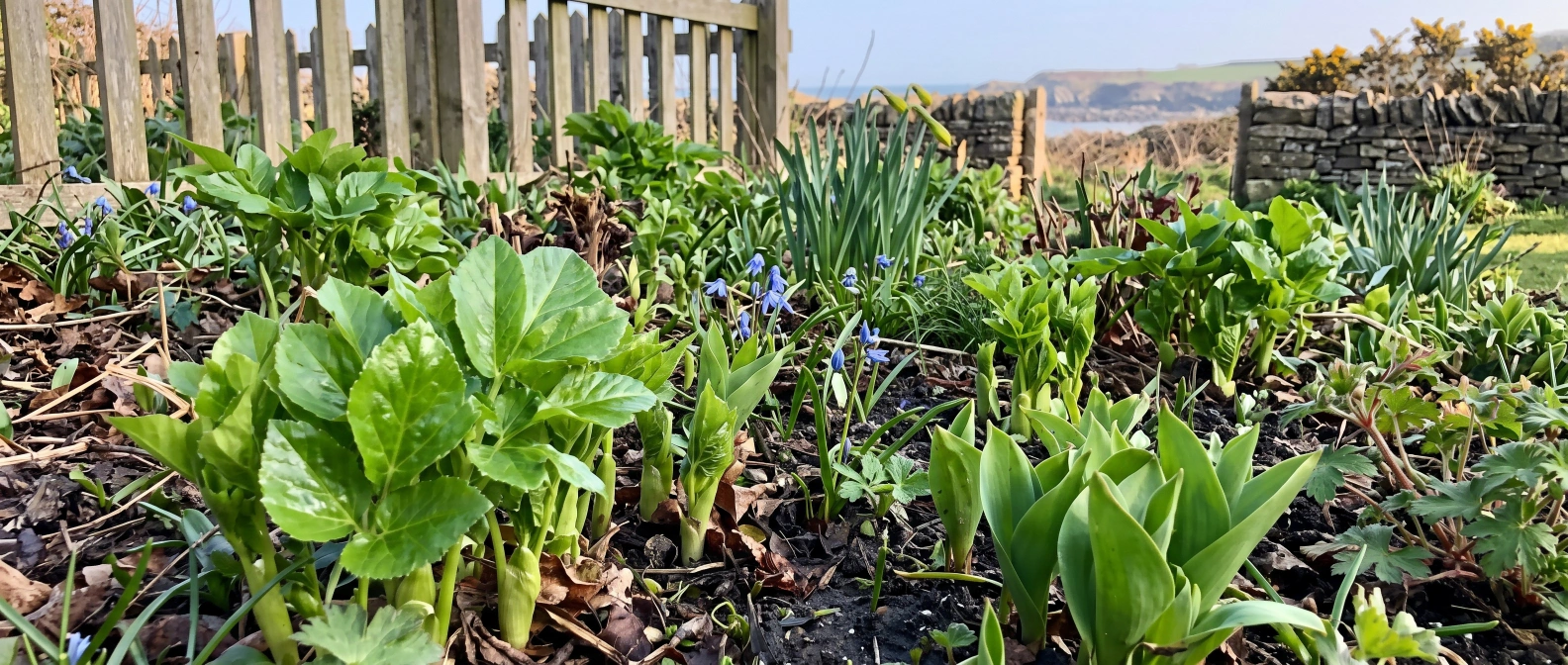
A hardy coastal perennial with a genuine celery-like flavour, per the crop database's own description, harvested in early spring -- among the first fresh pickings of the year. Once Britain's everyday pot-herb, it was largely displaced by celery from the 17th century onward, but self-seeds readily and needs almost no attention once established.
Water need
A genuinely tough coastal plant, well adapted to free-draining ground near the sea -- it copes with dry spells far better than true celery does.
Calories at a glance
490 kcal/kg -- grown for its early-season pot-herb flavour rather than as a bulk calorie crop (scale is log-based across all 55 core crops in the calculator).
Temperature Range by Month
Month on the bottom, temperature up the side. The pale green background is what the plant can survive at all -- fatal above or below it, labelled directly on the chart where that applies to your zone. The coral band is its ideal range, and only fades in during the months this zone would actually have shoots being harvested -- reusing the exact same calendar data as further down the page. The blue line is real monthly climate data (not a modelled estimate) for a representative rural/agricultural location in this zone -- a small farming town or agricultural research station rather than a major city, to avoid the warmer bias city weather stations have. For the actual verdict on how well this crop does in your zone, see the badge at the top of the page -- that's based on the site's own researched yield figures, not this chart.
Quick Start: Sowing to Storage
- Sow direct in late summer or autumn. Sow direct, timing for late summer or autumn to mimic its natural self-seeding cycle.
- Let plants establish over winter. Allow seedlings to establish through the cooler months, ready for the plant's genuinely early spring growth spurt.
- Harvest young stems and leaves in early spring. Cut young stems, leaves and flower buds while still tender, before the plant toughens as it moves toward flowering.
- Let some plants flower and self-seed. Leave a portion of the planting to flower and set seed, since Alexanders self-seeds readily and helps maintain the patch.
- Use fresh soon after picking. Use stems and leaves fresh soon after harvest, since this crop has no meaningful long-term storage route.
Sowing & Harvesting Calendar
Pick your zone under "Temperature Range by Month" above and this updates too. Harvest here falls in genuine early spring, well ahead of most other crops on this site.
Calories & Yield
Mediterranean gives the best yield here, and it's not viable outdoors in the Boreal or Arid zones.
| Climate Zone | Yield per plant | Calories per plant | Viability |
|---|---|---|---|
| Tropical / Humid | 2.00 kg | 980 kcal | Viable |
| Subtropical | 2.00 kg | 980 kcal | Viable |
| Mediterranean | 2.50 kg | 1,225 kcal | Viable -- best yield |
| Temperate Maritime | 2.00 kg | 980 kcal | Viable |
| Temperate Continental | 0.90 kg | 441 kcal | Challenging (60% yield) |
| Cool / Boreal | 0.00 kg | 0 kcal | Not viable outdoors |
| Arid / Semi-Arid | 0.00 kg | 0 kcal | Not viable outdoors |
| Highland / Alpine | 0.72 kg | 352.8 kcal | Challenging (60% yield) |
Figures per established plant per year, from the site's own crop database. Continental and Alpine already reflect the 60% penalty applied to challenging zones.
A note on varieties: Alexanders is mostly grown as a single undifferentiated type -- real named-cultivar diversity is genuinely thin.
Seed Saving -- Quick Guide
Alexanders is an insect-pollinated umbellifer that doesn't cross with carrot, parsley or celery -- different genera -- though it is itself naturalised and semi-wild along many UK coastal roads.
SERVINGS, NOT DAILY CALORIES This works out plate-sized servings of Alexanders from your seed during its fresh harvest window only, not your group's full daily calorie needs. For that, use the main calculator.
Estimated for your selected zone above, using this site's own germination, loss and yield figures for Alexanders -- a helping is roughly what you'd put on a plate as part of a meal with other veg. Treat it as a planning estimate, not a promise.
Storage & Preservation
Fresh stems and leaves keep for only a few days refrigerated, similar to celery.
There's no meaningful long-term preservation route for this crop -- it's best treated as a genuine early-spring fresh pot-herb rather than something to store or bank.
Growing Alexanders Without Bought Inputs
Genuinely one of the toughest, most self-sufficient crops on this whole site -- once established, it self-seeds and maintains its own patch with no ongoing intervention.
Few pests bother it seriously -- slugs on young seedlings are about the only real early risk.
Hand-picking slugs at dusk while plants are small is a simple, genuinely effective input-free measure.
Frequently Asked Questions
Does Alexanders cross-pollinate with lovage?
No. Both are in the Apiaceae family, but Alexanders is Smyrnium olusatrum and lovage is Levisticum officinale -- different genera. They share a family resemblance and a similar celery-like flavour, but genuinely don't cross-pollinate with each other.
Why is Alexanders called that?
The name is thought to trace back to Alexandria, reflecting its long history as a cultivated pot-herb across the Mediterranean and, later, coastal Britain, before celery largely replaced it in kitchens from the 17th century onward.
When is Alexanders actually ready to harvest?
Early spring, per the crop database's own description -- genuinely one of the earliest fresh pickings of the year, often ready well before most spring vegetables get going.