
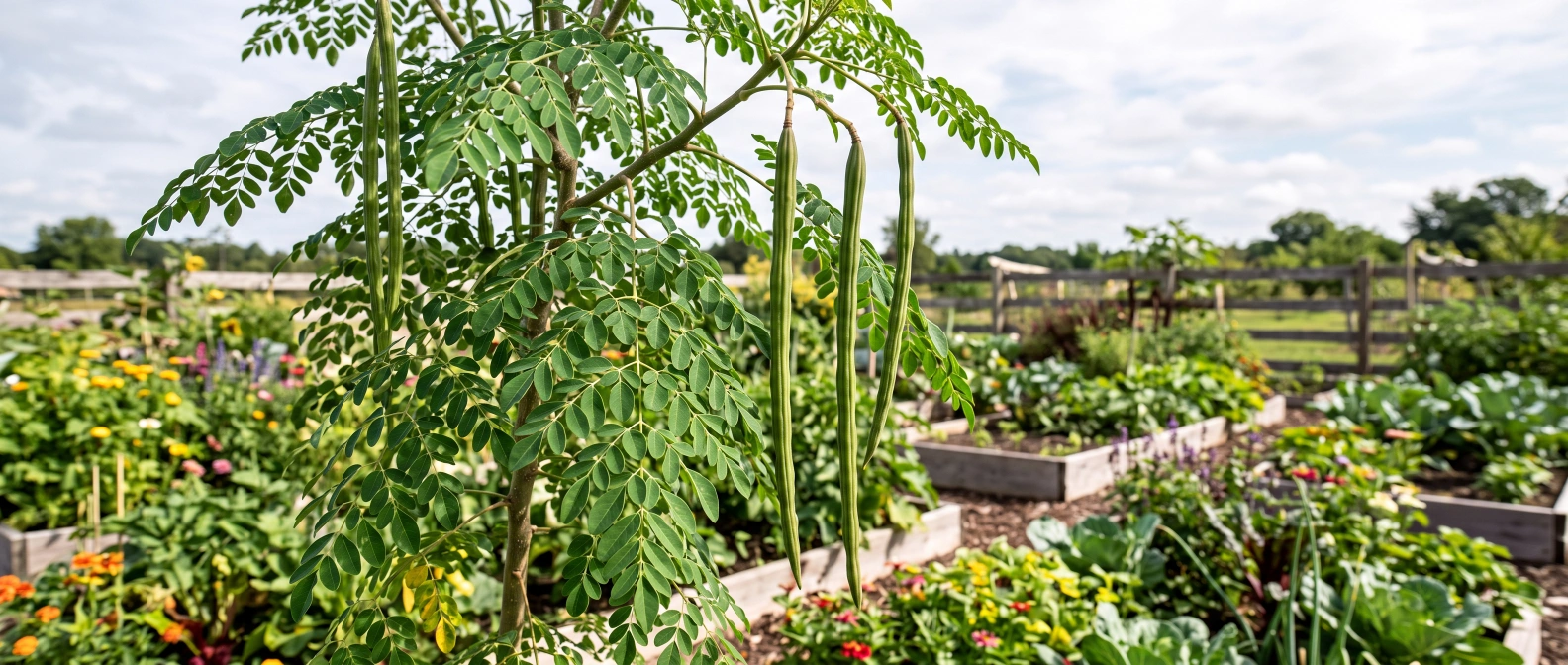
A fast-growing tropical tree grown for both leaves and pods, both genuinely edible per the crop database, and by far the most calorie-dense crop on this whole hub. Where sea kale, walking onion, lovage and Alexanders are chosen for hardiness, moringa earns its place here on sheer tropical productivity instead.
Water need
A genuinely deep-rooted, drought-tolerant tree once established -- one of its real strengths in the warm, dry zones where it grows outdoors.
Calories at a glance
2,650 kcal/kg -- genuinely closer to a grain or legume than a typical leafy vegetable, and easily the densest crop on this hub (scale is log-based across all 55 core crops in the calculator).
Temperature Range by Month
Month on the bottom, temperature up the side. The pale green background is what the plant can survive at all -- fatal above or below it, labelled directly on the chart where that applies to your zone. The coral band is its ideal range, and only fades in during the months this zone would actually have the tree in active leaf -- reusing the exact same calendar data as further down the page. The blue line is real monthly climate data (not a modelled estimate) for a representative rural/agricultural location in this zone -- a small farming town or agricultural research station rather than a major city, to avoid the warmer bias city weather stations have. For the actual verdict on how well this crop does in your zone, see the badge at the top of the page -- that's based on the site's own researched yield figures, not this chart.
Quick Start: Sowing to Storage
- Sow seed direct in warm soil. Sow seed direct once soil is reliably warm, or start under cover in cooler zones where it will need a polytunnel to survive at all.
- Grow on as a fast tree. Let the young tree grow on, watering regularly while it establishes -- moringa is genuinely fast-growing given warmth.
- Harvest leaves continuously. Pick young leaves regularly through the growing season, the way a genuine living-larder crop is used.
- Harvest pods when young and tender. Pick the long slender pods while still young and tender for the best eating quality, before they toughen.
- Prune to keep it manageable. Cut back hard each year to keep the tree at a pickable height and to encourage fresh, tender new leaf growth.
Sowing & Harvesting Calendar
Pick your zone under "Temperature Range by Month" above and this updates too. Zones 4-6 and 8 show no window at all here, reflecting moringa's genuine frost tenderness outdoors.
Calories & Yield
Tropical gives the best yield here by a wide margin, and it's not viable outdoors in the Maritime, Continental, Boreal or Alpine zones -- a polytunnel is the only route in those.
| Climate Zone | Yield per plant | Calories per plant | Viability |
|---|---|---|---|
| Tropical / Humid | 8.00 kg | 21,200 kcal | Viable -- best yield |
| Subtropical | 6.00 kg | 15,900 kcal | Viable |
| Mediterranean | 1.80 kg | 4,770 kcal | Challenging (60% yield) |
| Temperate Maritime | 0.00 kg | 0 kcal | Not viable outdoors |
| Temperate Continental | 0.00 kg | 0 kcal | Not viable outdoors |
| Cool / Boreal | 0.00 kg | 0 kcal | Not viable outdoors |
| Arid / Semi-Arid | 5.00 kg | 13,250 kcal | Viable |
| Highland / Alpine | 0.00 kg | 0 kcal | Not viable outdoors |
Figures per established tree per year, from the site's own crop database. Mediterranean already reflects the 60% penalty applied to challenging zones. Zone 3-4 growers can still succeed under a polytunnel per the crop database's own note.
Varieties Worth Knowing
Moringa has less named-cultivar diversity than most vegetables in wide circulation, but one selection stands out for yield. Both below are open-pollinated (OP), meaning seed saved from them breeds true and is worth keeping under this site's seed-saving approach; neither is an F1 hybrid.
Seed Saving -- Quick Guide
Moringa is insect-pollinated with moderate crossing risk between varieties -- the long "drumstick" pods need to fully dry and brown on the tree before the seeds inside are ready to harvest.
SERVINGS, NOT DAILY CALORIES This works out plate-sized servings of moringa from your seed during its fresh harvest window only, not your group's full daily calorie needs. For that, use the main calculator.
Estimated for your selected zone above, using this site's own germination, loss and yield figures for moringa -- a helping is roughly what you'd put on a plate as part of a meal with other veg. Treat it as a planning estimate, not a promise.
Storage & Preservation
Fresh leaves keep for only a few days refrigerated, but they dry exceptionally well -- dried and powdered moringa leaf keeps for months and concentrates its nutrition further.
Young pods keep for about a week fresh and can also be dried for longer-term storage, a genuinely practical way to bank a heavy harvest.
Growing Moringa Without Bought Inputs
Genuinely fast-growing and low-input once established, tolerating poor soil far better than most trees, provided the climate stays warm enough.
Waterlogged soil and frost are the two real threats, rather than any specific pest.
Free-draining soil and, in marginal zones, a polytunnel are simple, genuinely effective input-free measures.
Frequently Asked Questions
Is moringa hardy like the rest of this hub?
No -- genuinely the opposite. Moringa is a frost-tender tropical tree, viable outdoors only in the warmest zones, and needs a polytunnel elsewhere it can grow at all. Every other perennial on this hub is chosen for hardiness; moringa is the one grown for tropical productivity instead.
Why is moringa so much more calorie-dense than the rest of this hub?
Its leaves and pods are both genuinely nutrient- and calorie-rich, per the crop database's own figures -- by a wide margin the most calorie-dense crop on the Perennial Vegetables hub, closer to a grain or legume than a typical leafy vegetable.
Does moringa cross-pollinate with anything else on this site?
No. Moringa oleifera is in its own family, Moringaceae, with no other crop from that family grown here -- so there's genuinely no crossing risk.