
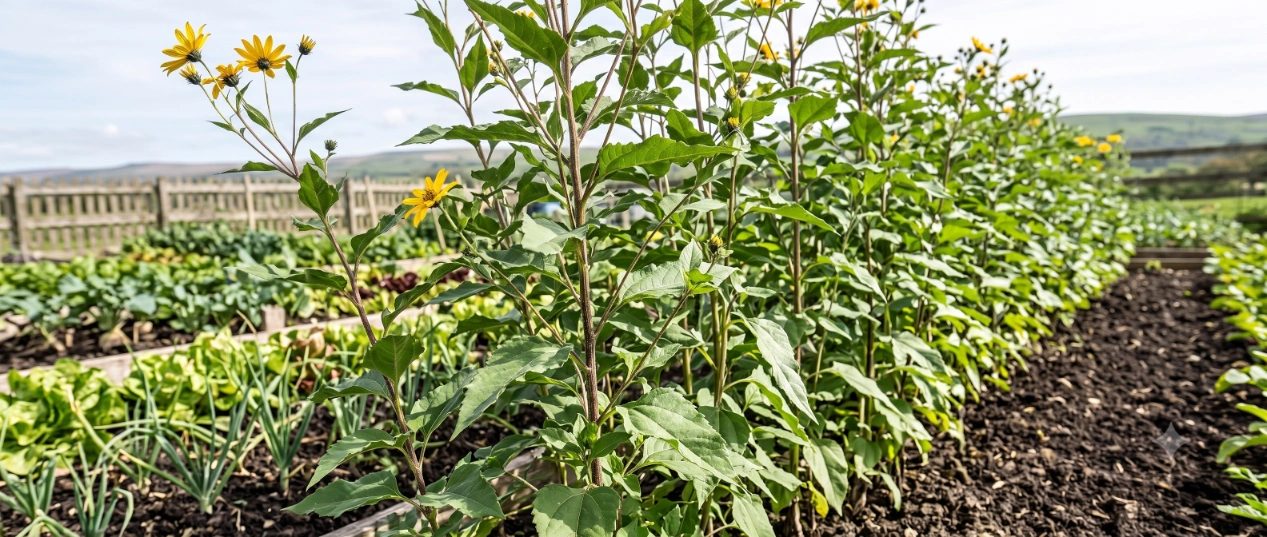
Jerusalem artichoke is the outlier of this whole category: plant it once and it comes back every year on its own, whether you want it to or not. It's grown from tuber rather than true seed, the same as potato, and the site's own crop data calls it a living larder outright -- dig as needed, and any fragment left behind is next year's crop. Its real challenge isn't growing it successfully, but containing it once it's established.
Water need
Genuinely low-input once established -- occasional watering in real dry spells is enough for this vigorous, tall-growing crop.
Calories at a glance
730 kcal/kg -- the highest of any root vegetable covered on this site (scale is log-based across all 55 crops in the calculator).
Temperature Range by Month
Month on the bottom, temperature up the side. The pale green background is what the plant can survive at all -- fatal above or below it, labelled directly on the chart where that applies to your zone. The coral band is its ideal range, and only fades in during the months this zone would actually have the crop in the ground -- reusing the exact same sowing/harvesting data as the calendar further down the page. The blue line is real monthly climate data (not a modelled estimate) for a representative rural/agricultural location in this zone -- a small farming town or agricultural research station rather than a major city, to avoid the warmer bias city weather stations have. For the actual verdict on how well this crop does in your zone, see the badge at the top of the page -- that's based on the site's own researched yield figures, not this chart.
Quick Start: Planting to Harvest
- Choose a permanent, contained spot. Decide on containment before planting, not after -- a bottomless container sunk into the ground, a buried barrier, or a bed you're happy to dedicate to this crop indefinitely.
- Plant tubers in early spring. Plant whole or cut tubers several inches deep once the soil has warmed, the same timing as planting seed potatoes.
- Leave it largely alone through summer. Jerusalem artichoke grows tall and vigorous with little input needed beyond occasional watering in genuinely dry spells.
- Harvest after the first frost cuts the top growth. Dig tubers from autumn once the frost has blackened the foliage above -- that's the normal signal the plant has finished bulking up the tubers below.
- Leave the rest in the ground for next year. Only dig what you need at a time -- the site's own crop data treats this as a living larder, and any tubers left behind simply become next year's crop automatically.
Planting & Harvesting Calendar
Pick your zone under "Temperature Range by Month" above and this updates too. The Plant row shows the one-time planting window -- remember this crop only needs planting once, not every year. The Harvest row has two shades: solid green is the main harvest window, while the striped tail reflects the living-larder option covered in Storage & Preservation below -- dig as needed rather than lifting the whole bed at once.
Calories & Yield
Jerusalem artichoke is the highest calorie density root crop on this site at about 730 kcal per kg, combined with genuinely large per-plant yields. Mediterranean, Maritime and Continental zones give the best yields here.
| Climate Zone | Yield per plant | Calories per plant | Viability |
|---|---|---|---|
| Tropical / Humid | -- | -- | Not viable |
| Subtropical | 2.5 kg | 1,825 kcal | Viable |
| Mediterranean | 3.5 kg | 2,555 kcal | Viable -- best yield |
| Temperate Maritime | 3.5 kg | 2,555 kcal | Viable -- best yield |
| Temperate Continental | 3.5 kg | 2,555 kcal | Viable -- best yield |
| Cool / Boreal | 2.5 kg | 1,825 kcal | Viable |
| Arid / Semi-Arid | -- | -- | Not viable |
| Highland / Alpine | 2.0 kg | 1,460 kcal | Viable |
Figures per plant sown, from the site's own crop database. Since each plant produces multiple tubers and this is a one-time planting, these figures repeat every year without resowing.
Varieties Worth Knowing
Jerusalem artichoke is mostly grown as an undifferentiated type, but a handful of named varieties do exist, mainly differing in tuber shape (smooth vs. knobbly, easier or harder to clean), height, and yield. Jerusalem artichokes are grown from saved tubers rather than true seed, so each variety below is marked true to type: replanting a saved tuber reliably reproduces the same variety, the tuber equivalent of this site's seed-saving approach for true-seed crops.
Seed Saving -- Quick Guide
Jerusalem artichoke is normally propagated by saving and replanting tubers rather than seed -- many varieties rarely flower or set viable seed in cooler climates anyway, so this sidesteps the question of crossing risk entirely.
SERVINGS, NOT DAILY CALORIES This works out plate-sized servings of Jerusalem artichoke from your planting tubers during its fresh harvest window only, not your group's full daily calorie needs. For that, use the main calculator.
Estimated for your selected zone above, using this site's own germination, loss and yield figures for Jerusalem artichoke -- a helping is roughly what you'd put on a plate as part of a meal with other veg. Treat it as a planning estimate, not a promise.
Storage & Preservation
The site's own crop data describes this crop plainly: plant once, harvest October to February indefinitely. Dig only what's needed at a time and leave the rest in the ground -- tubers keep far better there than lifted and stored, and the plant regrows from whatever's left behind regardless.
Once lifted, tubers don't store as long as potato -- they're thin-skinned and dry out quickly in open air, so use them within a couple of weeks, or store briefly in damp sand in a cool place if a short delay is unavoidable.
Growing Jerusalem Artichoke Without Bought Inputs
This is a remarkably trouble-free crop -- few pests or diseases bother it seriously in most gardens, and no bought inputs are typically needed to grow it successfully at all.
Containment, not protection, is the real ongoing task. A buried barrier of solid material (like sunk paving slabs or a bottomless container) sized to at least 45-60cm deep stops the spreading tubers escaping the bed without any bought materials beyond what's likely already lying around a homestead.
The tall growth also makes this crop a useful windbreak or summer screen for more delicate plants nearby -- a genuinely free structural benefit alongside the harvest itself.
Frequently Asked Questions
Do I need to plant Jerusalem artichoke every year?
No -- this is a genuine perennial. The site's own crop data describes it as "plant once, harvest indefinitely," since any tuber fragment left in the ground regrows the following year on its own.
How do I get seed or planting stock for Jerusalem artichoke?
From tubers, not true seed -- the same propagation model as potato and sweet potato on this site. Save a portion of your own harvest to replant, or more accurately, simply leave some tubers in the ground, since Jerusalem artichoke replants itself whether you mean it to or not.
Is it true Jerusalem artichoke can become invasive?
Yes, genuinely. A single plant can produce 75-200 tubers in one growing season, and even a small missed fragment sprouts a new plant, so an uncontained patch spreads well beyond where it was planted. Containment from day one -- a bottomless container, buried barrier, or an isolated bed you don't mind dedicating permanently -- is much easier than trying to remove it later.
How cold and hot can Jerusalem artichoke survive?
The tubers themselves are remarkably cold-hardy underground, tolerating hard freezes well below -15°C in most zones this crop is viable in. The top growth is more tender and is cut back by the first frost around 0°C, but that doesn't harm the plant -- it's actually the normal end-of-season signal that the tubers below are ready to dig.
Is Jerusalem artichoke a good calorie crop for self-sufficiency?
Very good -- around 730 kcal per kg, the highest of any root vegetable covered on this site, combined with genuinely large per-plant yields. Between that and needing to be planted only once, it's one of the most effort-efficient calorie crops here.
Do I need pesticides to grow Jerusalem artichoke?
No. It's a remarkably trouble-free crop with few serious pests or diseases in most gardens -- the far more common problem is controlling where it grows, not protecting it from anything.