
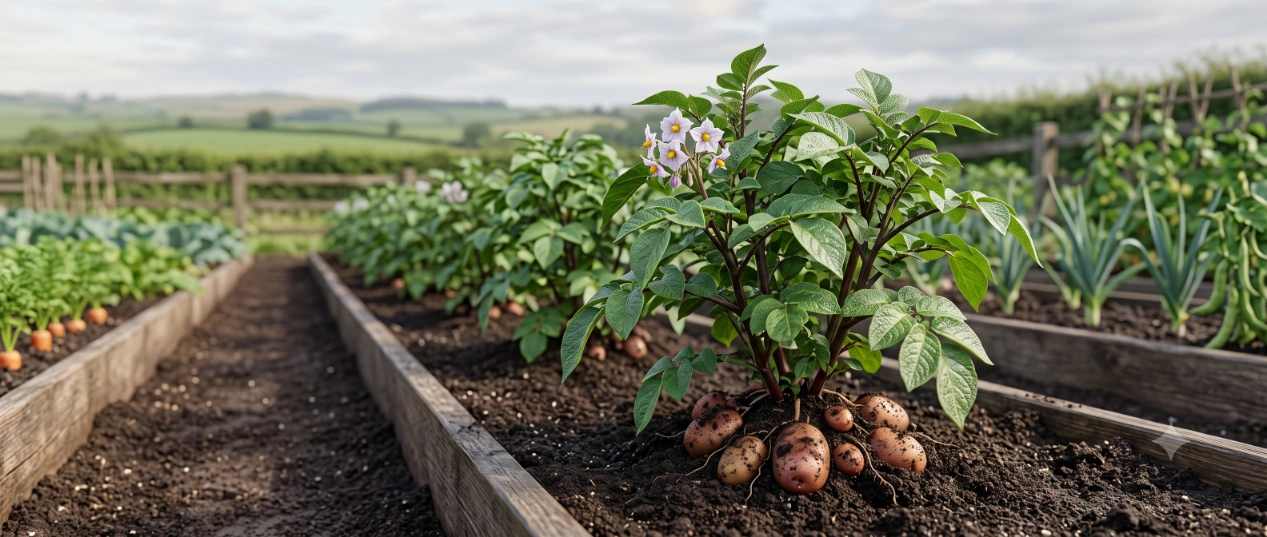
Unlike almost every other vegetable covered on this site so far, potato is a genuine calorie staple -- dense enough in energy, reliable enough in yield, and good enough at storing afterwards that it's been one of history's most important food-security crops. It's also structurally different underneath: grown from saved tubers rather than true seed, with no cross-pollination to worry about at all, and split here into two distinct timings -- early potatoes, planted and eaten sooner but barely storing, and maincrop, planted later for a bigger harvest that can keep for months.
Water need
Critical while tubers are forming and bulking up -- ease off shortly before harvest to help the skins toughen for storage.
Calories at a glance
770 kcal/kg -- genuinely calorie-dense, more than double kale or Brussels sprouts (scale is log-based across all 55 crops in the calculator, staples included).
Temperature Range by Month
Month on the bottom, temperature up the side. The pale green background is what the plant can survive at all -- fatal above or below it, labelled directly on the chart where that applies to your zone. Potato's real advantage in a zone like Maritime isn't hitting some ideal temperature -- it's a long season that never freezes hard and never crosses the roughly 27-28°C point where tuber formation stops (see the FAQ below). So instead of an "ideal band", the gold highlight marks the months the crop is actually in the ground -- reusing the exact same sowing/harvesting data as the calendar further down the page -- and the season length is called out directly. The blue line is real monthly climate data (not a modelled estimate) for a representative rural/agricultural location in this zone -- a small farming town or agricultural research station rather than a major city, to avoid the warmer bias city weather stations have. For the actual verdict on how well this crop does in your zone, see the badge at the top of the page -- that's based on the site's own researched yield figures, not this chart.
Early Potato
Maincrop Potato
Quick Start: Planting to Harvest
- Chit the seed potatoes. A few weeks before planting, stand seed potatoes in a cool, bright place (an egg carton works well) to develop short, sturdy sprouts. This isn't essential but gives earlies in particular a head start.
- Plant. Plant into well-drained soil once frost risk has eased for your zone -- earlier for early varieties, later for maincrop. Check the calendar below for your specific zone and hemisphere.
- Earth up as shoots grow. Mound soil (or mulch) over the emerging stems every couple of weeks as they grow, leaving just the top few centimetres exposed. This stops developing tubers greening from light exposure and generally increases yield.
- Tend through the season. Water consistently while tubers are forming and bulking up -- this is the single most yield-critical period. Ease off shortly before harvest to help the skins toughen for storage.
- Harvest and cure. Lift early potatoes as needed once plants flower, for eating fresh. For maincrop, wait until the foliage yellows and dies back, then lift and let the tubers dry/cure in a shaded, airy spot for a few days before moving them into storage.
Planting & Harvesting Calendar
Pick your zone under "Temperature Range by Month" above and both calendars below update together. The Sow row here means "plant seed potatoes": green is the normal safe planting window, amber is pushing the season by roughly a month either side with basic protection (fleece, cloche), blue is an even earlier under-glass start. The Harvest row is the lifting window -- notice how much later and longer maincrop's window runs compared to early.
Early Potato
Maincrop Potato
Calories & Yield
Potato is sold and planted by weight of seed potato, not by individual plant or seed packet, so the figures below are a yield ratio -- kilograms harvested per kilogram planted -- rather than yield per plant. At about 770 kcal per kg, this is a genuine calorie staple, not a nutrition-only crop like most of the vegetables covered elsewhere on this site.
Early Potato
| Climate Zone | Yield ratio | Calories per kg planted | Viability |
|---|---|---|---|
| Tropical / Humid | -- | -- | Not viable |
| Subtropical | 4.5× | 3,465 kcal | Viable |
| Mediterranean | 6.0× | 4,620 kcal | Viable |
| Temperate Maritime | 7.0× | 5,390 kcal | Viable |
| Temperate Continental | 6.5× | 5,005 kcal | Viable |
| Cool / Boreal | 4.0× | 3,080 kcal | Viable |
| Arid / Semi-Arid | -- | -- | Not viable |
| Highland / Alpine | 3.5× | 2,695 kcal | Viable |
Maincrop Potato
| Climate Zone | Yield ratio | Calories per kg planted | Viability |
|---|---|---|---|
| Tropical / Humid | -- | -- | Not viable |
| Subtropical | 6.0× | 4,620 kcal | Viable |
| Mediterranean | 7.5× | 5,775 kcal | Viable |
| Temperate Maritime | 8.0× | 6,160 kcal | Viable -- best yield |
| Temperate Continental | 7.5× | 5,775 kcal | Viable |
| Cool / Boreal | 5.0× | 3,850 kcal | Viable |
| Arid / Semi-Arid | -- | -- | Not viable |
| Highland / Alpine | 4.5× | 3,465 kcal | Viable |
Figures from the site's own crop database. Neither variant is viable in Tropical or Arid zones -- see the FAQ below for why. Maincrop consistently out-yields early potato in every zone where both are viable, which is the trade-off for its much longer season.
Varieties Worth Knowing
Potato varieties fill genuinely different niches -- earliness, storage life, disease resistance, texture -- so the right one depends on what you're growing it for. Potatoes are grown from saved tubers rather than true seed, so each variety below is marked true to type: replanting a saved tuber reliably reproduces the same variety, the tuber equivalent of this site's seed-saving approach for true-seed crops.
Seed Saving -- Quick Guide
Potato seed is genetically unpredictable, like an F1 hybrid, since the plant is highly heterozygous -- so it's propagated from saved tubers rather than true seed, which sidesteps cross-pollination entirely.
SERVINGS, NOT DAILY CALORIES This works out plate-sized servings of potato from your seed potatoes during its fresh harvest window only, not your group's full daily calorie needs. For that, use the main calculator.
Estimated for your selected zone above, using this site's own germination, loss and yield figures for potato -- a helping is roughly what you'd put on a plate as part of a meal with other veg. Treat it as a planning estimate, not a promise.
Storage & Preservation
This is potato's real standout feature: maincrop potatoes store longer than almost anything else in this database -- up to around 24-28 weeks (six-plus months) in the best zones, kept cool, dark and dry in sacks, boxes, or a traditional clamp. Early potatoes are the opposite -- bred and grown to eat fresh, they store for only a matter of weeks, so plan to eat those as you go rather than banking on them.
Beyond fresh storage, potatoes can be dried (as flakes or chips, though this is more processing-intensive than most home setups manage well) or simply left as the reliable base of the pantry that good ambient storage already makes them. There's little need to reach for freezing or fermenting the way you would with a crop that barely stores on its own.
Growing Potatoes Without Bought Inputs
Potato's biggest real threat is disease, not insects -- late blight especially, a fungus-like disease that spreads fast in warm, humid weather and can destroy a crop within days, affecting both foliage and tubers.
Growing a blight-resistant variety is the single most effective input-free defence in humid zones -- resistance bred into the variety costs nothing extra to use and needs no ongoing input at all. Sarpo Mira in particular stands out here: it's bred specifically for exceptional resistance to late blight (tested against multiple blight strains, not just one), making it one of the most reliable choices going into a humid or wet season.
Good airflow between plants (proper spacing, not overcrowding) reduces the humid microclimate blight thrives in, and pulling and destroying (not composting) any plant showing symptoms limits how far it spreads.
Hand-picking deals with the main insect concern where present -- Colorado potato beetle and its larvae are large, visible, and straightforward to remove by hand at a home-garden scale.
Crop rotation matters here too -- avoid planting potatoes (or other nightshades like tomatoes) in the same bed two years running, which helps starve out soil-borne pests and diseases between plantings.
Frequently Asked Questions
How do I "save seed" for potatoes if they don't produce true seed the normal way?
By saving some of your own harvested tubers to replant, not by collecting seed from flowers. This is cloning, not sexual reproduction -- every tuber you plant grows into a genetic copy of the parent plant, which is why potatoes are sold and saved by weight of seed potato rather than by seed count or packet.
Do I need to worry about cross-pollination with other potato varieties?
No, not for normal tuber-saving -- there's no isolation distance to maintain, unlike every brassica on this site. Potatoes do flower and can technically cross-pollinate to produce true botanical seed, but that only matters if you're deliberately breeding from seed rather than saving tubers, which is a specialist, rarely-used technique.
Why do certified seed potatoes exist if I can just save my own?
Virus buildup, not cross-pollination, is the real risk with home-saved tuber stock. Because each generation is a genetic clone of the last, viral infections accumulate and get passed on every single year rather than being reset, gradually reducing vigour and yield. Certified seed potato stock is tested and grown to stay virus-free -- something worth knowing even if you plan to save your own.
What's the actual difference between early and maincrop potatoes?
Timing and storage life. Early potatoes are planted sooner, harvested young after about 10-12 weeks as "new potatoes," and don't store long. Maincrop varieties are planted later, grown to full size over a longer season, and store dramatically longer afterwards -- in the best zones, over six months versus a matter of weeks for earlies.
Why isn't potato viable in Tropical or Arid zones?
Heat, not cold, is the real limit. Tuber formation itself shuts down once temperatures stay above roughly 27-28°C, so in zones that are consistently hot, or hot and dry together, the plant simply won't bulk up usable tubers regardless of how well the foliage grows.
Is potato a good calorie crop for self-sufficiency?
Yes -- unlike almost everything else in this vegetable section, potato is a genuine calorie staple. At around 770 kcal per kg, it's more than twice as calorie-dense as kale or Brussels sprouts, and its combination of real yield and long storage life is exactly why it's historically been one of the most important famine-security crops there is.
How long do potatoes actually store after harvest?
Longer than almost any other crop in this database -- up to around 24-28 weeks for maincrop potatoes in the best-storing zones, kept cool, dark and dry. Early potatoes store for only a matter of weeks by comparison, since they're bred and grown to be eaten fresh rather than kept.
What is blight and how do I protect against it?
Late blight is a fungus-like disease that spreads fast in warm, humid weather and can destroy a crop within days, affecting both foliage and tubers. The main input-free defence is growing a blight-resistant variety in humid zones -- Sarpo Mira is the standout choice here, bred specifically for exceptional resistance to late blight across multiple strains -- plus good airflow between plants and not saving tubers from any visibly affected plant.
Do I need pesticides to grow potatoes?
Not usually. The main pest to watch for is the Colorado potato beetle where present, which hand-picking controls well at a home-garden scale, and earthing up (mounding soil around the stems) protects tubers from light and from some pest and disease pressure at the same time.