
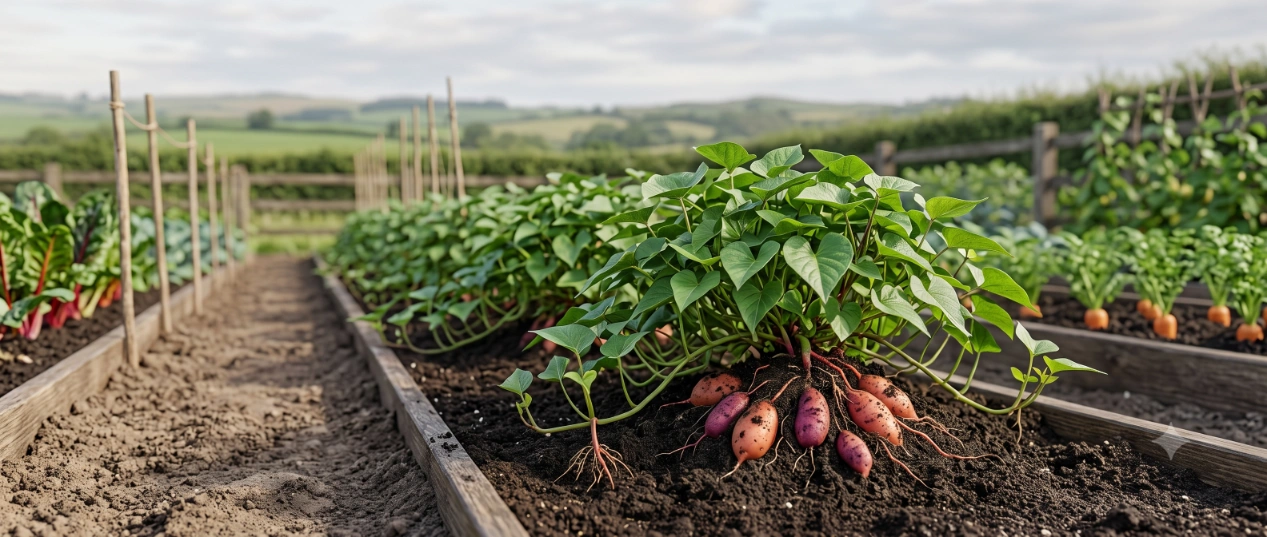
Despite the name, this has nothing to do with regular potato -- a completely different plant family, propagated the same vegetative way (from rooted cuttings called slips, not tubers and not true seed) but with essentially the opposite climate needs. Where potato fails in this site's hottest zones, sweet potato fails in the coldest ones, killed outright by any frost. At around 860 kcal per kg it's also the most calorie-dense crop covered on this site so far -- a genuine staple option, just for warm-climate growers rather than cool ones.
Water need
Consistent watering helps, but avoid heavy nitrogen feeding -- it pushes leafy vine growth at the expense of the roots you actually want.
Calories at a glance
860 kcal/kg -- the most calorie-dense crop on this site so far, ahead of even regular potato (scale is log-based across all 55 crops in the calculator).
Temperature Range by Month
Month on the bottom, temperature up the side. The pale green background is what the plant can survive at all -- fatal above or below it, labelled directly on the chart where that applies to your zone. The coral band is its ideal range, and only fades in during the months this zone would actually have the crop in the ground -- reusing the exact same sowing/harvesting data as the calendar further down the page. The blue line is real monthly climate data (not a modelled estimate) for a representative rural/agricultural location in this zone -- a small farming town or agricultural research station rather than a major city, to avoid the warmer bias city weather stations have. For the actual verdict on how well this crop does in your zone, see the badge at the top of the page -- that's based on the site's own researched yield figures, not this chart.
Quick Start: Slips to Harvest
- Start or obtain slips. Grow your own by sprouting a whole sweet potato in water or moist soil, then cutting off and rooting the shoots once they have a few leaves -- or source certified slips if available. Either way, you're planting a rooted cutting, not seed.
- Plant once the soil is warm. Wait until soil stays reliably above about 15.5°C (60°F) and all frost risk has passed before planting out. Space vines generously -- they sprawl widely as they grow.
- Tend through the season. Water consistently but avoid heavy nitrogen feeding, which pushes leafy growth at the expense of root formation. The sprawling vines shade out most weeds on their own once established.
- Harvest before frost. Dig the whole crop before the first frost -- vines are killed outright by it, and cold can damage tubers left in the ground. Handle roots gently; bruised or cut skin invites rot in storage.
- Cure before storing. Unlike regular potato, sweet potato benefits hugely from curing: a period of warm, humid conditions (roughly 27-30°C with high humidity) for about a week, which heals minor wounds and converts starches to sugars -- improving both flavour and storage life.
Planting & Harvesting Calendar
Pick your zone under "Temperature Range by Month" above and this updates too. The Sow row here means "plant slips": green is the normal safe planting window, amber is pushing the season by roughly a month either side, blue is an even earlier start under cover. The Harvest row is the lifting window, which always ends before frost risk in that zone. Notice Boreal and Alpine show no window at all -- neither zone offers a long enough frost-free stretch for this crop.
Calories & Yield
Sweet potato is a genuine calorie staple -- at around 860 kcal per kg it's the most calorie-dense crop covered on this site so far, ahead of even regular potato. Figures below are per plant/slip, and Maritime's yield already reflects the 60% penalty the calculator applies where the zone is rated "challenging" rather than fully viable.
| Climate Zone | Yield per plant | Calories per plant | Viability |
|---|---|---|---|
| Tropical / Humid | 5.5 kg | 4,730 kcal | Viable |
| Subtropical | 6.5 kg | 5,590 kcal | Viable -- best yield |
| Mediterranean | 5.0 kg | 4,300 kcal | Viable |
| Temperate Maritime | 1.8 kg | 1,548 kcal | Viable -- challenging (60% yield) |
| Temperate Continental | 4.0 kg | 3,440 kcal | Viable |
| Cool / Boreal | -- | -- | Not viable |
| Arid / Semi-Arid | 3.0 kg | 2,580 kcal | Viable |
| Highland / Alpine | -- | -- | Not viable |
Figures per plant, from the site's own crop database. Worth noticing: Arid is fully viable for sweet potato despite failing regular potato entirely, while Maritime -- a solid zone for regular potato -- only just scrapes by here. The two crops really do suit different climates.
Varieties Worth Knowing
Sweet potato varieties differ mainly in days-to-harvest, growth habit and flesh colour. Sweet potatoes are grown from slips taken off saved roots rather than true seed, so each variety below is marked true to type: slips taken from a saved root reliably reproduce the same variety, the root equivalent of this site's seed-saving approach for true-seed crops.
Seed Saving -- Quick Guide
Sweet potato is propagated from saved roots sprouted into "slips" rather than true seed -- seed-grown plants would be genetically unpredictable, so this sidesteps cross-pollination entirely.
SERVINGS, NOT DAILY CALORIES This works out plate-sized servings of sweet potato from your slips during its fresh harvest window only, not your group's full daily calorie needs. For that, use the main calculator.
Estimated for your selected zone above, using this site's own germination, loss and yield figures for sweet potato -- a helping is roughly what you'd put on a plate as part of a meal with other veg. Treat it as a planning estimate, not a promise.
Storage & Preservation
Curing first matters more here than for almost any other root crop. A week or so at warm, humid conditions (roughly 27-30°C with high humidity) heals minor wounds from digging and converts some starches to sugars, noticeably improving both flavour and how well the roots then keep.
After curing, sweet potato stores for up to around 8 weeks in the best zones, cool (but not cold -- chilling below about 13°C/55°F damages cured roots) and dry. The crop database specifically flags this as a strength for genuinely warm climates, where regular potato often isn't a viable option at all -- the two crops end up covering different ground rather than competing directly.
Growing Sweet Potato Without Bought Inputs
Sweet potato's main pest in warm climates is the sweet potato weevil, whose larvae tunnel into roots -- a different problem from regular potato's Colorado potato beetle, and one that's harder to control by hand-picking since it's smaller and less conspicuous.
Starting from clean, weevil-free slips is the single most effective input-free defence -- most infestations trace back to planting material that was already carrying weevils or their eggs, not the growing site itself.
Crop rotation helps break the weevil's life cycle in the soil between plantings, the same principle as for other root and tuber crops.
The sprawling vine habit itself is a genuine zero-input advantage -- once established, the dense foliage shades out most weeds without any mulching or ongoing weeding needed.
Frequently Asked Questions
How do I get sweet potato slips?
Grow your own by sprouting a whole sweet potato in water or moist soil until shoots emerge, then cutting those shoots off once they've grown a few leaves and letting them root (in water or straight into soil) before planting out. This is the normal way to propagate sweet potato at home, not from true seed.
Can I save my own slips year to year, especially in cooler zones?
Yes, though how depends on your climate. In frost-free zones you can often keep a few tubers or vines going year-round. In colder zones, the usual approach is to store a few whole tubers indoors over winter (dry, cool but not cold) and sprout fresh slips from them in spring, similar to overwintering a dahlia tuber -- some growers instead keep a potted vine growing indoors through winter as an alternative.
Do I need to worry about cross-pollination with other varieties?
Not for normal propagation -- growing from slips sidesteps pollination entirely, the same as potato grown from tubers. Sweet potato flowers are actually self-incompatible (a single variety usually can't set true seed on its own at all), which is only relevant to the rare grower deliberately breeding from true seed, not to ordinary slip-based growing.
How cold and hot can sweet potato survive, and why does regular potato fail in totally different zones?
Sweet potato's vines are killed outright by any frost at all, and roots take chilling damage even above freezing if it's cold enough for long enough -- the opposite problem from regular potato, which fails in this site's hottest zones because heat stops tuber formation. The two crops share a name but have essentially opposite climate requirements.
Why isn't sweet potato viable in Boreal or Alpine zones?
Both are too cold for a crop that's killed outright by frost and needs a long stretch of genuinely warm weather to bulk up usable roots at all. This is the reverse of regular potato, which fails in the hottest zones instead -- between the two potatoes, most of the temperature spectrum is covered.
How long does sweet potato store after harvest?
Up to around 8 weeks in the best zones, tapering down to as little as 3-4 weeks elsewhere it's viable. The crop database specifically notes it as a good storage option for genuinely warm climates -- exactly where regular potato often isn't viable at all, so the two crops fill different gaps rather than directly competing.
Is sweet potato a good calorie crop for self-sufficiency?
Yes -- at around 860 kcal per kg it's the most calorie-dense crop covered on this site so far, even ahead of regular potato. Combined with a real yield and decent storage life in the zones where it's viable, it's a genuine staple option for warm-climate growers.
Why is the hot-weather tolerance figure for sweet potato marked as unverified?
Because no confirmed lethal heat ceiling could be sourced for it during research -- the figure used here (around 38°C/100°F) is a reasonable placeholder, not a confirmed number. In practice this matters less than it would for a cold figure, since sweet potato's real-world failure mode is overwhelmingly cold damage, not heat.
Do I need pesticides to grow sweet potato?
Not usually. Sweet potato weevil is the main pest to watch for in warm climates, and it's harder to control by hand-picking than regular potato's Colorado potato beetle -- clean, weevil-free slips and crop rotation are the main input-free defences. The vines also sprawl widely enough to smother most weeds on their own, which helps too.