
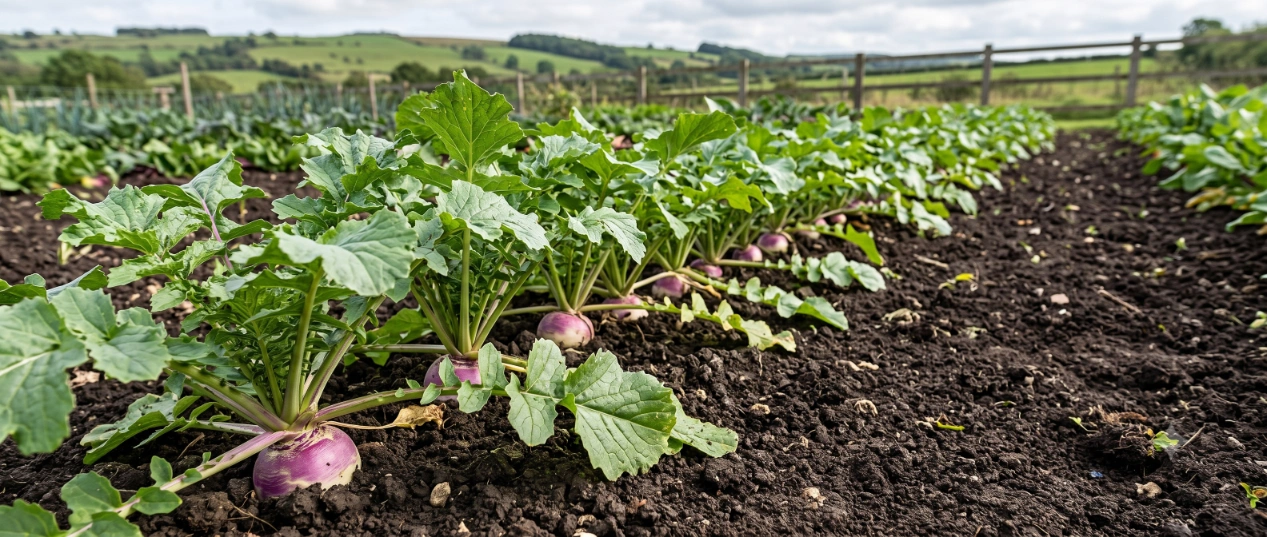
Turnip is the quick crop of this group -- ready in 6-8 weeks rather than the full season swede, parsnip or beetroot need, and meant to be sown repeatedly through the growing season instead of once. It's also botanically distinct from swede despite looking related: turnip is Brassica rapa, swede is Brassica napus, and the two don't cross. Its real strength for self-sufficiency is filling gaps between slower crops, not calorie density on its own.
Water need
Turnip is even more sensitive to inconsistent watering than swede -- dry spells followed by heavy watering split the roots and trigger bolting.
Calories at a glance
280 kcal/kg -- the lowest of the root vegetables covered so far (scale is log-based across all 55 crops in the calculator).
Temperature Range by Month
Month on the bottom, temperature up the side. The pale green background is what the plant can survive at all -- fatal above or below it, labelled directly on the chart where that applies to your zone. The coral band is its ideal range, and only fades in during the months this zone would actually have the crop in the ground -- reusing the exact same sowing/harvesting data as the calendar further down the page. The blue line is real monthly climate data (not a modelled estimate) for a representative rural/agricultural location in this zone -- a small farming town or agricultural research station rather than a major city, to avoid the warmer bias city weather stations have. For the actual verdict on how well this crop does in your zone, see the badge at the top of the page -- that's based on the site's own researched yield figures, not this chart.
Quick Start: Sowing to Harvest
- Sow direct, and sow again soon after. Turnip doesn't transplant well -- sow direct, thinly, and repeat every 2-3 weeks through your zone's sowing window to keep a continuous harvest coming rather than one glut.
- Thin early. Thin to around 10-15cm apart as soon as seedlings are large enough to handle -- crowded turnips stay small and are more prone to bolting.
- Keep the soil consistently moist. Turnip is even more sensitive to inconsistent watering than swede -- dry spells followed by heavy watering split the roots and encourage bolting.
- Harvest young. Pull roots at golf-ball to tennis-ball size for the best flavour and texture -- turnips left too long, especially in warm weather, turn woody and strongly flavoured.
- Leave a late batch standing in mild zones. A final sowing can be left in the ground and pulled as needed into winter in mild zones, the same living-larder approach as swede -- colder zones should lift before the ground freezes.
Sowing & Harvesting Calendar
Pick your zone under "Temperature Range by Month" above and this updates too. The Sow row: green is the normal safe sowing window, amber is pushing the season by roughly a month either side, blue is an even earlier under-glass start. Unlike the slower root crops on this site, turnip's window is wide enough to sow multiple batches within it. The Harvest row has two shades: solid green is the main harvest window, while the striped tail reflects the living-larder option covered in Storage & Preservation below -- realistic only in your zone's milder winters.
Calories & Yield
Turnip is the lowest calorie density root crop covered so far at about 280 kcal per kg. Subtropical and Mediterranean zones give the best yields here, but the real advantage is speed -- multiple sowings per season add up.
| Climate Zone | Yield per plant | Calories per plant | Viability |
|---|---|---|---|
| Tropical / Humid | 0.2 kg | 56 kcal | Viable |
| Subtropical | 0.3 kg | 84 kcal | Viable -- best yield |
| Mediterranean | 0.3 kg | 84 kcal | Viable -- best yield |
| Temperate Maritime | 0.25 kg | 70 kcal | Viable |
| Temperate Continental | 0.25 kg | 70 kcal | Viable |
| Cool / Boreal | 0.2 kg | 56 kcal | Viable |
| Arid / Semi-Arid | -- | -- | Not viable |
| Highland / Alpine | 0.2 kg | 56 kcal | Viable |
Figures per plant sown, from the site's own crop database.
Varieties Worth Knowing
Turnip varieties split roughly into fast salad types eaten young and slower, sweeter storage types -- so the right one depends on whether you're after a quick crop or a winter keeper. All the varieties below are open-pollinated (OP), meaning seed saved from them breeds true and is worth keeping under this site's seed-saving approach; none are F1 hybrids.
Seed Saving -- Quick Guide
Turnip crosses freely with Chinese cabbage, pak choi and mizuna -- all the same species (Brassica rapa) -- but not with cabbage, kale or broccoli, which are a different species entirely.
SERVINGS, NOT DAILY CALORIES This works out plate-sized servings of turnip from your seed during its fresh harvest window only, not your group's full daily calorie needs. For that, use the main calculator.
BIENNIAL Turnip is a biennial, not an annual -- despite maturing fast, it doesn't produce seed in its first year. Roots grow in year one, a few overwintered roots flower and set seed in year two, and that seed is only ready to sow in year three. If you're starting from scratch with no ongoing seed supply, that means having enough seed on hand for both year one's and year two's sowing up front. Plan for roughly double the seed quantity below if that's your situation.
Estimated for your selected zone above, using this site's own germination, loss and yield figures for turnip -- a helping is roughly what you'd put on a plate as part of a meal with other veg. Treat it as a planning estimate, not a promise.
Storage & Preservation
The site's own crop data calls turnip a living larder in mild zones -- a late-season sowing can simply be left in the ground and pulled as needed right through winter, the same as swede.
In colder zones where the ground freezes solid, lift before that happens, twist off the tops, and layer the unwashed roots in slightly damp sand in a cool shed or cellar, where they'll keep for a few months -- turnip doesn't store quite as long as the denser roots on this site, so use it up first.
Growing Turnip Without Bought Inputs
Turnip shares the same pest pressure as this site's other brassicas -- flea beetle riddling young leaves with small holes, and cabbage root fly attacking at the base of the stem.
Fine mesh or fleece from sowing onward is the single most effective input-free defence against both -- it physically excludes the adult insects before they can lay eggs, and matters even more here since flea beetle damage on fast-growing young turnip seedlings can be severe enough to stop them establishing at all.
Crop rotation reduces clubroot and other soil-borne brassica problems building up -- avoid growing turnip or any other brassica in the same spot two years running, and keep in mind how many successive sowings of turnip alone that spot has already had this season.
Frequently Asked Questions
Why does turnip get sown several times a season instead of once?
Because it's fast -- turnip is ready in just 6-8 weeks, far quicker than swede, parsnip or beetroot. Sowing a fresh batch every few weeks through the growing season keeps a continuous supply coming rather than one big harvest all at once.
Does turnip cross-pollinate with swede or the other brassicas on this site?
No. Turnip (Brassica rapa) is a different species from swede (Brassica napus) and from the kale/cabbage/broccoli/cauliflower/Brussels sprouts/kohlrabi group (Brassica oleracea). None of them cross with each other under normal garden conditions.
What does turnip actually need isolating from, then?
Other Brassica rapa crops -- Chinese cabbage, bok choy, mustard spinach and any other turnip variety flowering nearby. None of those are grown elsewhere on this site, so most home gardeners only need to isolate different turnip varieties from each other.
How cold and hot can turnip survive?
Roughly -4°C to 24°C (25°F to 75°F) for good root quality, with light frost improving flavour. Above 24°C, roots turn woody and strong-flavoured and the plant is prone to bolting, so turnip is best treated as a cool-season crop even more strictly than swede.
Is turnip a good calorie crop for self-sufficiency?
Modest -- around 280 kcal per kg, the lowest of the root vegetables covered on this site so far. Its real value for self-sufficiency is speed and succession cropping, filling gaps between slower-growing staples, not calorie density on its own.
Do I need pesticides to grow turnip?
No. Turnip shares the same flea beetle and cabbage root fly pressure as this site's other brassicas, and the same input-free defences apply -- fine mesh or fleece from sowing, and crop rotation to avoid a soil-borne pest build-up.