
This calendar is compressed into a genuinely short, frost-bounded window rather than spread across a long conventional year. The table below shows one practical cycle across a small number of beds; adapt bed numbers to whatever terraced or sheltered space you're actually working with.
A Rotation Compressed Into a Short Season
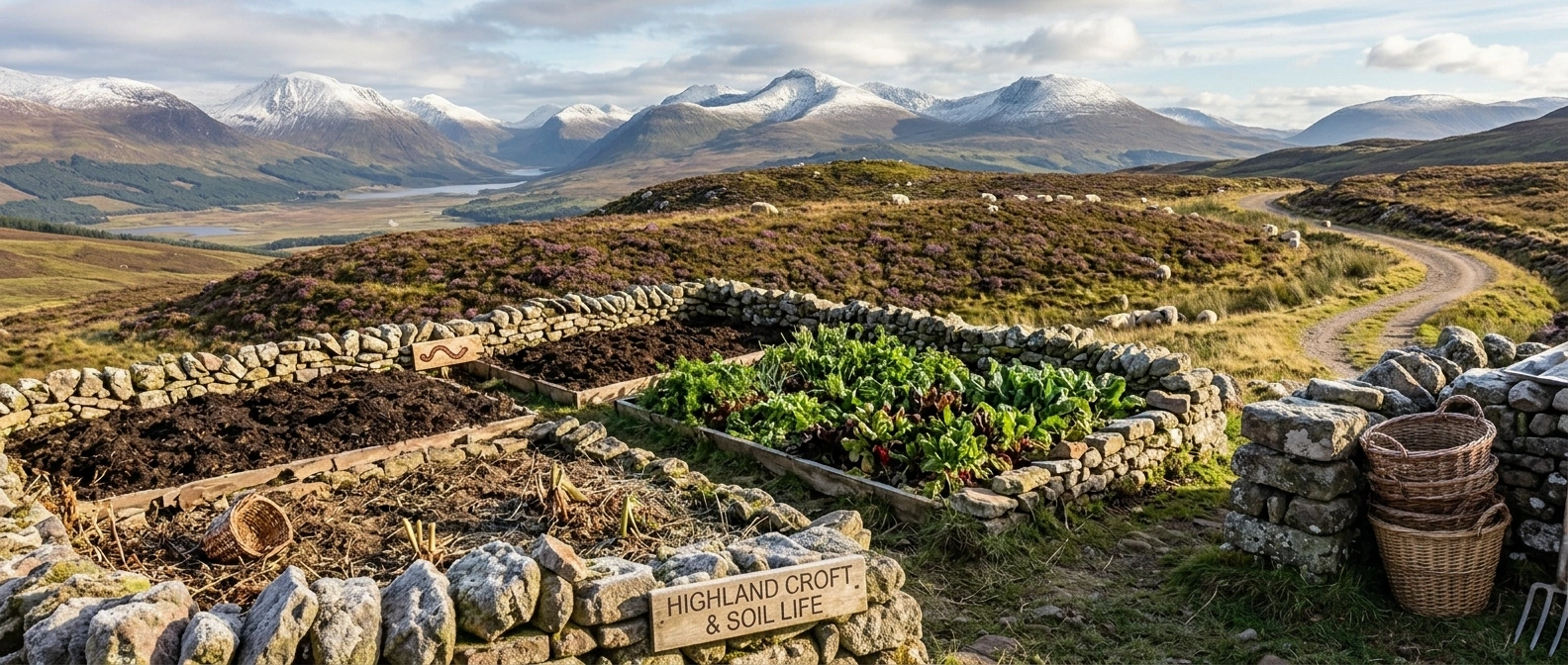
Every stage here happens faster and closer together than in a longer-season climate, and the off-season is treated as active compost-building time rather than dead time.
| Bed / Stage | Timing | Compost Action |
|---|---|---|
| Bed A -- Early-season planting | As soon as the ground is workable after thaw | Apply finished compost right away; fast-maturing, cold-hardy varieties |
| Bed B -- Brief peak growth | The short, genuine warm stretch of the season | Liquid feed at midday (see Chapter 16); mulch to buffer freeze-thaw |
| Bed C -- Early harvest | Ahead of the first hard frost, which can arrive early | Clear promptly; top-dress and mulch heavily before closing down |
| Bed D -- Long off-season | Through the bulk of the year, well beyond the growing window | No garden activity expected; build and protect next season's compost |
Green Manures: Genuinely Limited Here
Only a few genuinely cold-hardy, fast-enough green manure options actually fit inside a window this short (see Chapter 12). Where one fits, it's worth using, but this rotation doesn't lean on green manures the way a longer-season climate's calendar can.
The Off-Season Is Compost-Building Season
Rather than expecting garden activity to continue through the long off-season, treat that time as when the next batch of compost gets built and protected, in line with the seasonal management approach in Chapter 13, ready to apply the moment the ground is workable again.
Frequently Asked Questions
Why is this rotation so compressed compared to other climates?
Because the growing window here is genuinely short and frost-bounded, cut off from both ends regardless of daylight hours. The rotation compresses planting, growth and harvest into whatever weeks are actually workable, and treats the long off-season as time to build and protect the next batch of compost rather than expecting garden activity to continue.
When should compost go onto the beds in this rotation?
Right at the start of the short season, as soon as the ground is workable, so it has the maximum time to benefit the crop before frost closes things down again. There's little time to spare, so compost should be ready and waiting rather than being finished after the season has already begun.
What crop varieties actually fit inside a growing window this short?
Fast-maturing, cold-tolerant varieties bred or selected specifically for a short season, rather than varieties that assume a long, mild summer. Matching variety choice to the season is as important here as the compost itself.