
The biology of composting doesn't change with climate: microbes need carbon for energy and nitrogen for growth, and the target ratio is the same everywhere, roughly 25-30 parts carbon to 1 part nitrogen by weight. What changes completely in an arid or semi-arid climate is which half of that equation is easy and which is hard.
Carbon Is Abundant, Nitrogen Is Precious
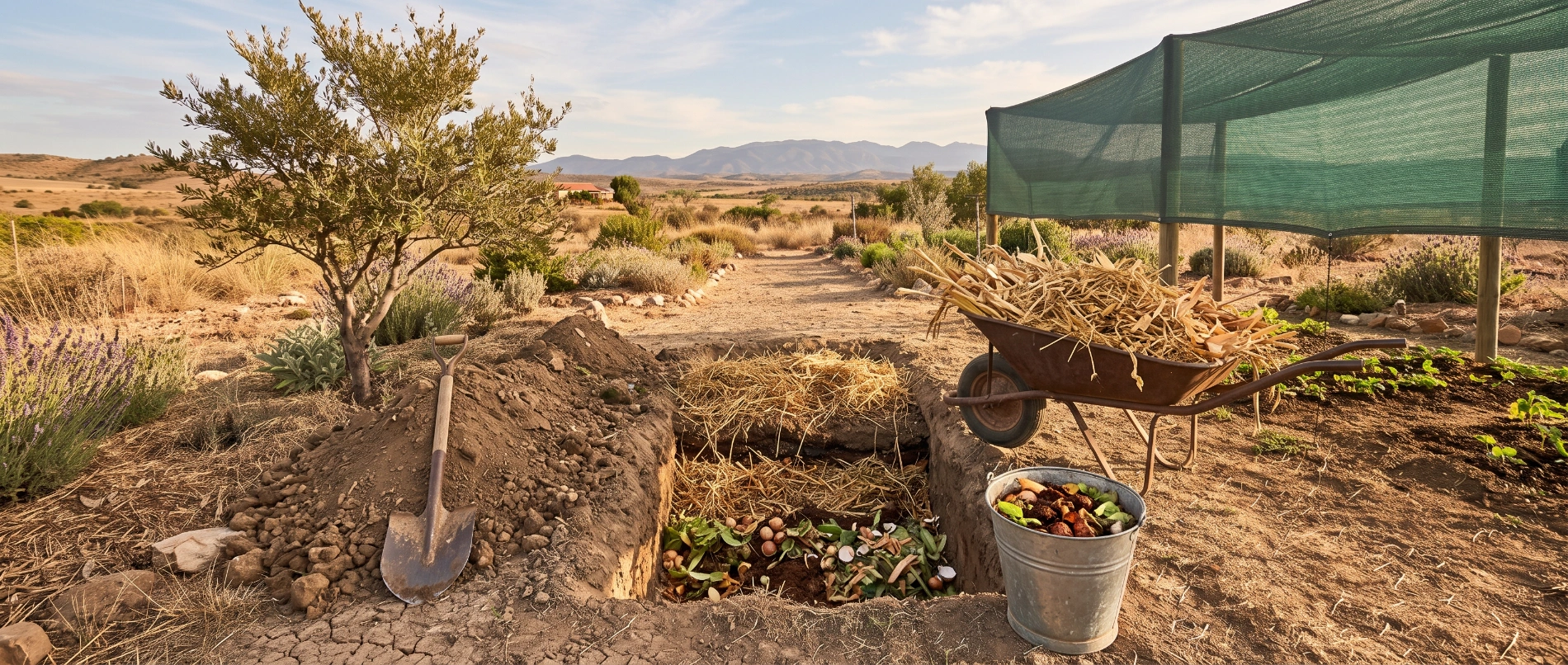
Dryland vegetation is naturally carbon-heavy. Dead crop stalks, straw, dry grass, woody prunings and cardboard are all easy to come by in quantity, and none of it costs much effort to gather. That's the easy half of the ratio solved almost by default.
Nitrogen is the hard half. There's rarely a lush flush of fresh green growth here the way there is in a wetter climate, so the moist, nitrogen-rich material that balances all that dry carbon is genuinely scarce for most of the year. That makes manure (see Chapter 6), fresh kitchen scraps, and any weeds pulled while still green into resources worth protecting and using deliberately, not just occasional additions.
A heap built mostly on dry carbon, with only a token amount of nitrogen mixed in, will decompose extremely slowly no matter how much heat or moisture it gets, because the microbial population doing the work simply can't grow fast enough without protein-building material to feed on.
Carbon vs Nitrogen at a Glance
A representative spread of materials genuinely available in a dry climate, from the most carbon-heavy to the most nitrogen-heavy. The full input list, with practical notes on using each one, is in the next chapter.
| Material | Type | Approx C:N Ratio | Notes |
|---|---|---|---|
| Cardboard (plain) | C | ~400:1 | Shred or soak first to speed breakdown |
| Dry crop stalks | C | ~100:1 | Chop or crush for faster decomposition |
| Straw | C | ~80:1 | Abundant, easy, the default brown here |
| Woody prunings | C | ~100-500:1 | Very slow alone; shred and mix thin |
| Dry leaves / brush | C | ~60:1 | Good bulk carbon where available |
| Legume green manure trimmings | N | ~15:1 | A rare fresh-green nitrogen source (see Chapter 12) |
| Kitchen scraps | N | ~15:1 | Precious here -- don't waste any of it |
| Fresh-pulled weeds | N | ~15:1 | Pull before seed set; a genuine nitrogen source |
| Fresh manure | N | ~15-20:1 | The backbone nitrogen source in most dryland systems |
| Urine (diluted) | N | ~1:1 | A concentrated, always-available activator |
Ratios are approximate -- real material varies with freshness, moisture content and exact species. Treat them as a guide to relative balance, not a figure to measure precisely.
Working By Volume, Not Weight
You don't need to weigh anything to get this right in practice. Dry carbon material is typically bulkier and lighter than nitrogen-rich material, so working by volume naturally lands close to the target ratio: roughly two buckets or barrowloads of dry carbon (stalks, straw, brush) to every one bucket of nitrogen-rich material (manure, kitchen scraps, fresh-pulled weeds).
The practical challenge here is rarely getting that ratio precisely right, it's actually having a full bucket of nitrogen-rich material to work with. Since carbon is already abundant, err on the side of adding more nitrogen than the 2:1 rule suggests if you're unsure, rather than less -- an all-carbon heap that stalls (see below) is a far more common failure here than an over-green one.
Troubleshooting: The All-Carbon Heap
The most common failure in this climate isn't a slimy, over-wet heap, it's the opposite: a heap that's dry, straw-coloured throughout, and barely breaking down at all months after it was built. This is almost always an all-carbon heap, built from stalks, straw or brush with too little nitrogen mixed in from the start.
Piling on more dry material never fixes this, since it only makes the imbalance worse. The actual fix is to go looking for nitrogen deliberately: work in manure, add diluted urine, save every scrap of kitchen waste for this heap rather than another, or pull a bucket of fresh green weeds to dig in. Treat the search for nitrogen as an active, ongoing task in this climate, not something that happens on its own.
Frequently Asked Questions
What's the ideal carbon-to-nitrogen ratio in a dry climate?
The target is the same as anywhere else, roughly 25-30 parts carbon to 1 part nitrogen by weight. What's different here is how hard that ratio is to reach in practice, because carbon-rich dry material like crop stalks, straw and woody prunings is genuinely abundant, while nitrogen-rich material is scarce for most of the year. The ratio itself hasn't changed, but getting there means actively seeking out nitrogen rather than assuming it will turn up.
Why won't my heap decompose even though it's full of material?
The most common failure mode in this climate is a heap that's almost entirely carbon, built from dry stalks, straw or brush with little or no nitrogen mixed in. Carbon without enough nitrogen leaves the microbial population starved of the protein-building blocks it needs to grow, so decomposition crawls along or stalls completely regardless of how much dry material you pile on. Adding more carbon makes this worse, not better -- the fix is deliberately seeking out nitrogen instead, such as manure, urine or fresh kitchen scraps.
Why is nitrogen-rich material so much harder to find here than carbon?
Nitrogen-rich "green" material is generally fresh, moist plant growth, and dryland climates simply produce far less of it than wetter ones, especially outside a short growing season. Carbon-rich material, by contrast, is what a dry landscape naturally produces in abundance: dead stalks, dry grass, straw and woody prunings. That's why manure and any fresh scraps or weeds become precious, hard-won resources here rather than something to take for granted.
Do I need to weigh my compost inputs to get the ratio right?
No -- working by volume rather than weight is accurate enough in practice, because dry carbon material is typically bulkier and lighter than nitrogen-rich material. The rule of thumb is roughly two buckets or barrowloads of dry carbon material to every one bucket of manure, scraps or fresh-pulled weeds. In this climate the practical task isn't measuring that ratio precisely, it's making sure you actually have a full bucket of nitrogen-rich material to work with in the first place, since that's the half that's genuinely hard to come by.