
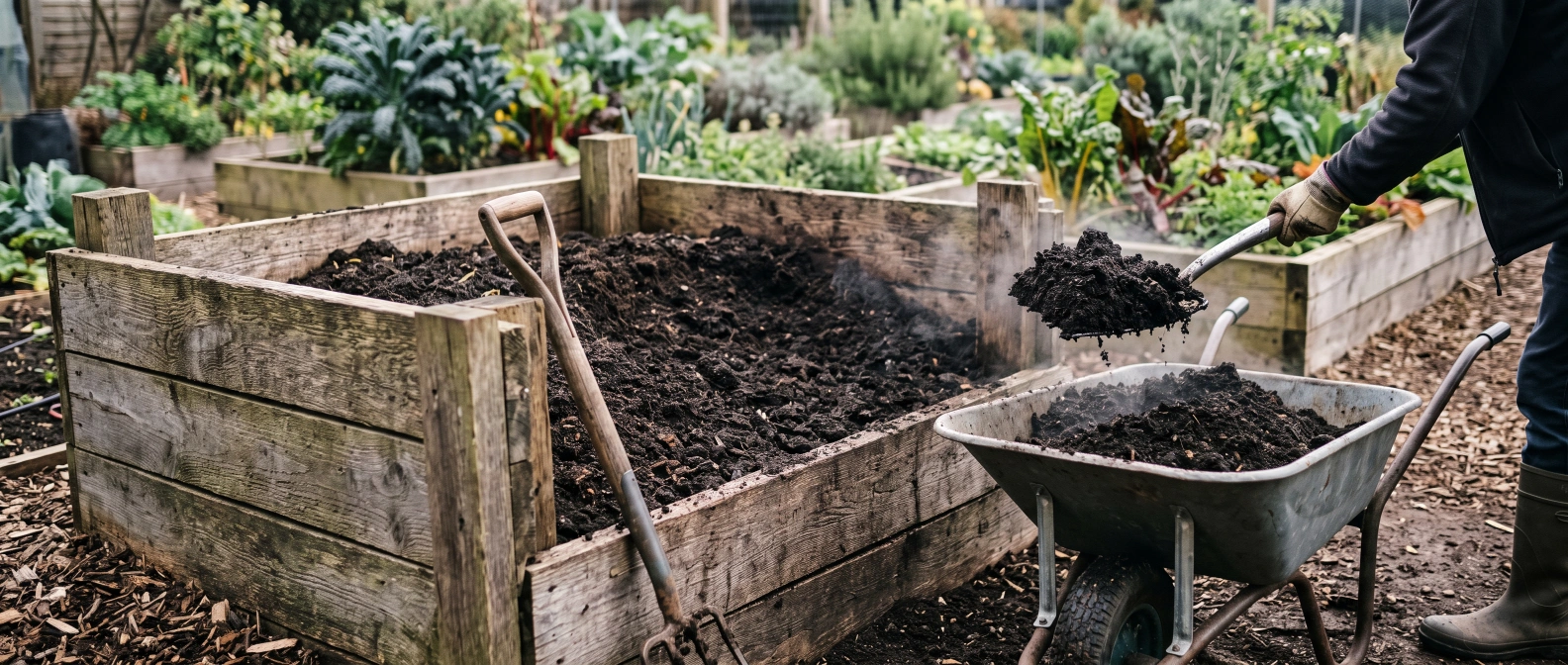
Growing food year after year takes fertility out of the soil, and compost is how you put it back. This calculator works out how much finished compost your growing area needs each year, how much your own kitchen scraps, garden waste and manure will actually make, and how big a bin you need to make it. Most households are surprised by the gap, so it is far better to find out now than in the middle of the season. As a starting example, a household of two with average soil, 30 barrow loads of garden waste a year and 100 m² of vegetable beds (compost on the rows only, in a temperate maritime climate) needs about 875 litres of compost a year and can make about 1,050 litres, so it is covered. Change any figure below to see your own result.
Your garden and household
Your compost plan
My compost plan
What to do about it
How much compost per square metre?
Vegetable beds need compost every year because each crop takes nutrients out of the soil. The amount depends mostly on how good your soil already is. One centimetre of compost over one square metre is 10 litres, so these are the yearly amounts to spread over beds that are being fed:
| Soil quality | Depth a year | Per m² | Per 10 m² | Barrow loads per 10 m² |
|---|---|---|---|---|
| Good: dark, crumbly, plenty of worms | 1 cm (0.4 in) | 10 litres | 100 litres | about 1 |
| Average: workable but not special | 2.5 cm (1 in) | 25 litres | 250 litres | about 3 |
| Poor: pale, sandy, heavy clay or compacted | 5 cm (2 in) | 50 litres | 500 litres | about 6 |
A barrow load here is 80 litres. For a rough conversion in US units, 1 inch of compost over a square foot is about 0.6 US gallons.
Worked examples
These use average soil. "Rows only" means compost goes on the planting rows and strips, about half the area, which is how most people actually apply it.
| Growing area | Spread over the whole area | Rows only |
|---|---|---|
| A 4 m × 10 m vegetable plot (40 m²) | 1,000 litres (1 m³), about 12.5 barrow loads | 500 litres, about 6 barrow loads |
| A 100 m² garden (a large family plot) | 2,500 litres, about 31 barrow loads | 1,250 litres, about 16 barrow loads |
| A 250 m² allotment | 6,250 litres, about 78 barrow loads | 3,125 litres, about 39 barrow loads |
For other sizes see the example pages for 10, 25, 50, 100, 250 and 500 square metres below, or enter your own area in the calculator.
How much compost can a household make?
Composting shrinks material to roughly a third of its starting volume. A person produces about 300 litres a year of kitchen scraps plus the cardboard needed to balance them, which makes about 105 litres of finished compost. That is less than most gardeners expect:
| People in the household | Raw scraps a year | Finished compost a year | Feeds, whole area (average soil) | Feeds, rows only |
|---|---|---|---|---|
| 1 | 300 litres | about 105 litres | about 4 m² | about 8 m² |
| 2 | 600 litres | about 210 litres | about 8 m² | about 17 m² |
| 4 | 1,200 litres | about 420 litres | about 17 m² | about 34 m² |
| 6 | 1,800 litres | about 630 litres | about 25 m² | about 50 m² |
Every 10 barrow loads of garden waste, leaves, grass clippings or manure you add makes about 280 litres more. That is why most households that want to grow a meaningful share of their food need to bring in extra material.
How this is worked out
These are rule-of-thumb figures for home gardens. Real results vary with your materials, how well you manage the heap, and your soil, so treat the answer as a planning estimate rather than a precise figure.
| Figure | Value used | Why |
|---|---|---|
| Land per person (when worked out from people) | 870 to 1,780 m² for a whole diet, depending on zone | The same figure the seed calculator and the printable guides use for one adult growing all their calories. It is then multiplied by the share of food you want to grow. |
| Compost to apply | Good soil 0.4 in (1 cm), average 1 in (2.5 cm), poor 2 in (5 cm), each a year, on the area that gets compost | Maintenance rates for vegetable growing, well below the heavy layers sometimes quoted for small beds. Only about half the area is treated by default (rows, not paths), and grain and bean ground gets a quarter of the depth. |
| Rotation and green manures | None, about 20% less, or about 35% less compost | A rule of thumb, not a measured figure. Legume green manures and rotations that rest part of the ground feed the soil another way, so less compost is needed on the ground you crop. The real saving depends on what is sown and for how long. |
| Litres per square metre | 10 litres for every cm of depth | 1 cm of compost over 1 m² is 10 litres, so 5 cm is 50 litres per m². |
| Kitchen scraps and cardboard | About 300 litres of raw material per person a year | Typical household kitchen waste plus enough cardboard and paper to balance it. |
| Humanure and cover material | About 600 litres of raw material per person a year | Roughly 1.5 litres a day of waste plus sawdust or similar cover material. This is a rough estimate, and it varies a lot with how much cover material is used. |
| Seaweed | Counted as a barrow load of raw material like any other | It is mostly water, so it adds less finished compost than dry material does. Treat that part of the result as optimistic. |
| Wheelbarrow load | 80 litres | A heaped garden barrow of loose material. |
| Finished compost from raw material | 35% of the starting volume | Heaps usually shrink to between a quarter and a half of their starting volume as they break down. |
| Range shown | 25% to 50% of the starting volume | How much a heap shrinks depends on the materials, the moisture and how often it is turned, so the figures show a typical value and the range either side of it. |
| Green and brown balance | One part green to two parts brown, by volume | A common rule of thumb for a healthy heap. Greens are scraps, clippings and manure; browns are dry leaves, cardboard and straw. |
| Weight of finished compost | About 600 kg per cubic metre | Finished compost is damp and dense, between roughly 500 and 700 kg per cubic metre. |
| Batches a year | 1 (cold zones) to 4 (tropical) | A hot, well-managed heap can finish in a few months where it is warm, but only once or twice a year where winters stop it. |
| Smallest bin | 1 cubic metre (about 35 cubic feet) | Heaps smaller than this struggle to build and hold heat. |
Frequently Asked Questions
How much compost does a vegetable garden need each year?
A sensible maintenance rate for vegetable beds is a layer of finished compost 1 to 2.5 cm (0.4 to 1 inch) deep once a year, which is 10 to 25 litres per square metre. Poor, new or exhausted soil can take 5 cm (2 inches, 50 litres per square metre) while it is being built up. Because most of this goes on the rows and not the paths, the real amount for a whole garden is usually about half of the full-area figure.
Why do I make so much less compost than I expected?
Composting shrinks material a lot. Finished compost is typically only a quarter to half of the volume of the raw material you started with, because water and carbon are lost as the heap breaks down. A household's kitchen scraps alone usually make only a few wheelbarrow loads of compost a year, which is why most gardeners need extra sources such as garden waste, leaves, manure or green manures.
Can I use less compost than the calculator suggests?
Yes. Putting compost only where crops are growing, in planting holes, trenches or rows rather than across the whole bed, cuts the amount needed by half or more. Heavy feeders such as squash, brassicas and potatoes get the most, while beans and peas, which fix their own nitrogen, can get little or none.
How many barrow loads is a cubic metre of compost?
A cubic metre is 1,000 litres. A heaped garden wheelbarrow holds about 80 litres of loose material, so a cubic metre is roughly 12 barrow loads. Builders' barrows and large garden trugs vary from about 60 to 100 litres, so check the size of yours.
How much compost do I need per square metre?
Between 10 and 50 litres per square metre a year, which is a layer 1 to 5 cm deep. Healthy beds need about 10 to 25 litres, tired or new beds about 50. A 10 square metre bed with average soil needs about 250 litres, or three barrow loads, if you spread it over the whole bed.
How big should my compost bin be?
For hot composting, aim for at least one cubic metre (about 35 cubic feet), because smaller heaps struggle to hold heat. Beyond that, size the bin to the raw material you collect between batches. The calculator above works this out for your climate zone from the scraps, garden waste and manure you enter.
How long does compost take to make?
A well-built hot heap can finish in two to three months in warm weather. Cold or lightly managed heaps take six to twelve months, and in cool or high-altitude climates a heap may need until the following year. Your climate zone guide gives timings for where you live.
Is it safe to use humanure compost on vegetables?
Only when it has been composted carefully and aged for a long time. Most guidance is a hot heap followed by at least a year of ageing, and many sources recommend two years before it is used on food crops. It is safest used on fruit trees and ornamentals, or on crops that are cooked before eating. Check your local rules first.
Can I compost seaweed for the garden?
Yes. Seaweed breaks down quickly and is rich in potash and trace minerals. It can be mixed into a heap with drier material or used as a mulch. Check the local rules on collecting it, and remember that it is mostly water, so it adds less finished compost than dry material.
Compost needed for common garden sizes
Each page works out the compost, barrow loads and raw material for one growing area, for each soil quality and way of applying it.
- How much compost for 10 square metres (a few raised beds)
- How much compost for 25 square metres (a small vegetable patch)
- How much compost for 50 square metres (a good-sized garden plot)
- How much compost for 100 square metres (a large family plot)
- How much compost for 250 square metres (a full allotment)
- How much compost for 500 square metres (a small market garden)
Related guides
- The complete compost guide, with a 19-chapter guide for each climate
- Composting in your climate: tropical, subtropical, Mediterranean, temperate maritime, temperate continental, cool and boreal, arid and highland and alpine
- How to make compost without buying anything
- Building healthy soil without fertiliser
- Growing My Own Food: free printable guides
- Work out how much land your household needs to grow its food