
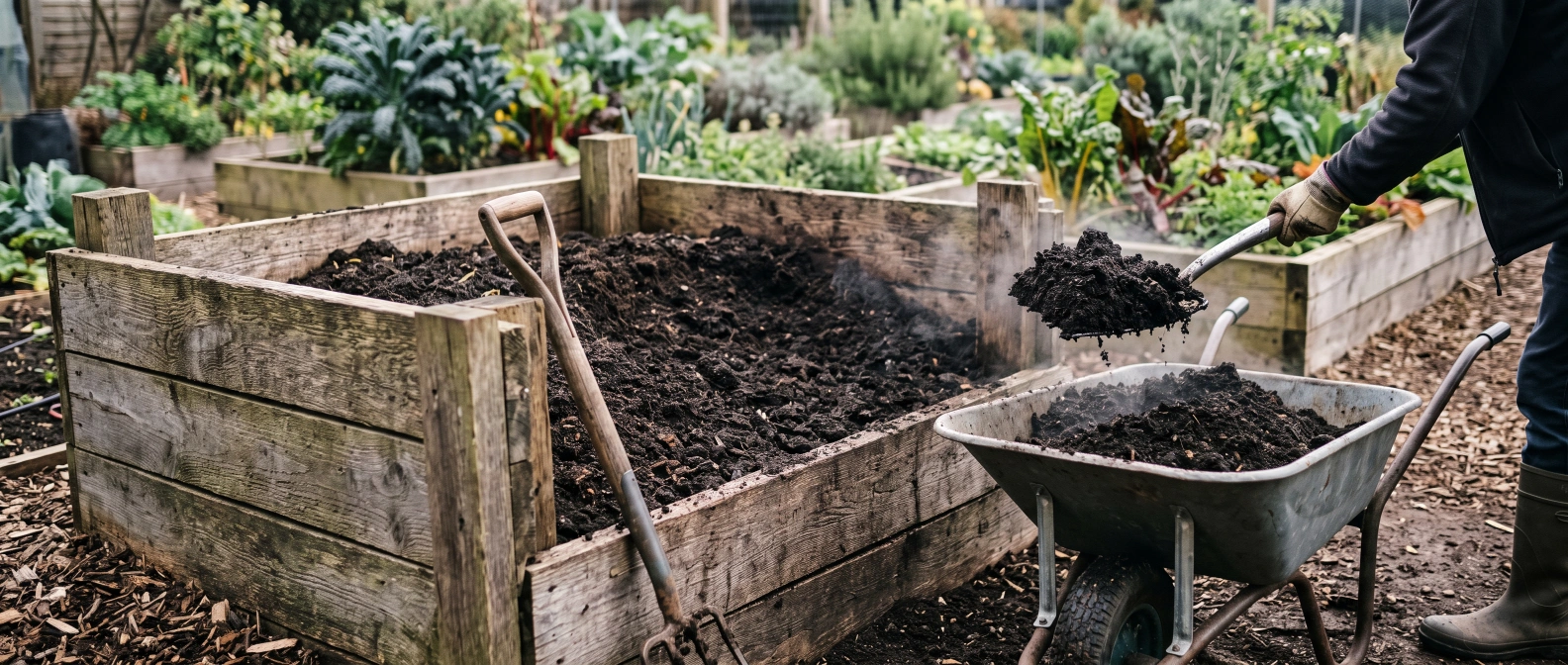
For 10 square metres (about 108 square feet) of vegetable beds with average soil you need about 125 litres of finished compost a year if you put it on the planting rows, or 250 litres if you spread it over the whole area. That is the size of two or three raised beds, so the compost a single household produces from scraps and garden waste can often cover it.
Compost needed for 10 m² a year
The amount depends on your soil and on where the compost goes. One centimetre of compost over one square metre is 10 litres, and a barrow load is 80 litres.
| Soil quality | Whole area | Rows only (half) | Planting holes only (quarter) |
|---|---|---|---|
| Good soil1 cm a year | 100 litresabout 1 barrow loads | 50 litresabout 1 barrow loads | 25 litresabout 0 barrow loads |
| Average soil2.5 cm a year | 250 litresabout 3 barrow loads | 125 litresabout 2 barrow loads | 63 litresabout 1 barrow loads |
| Poor soil5 cm a year | 500 litresabout 6 barrow loads | 250 litresabout 3 barrow loads | 125 litresabout 2 barrow loads |
These are maintenance rates for vegetable growing. Beans, peas and grain need much less than squash, brassicas and potatoes, so a plot with plenty of grain and beans needs less than the table shows.
What that means in raw material
Finished compost is only about a third of the material you start with. To make 125 litres (average soil, rows only) you need to compost roughly 357 litres of raw kitchen scraps, garden waste, leaves and manure over a year. That is about 0.1 barrow loads a week.
A person's kitchen scraps make only about 105 litres of compost a year, so the scraps alone from about 1 person would be needed to cover this. Most households make up the difference with garden waste, leaves, straw, manure from neighbours and, near the coast, seaweed.
A tip for 10 m² growers
Top raised beds up each spring with a 2.5 cm layer and fork nothing in: the worms will take it down. One compost bin of about one cubic metre is plenty for this area, and a tidy two-bay pair lets one rest while the other fills.