
Siting and building here has a genuinely dual priority that a single-extreme climate never faces: the same system, in the same spot, has to survive real summer heat and a real hard winter freeze within one calendar year. A site or a build chosen only with one season in mind will fail badly at the other end of the year, so both extremes need weighing together from the start.
Choosing a Site
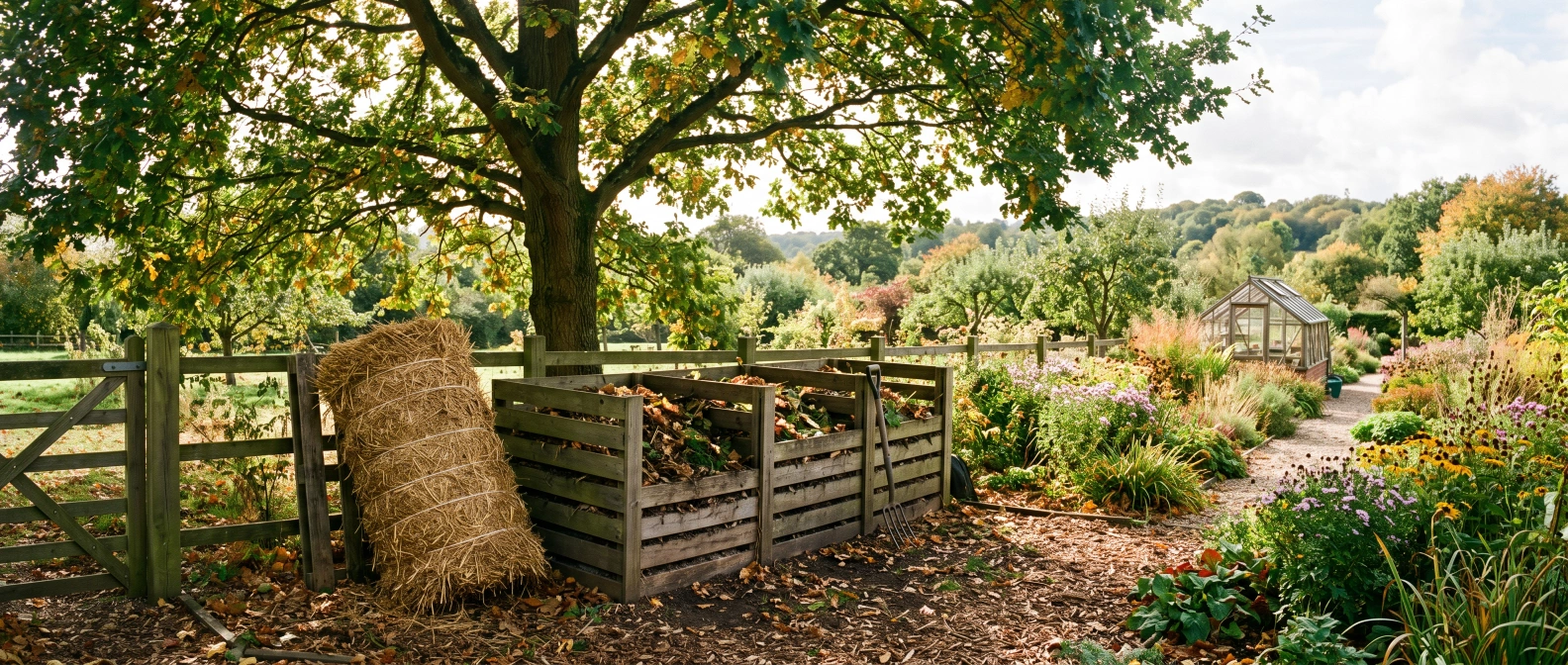
Some summer shade, but not year-round shade
A site under or beside a deciduous tree, or against the shaded north side of a building, genuinely helps in high summer, cutting the risk of a heap drying and overheating in continental heat that can regularly exceed 30°C. The advantage of a deciduous tree specifically is that it sheds its leaves for winter, so the same spot that shades the heap in July opens up to whatever low winter sun is available once the canopy is bare, giving a small but real thermal boost exactly when it's needed most.
Real wind shelter for winter
A hard winter wind strips heat from an exposed heap far faster than still cold air alone, a genuine concern here even if less extreme than a true boreal winter. Siting against a fence, hedge or wall on the prevailing winter wind side, or building a windbreak if nothing natural is available, measurably slows that heat loss and helps whatever residual warmth a heap holds last longer into the cold months.
Drainage that copes with both extremes
A site needs to shed sudden summer thunderstorm downpours without waterlogging, and also cope with spring meltwater once a frozen heap starts to thaw. A gently sloping, well-drained spot handles both situations far better than a low point that collects water at either end of the year.
Building for Both Extremes
- Solid timber or block construction that won't degrade under either summer heat or repeated winter freeze-thaw cycling. Cheap, thin materials that seemed fine in a mild climate often fail faster here, where the same joint or panel is stressed by two genuine extremes every year rather than one mild one.
- A removable or adjustable cover, more open and ventilated through summer to let excess heat and moisture escape, and closed down or supplemented with extra insulation through winter to hold in what warmth the heap can generate.
- An add-on winter jacket, a wrap of straw bales, bagged leaves or similar loose insulating material stacked around the bin's sides once the hard freeze sets in, then removed again in spring. This is distinct from the specific two-chamber design covered in the next chapter, it's a basic seasonal addition any single bin can use.
- A reasonably sized heap, roughly a cubic metre as a practical minimum, similar to the size recommended in other cooler climates. Enough mass to carry its own thermal buffer against both a hard freeze and drying summer heat.
Frequently Asked Questions
Should a compost heap here be sited in sun or shade?
Genuinely, a bit of both, which is what makes siting here different from a single-extreme climate. Some summer shade, from a deciduous tree or the north side of a building, helps stop a heap drying out and overheating in genuine continental summer heat, sometimes well above 30°C. But the same site should still get worthwhile winter sun, since once the tree's leaves drop in autumn that same spot opens up to whatever low winter sun is available, giving the heap a small but real thermal advantage through the cold months.
Does wind shelter actually matter for a compost heap in this climate?
Yes, particularly through winter. A hard winter wind genuinely accelerates heat loss from an exposed heap, stripping away what little warmth a heap holds even faster than still cold air would. This is similar in principle to the wind-chill concern covered in the Boreal guide, though less extreme here since the winter itself is shorter. A fence, hedge or building on the prevailing winter wind side makes a genuine difference.
What size heap actually works in a temperate continental climate?
Roughly a cubic metre as a practical minimum, similar to the size recommended in other cooler climates. A heap this size carries enough of its own thermal mass to buffer against both extremes here, it holds heat better against a hard winter freeze and resists drying out as fast in summer heat than a smaller pile would manage at either end of the year.