
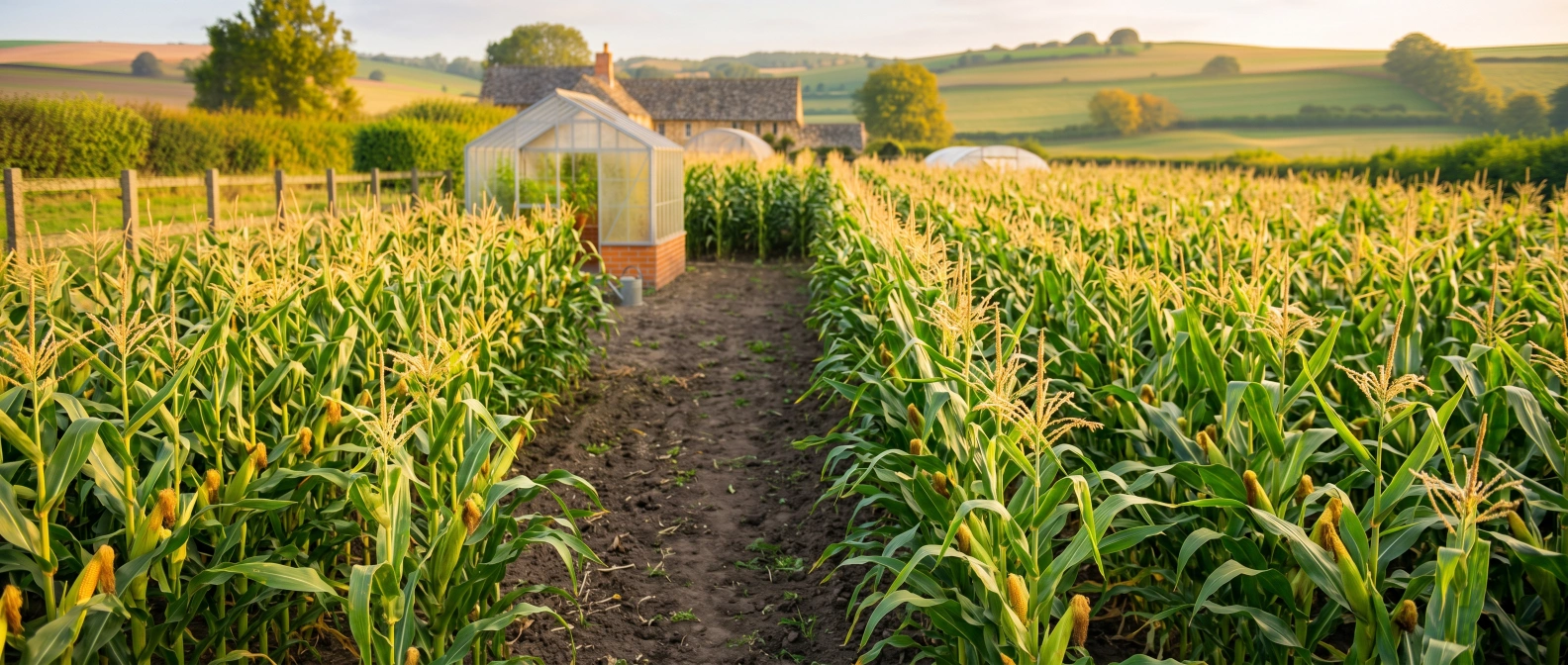
Maize is the outlier of this whole category -- genuinely wind-pollinated rather than self-pollinating like wheat, oats, barley and rice, and readily crossing with any other maize flowering nearby. The crop database's own instruction is blunt: it must be grown in a block, not a row, or it may not pollinate itself well at all. That same wind-pollination mechanism is exactly why real isolation matters here in a way it simply doesn't for this category's cereals.
Water need
Consistent moisture matters most around flowering -- stress at this stage directly reduces how well pollination succeeds.
Calories at a glance
3,650 kcal/kg -- one of the most calorie-dense crops on this entire site (scale is log-based across all 55 crops in the calculator).
Temperature Range by Month
Month on the bottom, temperature up the side. The pale green background is what the plant can survive at all -- fatal above or below it, labelled directly on the chart where that applies to your zone. The coral band is its ideal range, and only fades in during the months this zone would actually have the crop in the ground -- reusing the exact same sowing/harvesting data as the calendar further down the page. The blue line is real monthly climate data (not a modelled estimate) for a representative rural/agricultural location in this zone -- a small farming town or agricultural research station rather than a major city, to avoid the warmer bias city weather stations have. For the actual verdict on how well this crop does in your zone, see the badge at the top of the page -- that's based on the site's own researched yield figures, not this chart.
Quick Start: Sowing to Storage
- Choose flour corn varieties for staple grain. Select a flour corn variety specifically if the goal is a genuine staple grain rather than fresh sweetcorn eating -- flour types are bred and grown for exactly this.
- Sow direct once it's genuinely warm. Sow direct once the soil has reliably warmed in spring -- maize germinates poorly in cold soil.
- Plant in a block, not a single row. Arrange plants in a block of at least several rows rather than one long line -- this is what actually lets wind pollination fill out the cobs reliably.
- Keep watering even, especially around flowering. Consistent moisture matters most around the time the plant is flowering and setting cobs -- stress at this stage directly reduces how well pollination succeeds.
- Harvest once fully dry on the plant, and store dry. For flour corn, leave cobs on the plant until the kernels are hard and the husks have dried, then harvest, finish drying if needed, and store the dry grain in a cool, pest-proof container.
Sowing & Harvesting Calendar
Pick your zone under "Temperature Range by Month" above and this updates too. Notice Boreal and Alpine show no window at all -- this site's own yield data marks maize as not viable in either, needing more sustained warmth than those zones provide.
Calories & Yield
Maize is a genuine staple grain at about 3,650 kcal per kg. Subtropical zones give the best yield here, and it isn't viable at all in Boreal or Alpine.
| Climate Zone | Yield per plant | Calories per plant | Viability |
|---|---|---|---|
| Tropical / Humid | 0.35 kg | 1,277.5 kcal | Viable |
| Subtropical | 0.45 kg | 1,642.5 kcal | Viable -- best yield |
| Mediterranean | 0.35 kg | 1,277.5 kcal | Viable |
| Temperate Maritime | 0.15 kg | 328.5 kcal | Viable -- challenging (60% yield) |
| Temperate Continental | 0.30 kg | 1,095 kcal | Viable |
| Cool / Boreal | -- | -- | Not viable |
| Arid / Semi-Arid | 0.20 kg | 730 kcal | Viable |
| Highland / Alpine | -- | -- | Not viable |
Figures per plant sown, from the site's own crop database. Maritime's yield already reflects the 60% penalty the calculator applies where a zone is rated "challenging" rather than fully viable -- and remember maize genuinely needs a block, not a row, to pollinate reliably at all.
Varieties Worth Knowing
Flour and dent maize varieties (distinct from sweet corn, grown to dry down for grinding rather than eaten fresh) differ in kernel colour and hardness. All the varieties below are open-pollinated (OP), meaning seed saved from them breeds true and is worth keeping under this site's seed-saving approach; none are F1 hybrids.
Seed Saving -- Quick Guide
Corn is wind-pollinated and crosses freely with every other type -- sweet, pop, flour, flint, dent -- not just other maize varieties. It needs the largest isolation distances of any crop on this site, or hand-pollination in a small garden.
SERVINGS, NOT DAILY CALORIES This works out plate-sized servings of maize from your seed during its fresh harvest window only, not your group's full daily calorie needs. For that, use the main calculator.
Estimated for your selected zone above, using this site's own germination, loss and yield figures for maize -- a helping is roughly what you'd put on a plate as part of a meal with other veg. Treat it as a planning estimate, not a promise.
Storage & Preservation
For flour corn, the site's own crop data points to the classic route: leave cobs to dry fully on the plant, then harvest and store dry, shelling kernels off the cob when needed for grinding.
Kept cool, dry and pest-proof, dried maize kernels keep for a genuinely long time -- a real staple grain storage option, distinct from fresh sweetcorn's very short shelf life.
Growing Maize Without Bought Inputs
Corn earworm and birds are the main threats -- earworm larvae feed inside the developing cob, while birds can strip a stand of ripening cobs quickly if unprotected.
Netting over ripening cobs is a genuinely effective input-free defence against birds.
Companion planting with beans and squash (the traditional "Three Sisters" combination) is a classic input-free system for maize -- beans fix nitrogen the maize benefits from, and squash's sprawling leaves suppress weeds around the base of the block.
Frequently Asked Questions
Why must maize be grown in a block rather than a row?
Because maize is wind-pollinated, and a single long row lets most of the pollen simply blow past the plants it needs to reach rather than landing on nearby silks. A block planting puts far more plants close enough to catch each other's pollen, which is what actually fills out the cobs -- this isn't a yield tip, it's close to essential for a maize crop to pollinate itself at all.
Does maize cross-pollinate with wheat, oats or barley?
No -- maize is a completely different genus from all three, and wouldn't cross with them regardless of how it's pollinated. Its real cross-pollination risk is with other maize plants, including other varieties of maize grown nearby.
Why does maize need real isolation when the site's other grains mostly don't?
Because unlike wheat, oats, barley and rice, which self-pollinate before their flowers even open, maize's whole reproductive strategy depends on wind carrying pollen between plants. That's exactly what makes it so easy to cross-pollinate: any other maize variety flowering nearby, even a field away, can genuinely affect your harvest.
How cold and hot can maize survive?
Roughly 6°C to 35°C, with growth stalling well before either extreme -- chilling stress sets in below about 10-17°C, and pollen viability collapses above 35°C, which can wreck fertilisation even if the plant itself survives.
Is maize a good calorie crop for self-sufficiency?
Yes -- at around 3,650 kcal per kg it's one of the most calorie-dense crops on this entire site, and flour corn varieties specifically are grown for genuine staple grain rather than fresh sweetcorn eating.