
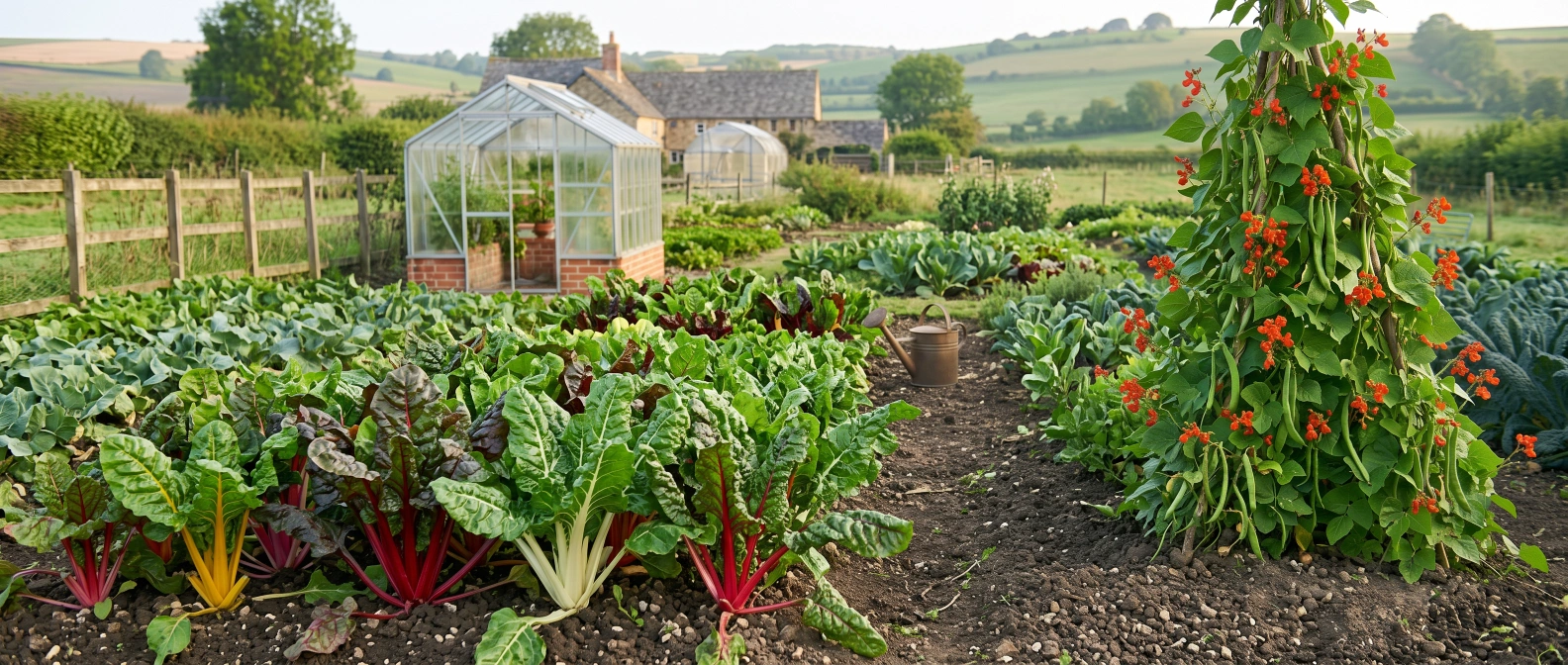
Chard is the same species as beetroot -- Beta vulgaris, just bred for its leaves and stems rather than its root -- and crosses with it freely, exactly the relationship the Beetroot page already describes from the other side. Its own real strength is stamina: a genuinely wide temperature tolerance and a cut-and-come-again habit mean a single sowing can keep producing edible leaves for months, outlasting spinach or lettuce through a difficult season.
Water need
Consistent moisture keeps the long harvest window going -- chard tolerates real heat, but drying out still checks growth.
Calories at a glance
190 kcal/kg -- modest, its real strength is a very long harvest window, not calorie density (scale is log-based across all 55 crops in the calculator).
Temperature Range by Month
Month on the bottom, temperature up the side. The pale green background is what the plant can survive at all -- fatal above or below it, labelled directly on the chart where that applies to your zone. The coral band is its ideal range, and only fades in during the months this zone would actually have the crop in the ground -- reusing the exact same sowing/harvesting data as the calendar further down the page. The blue line is real monthly climate data (not a modelled estimate) for a representative rural/agricultural location in this zone -- a small farming town or agricultural research station rather than a major city, to avoid the warmer bias city weather stations have. For the actual verdict on how well this crop does in your zone, see the badge at the top of the page -- that's based on the site's own researched yield figures, not this chart.
Quick Start: Sowing to Harvest
- Sow direct. Sow seed direct where it's going to grow, thinning seedlings once they're large enough to handle -- like beetroot, each seed is actually a small cluster that produces multiple seedlings.
- Keep watering even. Consistent moisture keeps the long harvest window going -- chard tolerates real heat, but drying out still checks growth and encourages bolting.
- Harvest outer leaves, not the whole plant. Cut individual outer leaves as needed rather than harvesting the whole plant at once -- this is what lets a single sowing keep producing for months.
- Let the centre keep growing. Always leave the central growing point intact when picking -- damage it and the whole plant stops producing new leaves.
- Keep picking through mild frost. Chard tolerates mild frost well, so keep harvesting into autumn and even winter in milder zones rather than stopping at the first cold snap.
Sowing & Harvesting Calendar
Pick your zone under "Temperature Range by Month" above and this updates too. Notice the harvest window is unusually wide compared to most crops on this site -- a direct result of chard's cut-and-come-again habit letting one sowing keep producing across several months. Arid shows no window at all, since this site's own yield data marks chard as not viable there.
Calories & Yield
Chard is a nutrition crop, not a calorie one -- about 190 kcal per kg. Subtropical and Maritime zones give the best yields here.
| Climate Zone | Yield per plant | Calories per plant | Viability |
|---|---|---|---|
| Tropical / Humid | 0.5 kg | 95 kcal | Viable |
| Subtropical | 0.6 kg | 114 kcal | Viable -- best yield |
| Mediterranean | 0.5 kg | 95 kcal | Viable |
| Temperate Maritime | 0.6 kg | 114 kcal | Viable -- best yield |
| Temperate Continental | 0.5 kg | 95 kcal | Viable |
| Cool / Boreal | 0.35 kg | 66.5 kcal | Viable |
| Arid / Semi-Arid | -- | -- | Not viable |
| Highland / Alpine | 0.35 kg | 66.5 kcal | Viable |
Figures per plant sown, from the site's own crop database. Because chard is cut-and-come-again, one plant continues yielding across the whole harvest window shown above -- these figures represent cumulative output, not a single cut.
Varieties Worth Knowing
Chard varieties mostly differ in stem colour -- purely visual, since flavour is broadly similar across the board. All the varieties below are open-pollinated (OP), meaning seed saved from them breeds true and is worth keeping under this site's seed-saving approach; none are F1 hybrids.
Seed Saving -- Quick Guide
Chard, beetroot and perpetual spinach are all the same species (Beta vulgaris) grown for different parts of the plant -- letting any two flower nearby produces an unpredictable cross instead of true seed from either.
SERVINGS, NOT DAILY CALORIES This works out plate-sized servings of chard from your seed during its fresh harvest window only, not your group's full daily calorie needs. For that, use the main calculator.
BIENNIAL Chard is a biennial, not an annual -- it doesn't produce seed in its first year. Plants grow through year one, a few overwintered plants flower and set seed in year two, and that seed is only ready to sow in year three. If you're starting from scratch with no ongoing seed supply, that means having enough seed on hand for both year one's and year two's sowing up front. Plan for roughly double the seed quantity below if that's your situation.
Estimated for your selected zone above, using this site's own germination, loss and yield figures for chard -- a helping is roughly what you'd put on a plate as part of a meal with other veg. Treat it as a planning estimate, not a promise.
Storage & Preservation
Chard isn't described as a storage crop in the site's own crop data -- its value is a very long cut-and-come-again fresh-eating window rather than something to bank for later.
Beyond fresh eating, chard freezes reasonably well after blanching, and the stems in particular can be pickled -- practical ways to use up a genuine glut rather than long-term staple storage.
Growing Chard Without Bought Inputs
Chard is a relatively trouble-free crop -- leaf miner is the main pest to watch for, similar to beetroot and spinach, its larvae tunnelling visibly inside the leaves.
Removing and destroying affected leaves as soon as mining is spotted is the main input-free defence -- picking regularly for eating already does much of this work naturally.
Crop rotation alongside beetroot matters here too, since they share the same species and similar pest and disease pressure -- avoid growing chard or beetroot in the same spot two years running.
Frequently Asked Questions
Does chard cross-pollinate with beetroot?
Yes -- chard and beetroot are the same species, Beta vulgaris, just bred for different parts of the plant (leaves and stems versus root). If either is left to flower near the other, they cross freely. This is the same relationship the Beetroot page describes from the other side.
Is "perpetual spinach" the same as chard?
Very closely related -- perpetual spinach is also Beta vulgaris, a leaf-beet type bred to taste more like true spinach and be more bolt-resistant, but it's essentially a chard relative rather than a separate crop. It's also a genuine cross-partner for chard and beetroot, despite the misleading "spinach" name.
Can wild sea beet cross-pollinate my chard?
Yes, and it's a genuine risk for coastal growers specifically. Sea beet (Beta vulgaris subsp. maritima), the wild ancestor of chard and beetroot, grows prolifically on shingle, cliffs and upper beaches along Atlantic and Mediterranean coasts, and shares the same wind-pollinated system, so it doesn't need to be deliberately planted to cross with chard grown for seed nearby. If you're saving chard seed near a coastline, check for flowering sea beet within your isolation distance, not just cultivated relatives in neighbouring gardens.
How cold and hot can chard survive?
Roughly -9°C to 35°C -- a genuinely wide range for this site, tolerating both moderate frost and real heat better than spinach or lettuce. That combination is exactly why chard often outlasts both through a difficult season.
Why isn't chard viable in Arid zones on this site?
Even with genuine heat tolerance, chard still needs reasonably consistent moisture to keep producing over months rather than bolting or stalling -- a combination genuine aridity doesn't reliably provide.
Is chard a good calorie crop for self-sufficiency?
Modest -- around 190 kcal per kg. Its real strength is a very long cut-and-come-again harvest window from a single sowing, not calorie density.