
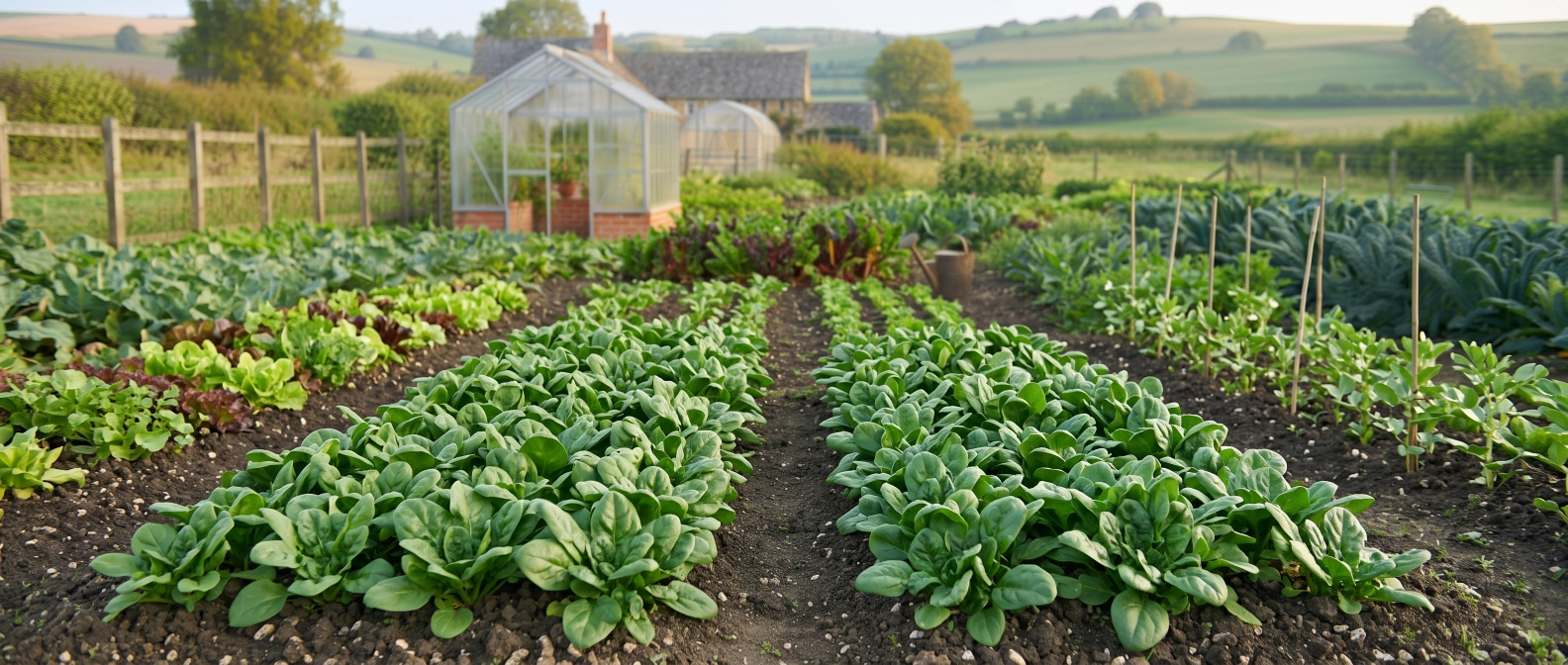
Spinach has a genuinely unusual habit for this site: individual plants are either male or female, never both, so setting seed needs both sexes flowering together rather than a single plant self-pollinating. It's also prone to bolting in heat, which is exactly why the crop database recommends "perpetual spinach" as a more reliable substitute -- though that name is misleading, since perpetual spinach is actually a relative of chard and beetroot, not true spinach at all.
Water need
Consistent moisture keeps growth steady -- dry spells are a common trigger for premature bolting, on top of heat.
Calories at a glance
230 kcal/kg -- modest, its real strength is iron and vitamin C, not calories (scale is log-based across all 55 crops in the calculator).
Temperature Range by Month
Month on the bottom, temperature up the side. The pale green background is what the plant can survive at all -- fatal above or below it, labelled directly on the chart where that applies to your zone. The coral band is its ideal range, and only fades in during the months this zone would actually have the crop in the ground -- reusing the exact same sowing/harvesting data as the calendar further down the page. The blue line is real monthly climate data (not a modelled estimate) for a representative rural/agricultural location in this zone -- a small farming town or agricultural research station rather than a major city, to avoid the warmer bias city weather stations have. For the actual verdict on how well this crop does in your zone, see the badge at the top of the page -- that's based on the site's own researched yield figures, not this chart.
Quick Start: Sowing to Harvest
- Sow direct in spring and again in late summer. Sow direct in two windows -- early spring for a summer harvest before heat triggers bolting, and again in late summer for an autumn/winter crop.
- Thin to final spacing. Thin seedlings as soon as they're large enough to handle -- crowded spinach stays small and bolts faster.
- Keep watering even. Consistent moisture keeps growth steady -- dry spells are a common trigger for premature bolting, on top of heat.
- Harvest outer leaves as needed. Pick outer leaves as cut-and-come-again where the variety allows, extending a single sowing's harvest rather than cutting the whole plant at once.
- Switch to perpetual spinach for a more reliable summer crop. If true spinach keeps bolting in your zone's summer heat, perpetual spinach (a chard/beet relative, not true spinach) is a more heat-tolerant substitute with a similar taste and texture.
Sowing & Harvesting Calendar
Pick your zone under "Temperature Range by Month" above and this updates too. Notice two separate sow windows in most zones -- spring and late-summer batches, deliberately avoiding the hottest, most bolt-prone months in between.
Calories & Yield
Spinach is a nutrition crop, not a calorie one -- about 230 kcal per kg. Subtropical, Mediterranean, Maritime and Continental zones all give the same best yield here.
| Climate Zone | Yield per plant | Calories per plant | Viability |
|---|---|---|---|
| Tropical / Humid | 0.20 kg | 46 kcal | Viable |
| Subtropical | 0.25 kg | 57.5 kcal | Viable -- best yield |
| Mediterranean | 0.25 kg | 57.5 kcal | Viable -- best yield |
| Temperate Maritime | 0.25 kg | 57.5 kcal | Viable -- best yield |
| Temperate Continental | 0.25 kg | 57.5 kcal | Viable -- best yield |
| Cool / Boreal | 0.18 kg | 41.4 kcal | Viable |
| Arid / Semi-Arid | 0.10 kg | 13.8 kcal | Viable -- challenging (60% yield) |
| Highland / Alpine | 0.15 kg | 34.5 kcal | Viable |
Figures per plant sown, from the site's own crop database. Arid's yield already reflects the 60% penalty the calculator applies where a zone is rated "challenging" rather than fully viable. Spinach is viable in every one of this site's eight zones.
Varieties Worth Knowing
Modern spinach breeding leans heavily on F1 hybrids for disease resistance, so there are fewer OP heirlooms in wide circulation than for most leafy greens -- these are the well-established exceptions. All the varieties below are open-pollinated (OP), meaning seed saved from them breeds true and is worth keeping under this site's seed-saving approach; none are F1 hybrids.
Seed Saving -- Quick Guide
Spinach is wind-pollinated and usually dioecious -- individual plants are typically either male or female, so a healthy seed crop depends on having enough of each sex flowering together, not just isolation from other varieties.
SERVINGS, NOT DAILY CALORIES This works out plate-sized servings of spinach from your seed during its fresh harvest window only, not your group's full daily calorie needs. For that, use the main calculator.
Estimated for your selected zone above, using this site's own germination, loss and yield figures for spinach -- a helping is roughly what you'd put on a plate as part of a meal with other veg. Treat it as a planning estimate, not a promise.
Storage & Preservation
Spinach isn't described as a storage crop in the site's own crop data at all -- it's grown to be picked young and eaten fresh, typically within days.
For anything beyond fresh eating, spinach freezes reasonably well after blanching -- a practical way to bank a surplus from a productive sowing rather than trying to keep it fresh long-term.
Growing Spinach Without Bought Inputs
Leaf miner and downy mildew are the main risks -- leaf miner larvae tunnel visibly inside the leaves, and downy mildew shows as pale patches on top with fuzzy growth underneath, worsened by damp, still air.
Good spacing for airflow and avoiding overhead watering late in the day are the main input-free defences against mildew.
Switching to perpetual spinach for summer sowings sidesteps both the worst heat-driven bolting and some of true spinach's pest pressure, without needing any bought input at all.
Frequently Asked Questions
Is "perpetual spinach" the same crop as true spinach?
No, despite the name. This site's own crop data recommends perpetual spinach as a more reliable, less bolt-prone alternative -- but botanically it's a leaf-beet form of Beta vulgaris, the same species as chard and beetroot, not true spinach (Spinacia oleracea) at all. If you grow it alongside chard or beetroot and save seed from more than one, treat them as real cross-partners.
Why does spinach need separate male and female plants?
Because true spinach is dioecious -- individual plants are either male or female, never both. Unlike most crops on this site, a single spinach plant genuinely can't self-pollinate; you need both sexes present and flowering together to set any seed at all.
Does spinach cross-pollinate with anything else on this site?
No -- true spinach (Spinacia oleracea) has no cultivated relative anywhere else in this database. It's wind-pollinated, so isolation from other spinach varieties needs real distance, but there's no other crop here close enough botanically to cross with it.
How cold and hot can spinach survive?
Roughly -9°C to 24°C, genuinely cold-hardy once established, with a touch of frost said to sweeten the leaves. Heat is the real limit -- sustained temperatures above about 24°C reliably trigger bolting, which is exactly why the crop database recommends perpetual spinach as a more heat-tolerant, less bolt-prone alternative.
Is spinach a good calorie crop for self-sufficiency?
Modest -- around 230 kcal per kg. Its real value is iron and vitamin C, not calories, so it's worth growing for nutrition and variety alongside calorie-dense staples rather than instead of them.