
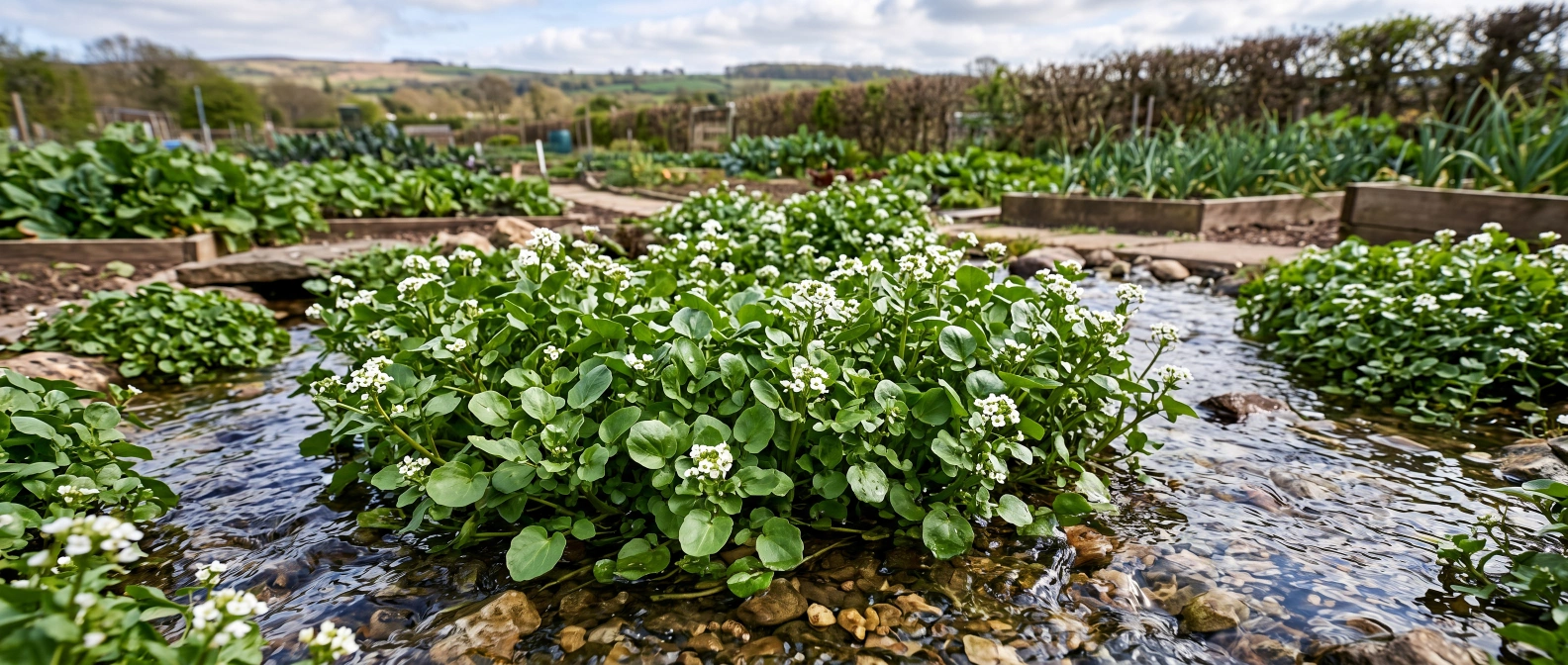
Grown from cuttings rather than seed in normal practice, and genuinely harvestable year-round in mild zones with a reliable water source, per the crop database's own description. Its water requirement is the whole story here -- everything else about growing it is straightforward once that condition is met.
Water need
Genuinely off the normal scale here -- this isn't "water it more," it needs a permanent water source, not just moist soil.
Calories at a glance
110 kcal/kg -- the lowest calorie density of any leafy green on this hub; grown for its peppery flavour and nutrition, not calories (scale is log-based across all 55 core crops in the calculator).
Temperature Range by Month
Month on the bottom, temperature up the side. The pale green background is what the plant can survive at all -- fatal above or below it, labelled directly on the chart where that applies to your zone. The coral band is its ideal range, and only fades in during the months this zone would actually have the crop in the ground -- reusing the exact same sowing/harvesting data as the calendar further down the page. The blue line is real monthly climate data (not a modelled estimate) for a representative rural/agricultural location in this zone -- a small farming town or agricultural research station rather than a major city, to avoid the warmer bias city weather stations have. For the actual verdict on how well this crop does in your zone, see the badge at the top of the page -- that's based on the site's own researched yield figures, not this chart.
Quick Start: Cuttings to Harvest
- Start from stem cuttings. Take fresh stem cuttings from an existing patch or a bunch bought for eating, and place the cut ends in a glass of water until roots appear.
- Plant into a permanently wet spot. Plant rooted cuttings into the edge of a clean stream, a boggy bed, or a container standing permanently in a water tray -- ordinary garden soil that dries out isn't enough.
- Keep the water source clean and moving if possible. Slow-moving or regularly refreshed water genuinely grows better watercress than stagnant water, and reduces the risk of contamination.
- Harvest by cutting stems. Snip stems a few centimetres above the water or growing medium, leaving enough plant behind to keep regrowing.
- Pick regularly to keep growth tender. Regular cutting keeps new growth young and mild -- older, uncut stems can turn tougher and more peppery than most people want.
Planting & Harvesting Calendar
Pick your zone under "Temperature Range by Month" above and this updates too. Arid zones show no window at all -- the one zone on this site where watercress's water requirement simply can't be met reliably outdoors.
Calories & Yield
Tropical, Subtropical and Mediterranean zones tie for the best yield here -- and the crop is simply not viable at all in Arid conditions, for exactly the water-supply reasons already covered.
| Climate Zone | Yield per plant | Calories per plant | Viability |
|---|---|---|---|
| Tropical / Humid | 2.0 kg | 220 kcal | Viable -- best yield |
| Subtropical | 2.0 kg | 220 kcal | Viable -- best yield |
| Mediterranean | 2.0 kg | 220 kcal | Viable -- best yield |
| Temperate Maritime | 1.8 kg | 198 kcal | Viable |
| Temperate Continental | 1.5 kg | 165 kcal | Viable |
| Cool / Boreal | 0.6 kg | 66 kcal | Challenging (60% yield) |
| Arid / Semi-Arid | -- | -- | Not viable |
| Highland / Alpine | 0.6 kg | 66 kcal | Challenging (60% yield) |
Figures per plant, from the site's own crop database. Boreal and Alpine already reflect the 60% penalty applied to challenging zones.
A note on varieties: watercress is mostly grown as a single undifferentiated type, usually propagated from cuttings rather than named seed varieties -- real named-cultivar diversity is genuinely thin.
Seed Saving -- Quick Guide
Watercress grown near a stream or ditch faces a crossing risk most vegetables never have to worry about: truly wild watercress, the same species, often grows in exactly that kind of waterway.
SERVINGS, NOT DAILY CALORIES This works out plate-sized servings of watercress from your seed during its fresh harvest window only, not your group's full daily calorie needs. For that, use the main calculator.
Estimated for your selected zone above, using this site's own germination, loss and yield figures for watercress -- a helping is roughly what you'd put on a plate as part of a meal with other veg. Treat it as a planning estimate, not a promise.
Storage & Preservation
Fresh watercress wilts quickly and keeps only a few days refrigerated, ideally with stems standing in a little water -- it genuinely doesn't store well.
There's no good long-term preservation route for this crop -- it's best treated as a continuously-harvested fresh green rather than something to store or bank for later.
Growing Watercress Without Bought Inputs
Genuinely low-maintenance once a suitable wet spot is found -- the water source does most of the work, and the plant itself is tough and fast-growing.
Water quality is the real thing to watch, not pests -- avoid water sources with agricultural or livestock runoff nearby, for genuine food-safety reasons.
Choosing a clean water source from the start is the single most important input-free decision for this crop.
Frequently Asked Questions
Do I really need running water to grow watercress?
The crop database is direct: needs running water or very wet soil. A clean stream or spring is ideal, but a large container with the base standing permanently in a water tray, refreshed regularly, can substitute at garden scale. Ordinary damp soil that dries out between waterings isn't enough -- this is a genuinely different water requirement from every other crop on this site.
Is watercress normally grown from seed?
Not usually -- the crop database's own unit for watercress is "cutting," and in practice most home growers start new watercress from stem cuttings taken from an existing patch or a bunch bought for eating, since fresh stems root readily in water.
Why is watercress not viable in Arid zones?
Because its whole growing method depends on a consistent water source, and this site's yield data marks it not viable at all in Arid/Semi-Arid zones -- there simply isn't the reliable water availability its wet-footed growing habit needs.