
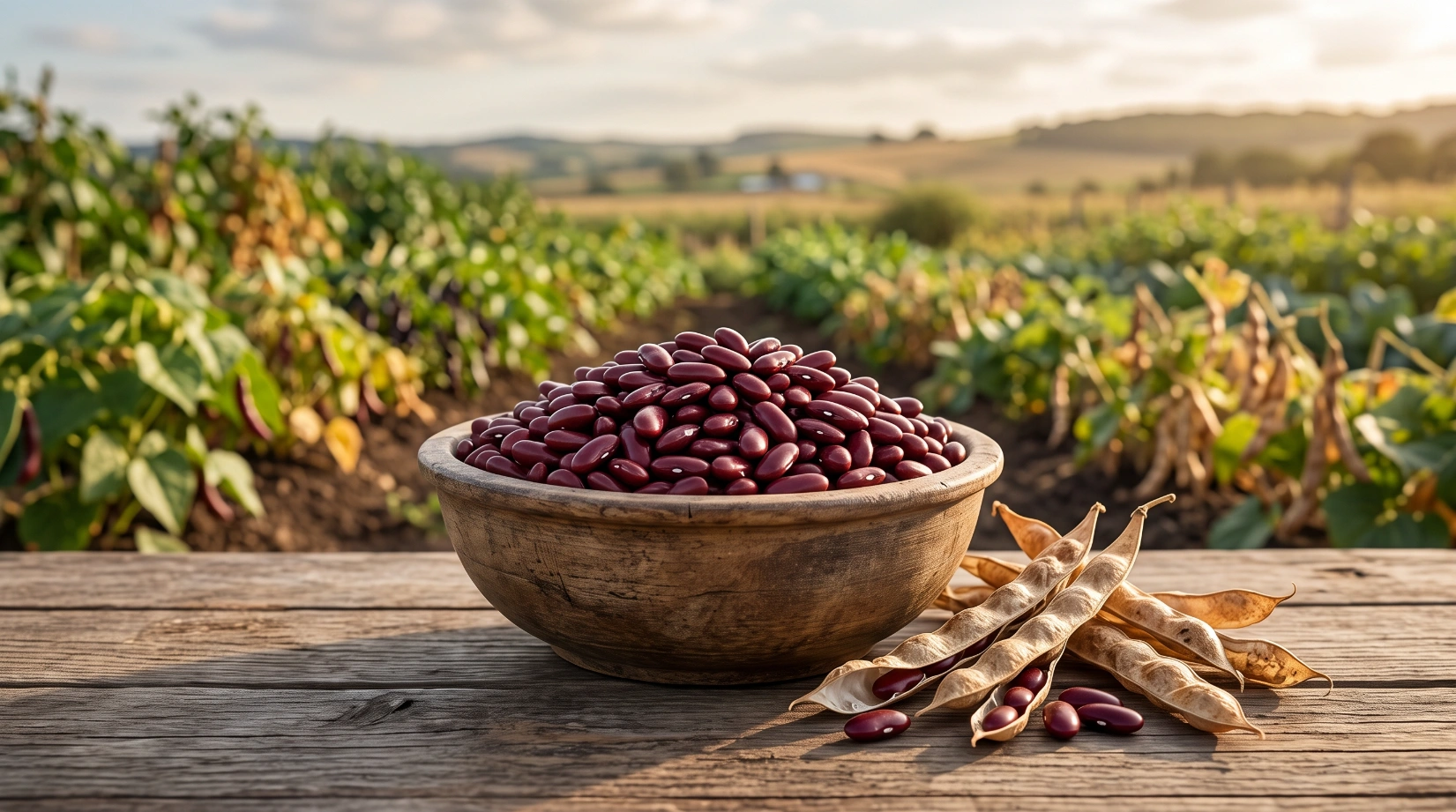
Per the crop database's own description, kidney bean is "one of the world's most grown beans" -- but it must be boiled vigorously to destroy lectins before it's safe to eat. It's Phaseolus vulgaris, the same species as black bean, pinto bean, navy bean and cannellini bean also grown on this hub -- all five cross-pollinate with each other and need isolation if you're saving pure seed from more than one type. Grown for drying, it's a frost-tender warm-season legume that fixes its own nitrogen while it grows.
Water need
Even moisture while flowering and podding improves the set, though established plants tolerate short dry spells.
Calories at a glance
3,330 kcal/kg dried -- in the same league as this site's other dried pulses (scale is log-based across all 55 core crops in the calculator).
Temperature Range by Month
Month on the bottom, temperature up the side. The pale green background is what the plant can survive at all -- fatal above or below it, labelled directly on the chart where that applies to your zone. The coral band is its ideal range, and only fades in during the months this zone would actually have the crop in the ground -- reusing the exact same sowing/harvesting data as the calendar further down the page. The blue line is real monthly climate data (not a modelled estimate) for a representative rural/agricultural location in this zone -- a small farming town or agricultural research station rather than a major city, to avoid the warmer bias city weather stations have. For the actual verdict on how well this crop does in your zone, see the badge at the top of the page -- that's based on the site's own researched yield figures, not this chart.
Quick Start: Sowing to Drying
- Sow after frost risk has passed. Sow direct once the soil has warmed and frost risk has passed -- kidney bean is a frost-tender warm-season crop and won't tolerate cold, wet soil.
- Support climbing varieties. Climbing kidney bean varieties need a sturdy pole or trellis; bush varieties are self-supporting and need none.
- Leave pods on the plant to dry fully. For dried storage, leave pods on the plant until they've turned dry and papery and the beans inside rattle, rather than picking young.
- Shell and finish drying indoors. Shell the dried pods and spread the beans out somewhere warm and airy for a final week of drying before storing in an airtight container.
- Boil vigorously for at least 10 minutes before eating. Before eating, dried kidney beans must be boiled vigorously for at least 10 minutes to destroy phytohaemagglutinin -- a slow cooker on low heat does not reach a safe temperature and must not be used as the only cooking step.
Sowing & Harvesting Calendar
Pick your zone under "Temperature Range by Month" above and this updates too. Boreal and Alpine show no window at all, since this site's own yield data marks kidney bean as not viable outdoors there.
Calories & Yield
Kidney bean is a genuine calorie staple when dried at about 3,330 kcal per kg. Tropical gives the best yield here, and Boreal and Alpine aren't viable outdoors.
| Climate Zone | Yield per plant | Calories per plant | Viability |
|---|---|---|---|
| Tropical / Humid | 3.0 kg | 9990 kcal | Viable -- best yield |
| Subtropical | 2.5 kg | 8325 kcal | Viable |
| Mediterranean | 2.5 kg | 8325 kcal | Viable |
| Temperate Maritime | 0.9 kg | 2997 kcal | Challenging (60% yield) |
| Temperate Continental | 2.5 kg | 8325 kcal | Viable |
| Cool / Boreal | -- | -- | Not viable |
| Arid / Semi-Arid | 0.9 kg | 2997 kcal | Challenging (60% yield) |
| Highland / Alpine | -- | -- | Not viable |
Figures per plant sown, dried weight, from the site's own crop database. Maritime and Arid already reflect the 60% penalty applied to challenging zones.
Varieties Worth Knowing
Kidney bean varieties mainly differ in colour depth. Both below are open-pollinated (OP), meaning seed saved from them breeds true and is worth keeping under this site's seed-saving approach; neither is an F1 hybrid.
Seed Saving -- Quick Guide
Kidney bean is Phaseolus vulgaris, the same species as French bean, pinto, navy, cannellini and borlotti -- all will cross with each other, but mostly self-pollinate so the risk stays low even grown close together.
SERVINGS, NOT DAILY CALORIES This works out plate-sized servings of kidney bean from your seed during its fresh harvest window only, not your group's full daily calorie needs. For that, use the main calculator.
Estimated for your selected zone above, using this site's own germination, loss and yield figures for kidney bean -- a helping is roughly what you'd put on a plate as part of a meal with other veg. Treat it as a planning estimate, not a promise.
Storage & Preservation
Kidney bean is grown here specifically for dried storage, not fresh eating -- pods are left on the plant until fully dry, then shelled and given a final week of airing indoors before going into an airtight container.
Stored this way in a cool, dry place, dried kidney beans keep for a genuinely long time -- years rather than months, the same storage league as wheat, oats and this site's other dried staples.
Growing Kidney Beans Without Bought Inputs
Bean beetles and aphids are the main pests to watch for -- they cluster on soft growth and pods, and heavy infestations can reduce yield.
Handpicking pests and encouraging predator insects with companion flowers is an effective input-free defence, along with keeping plants evenly watered so they aren't stressed.
Kidney bean fixes its own nitrogen via bacteria in root nodules, genuinely improving the soil for whatever's grown there next -- factor that into a wider rotation plan, not just a calorie one.
Frequently Asked Questions
Is it true kidney beans can be poisonous if not cooked properly?
Yes -- this is a genuine, well-documented risk, not folklore. Raw and undercooked kidney beans, especially red kidney beans, contain phytohaemagglutinin, a lectin that causes nausea, vomiting and diarrhoea within a few hours of eating. Dried beans must be boiled vigorously for at least 10 minutes before eating. A slow cooker on low heat does not reach a high enough temperature to destroy the toxin and is a documented cause of poisoning outbreaks.
Does kidney bean cross-pollinate with the other beans on this hub?
Yes, with four of them -- kidney bean, black bean, pinto bean, navy bean and cannellini bean are all Phaseolus vulgaris, literally the same species, so any two of them grown together can cross. It does not cross with lima bean (Phaseolus lunatus), which is a different species entirely.
Is kidney bean a good calorie crop for self-sufficiency?
Yes -- around 3,330 kcal per kg dried, in the same league as the site's other dried pulses and grains, and it's one of the world's most widely grown beans for exactly that reason.