
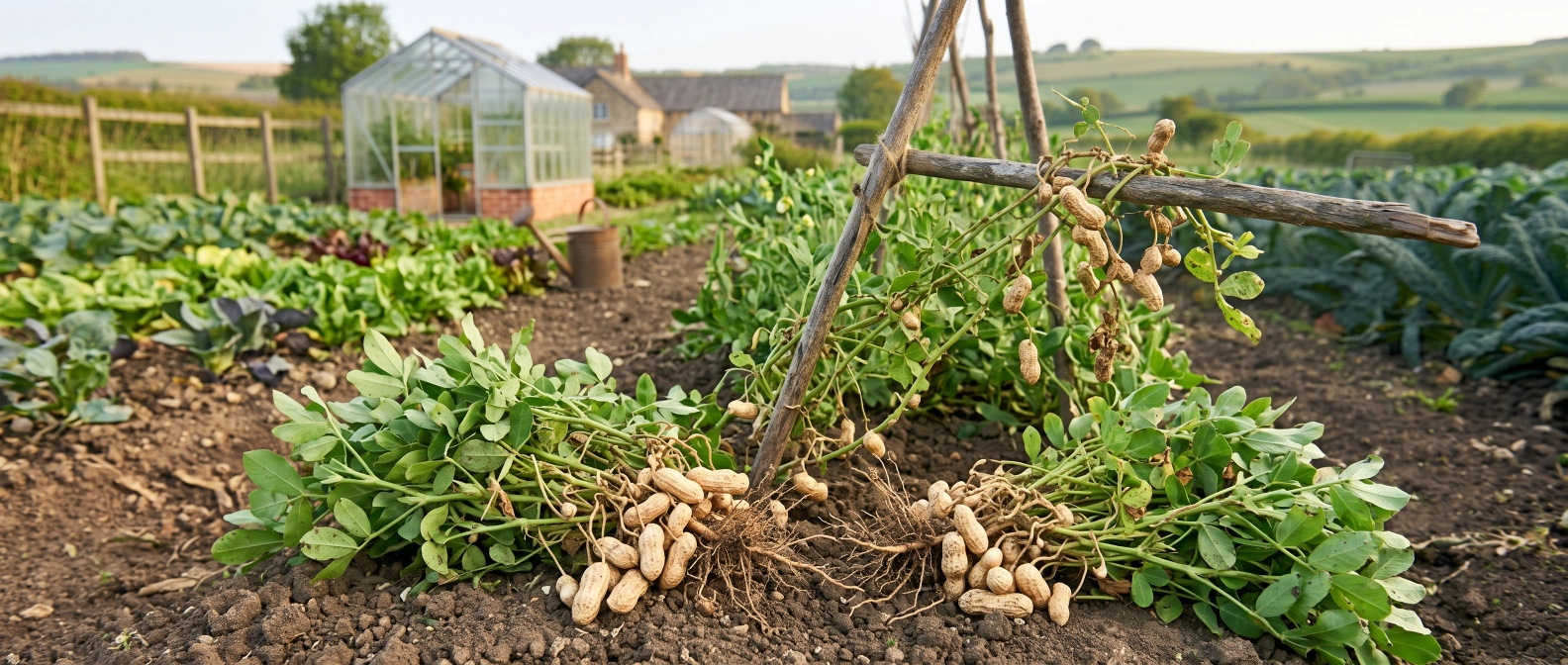
"Groundnut" is a literal description, not a nickname -- after peanut's flower pollinates itself (before it even opens, making cross-pollination close to a non-issue), its stalk pushes the fertilised ovary underground, where the pod actually develops. That underground habit means peanut is dug rather than picked, and it needs a genuinely long, warm season to pull off -- 120 frost-free days, the longest requirement of any legume on this site. In exchange, at 5,670 kcal per kg it's the single most calorie-dense crop covered here so far.
Water need
Reasonably drought-tolerant thanks to a deep root system, though even moisture through flowering and pegging genuinely improves pod numbers.
Calories at a glance
5,670 kcal/kg -- the highest of any crop covered on this site so far (scale is log-based across all 55 crops in the calculator).
Temperature Range by Month
Month on the bottom, temperature up the side. The pale green background is what the plant can survive at all -- fatal above or below it, labelled directly on the chart where that applies to your zone. The coral band is its ideal range, and only fades in during the months this zone would actually have the crop in the ground -- reusing the exact same sowing/harvesting data as the calendar further down the page. The blue line is real monthly climate data (not a modelled estimate) for a representative rural/agricultural location in this zone -- a small farming town or agricultural research station rather than a major city, to avoid the warmer bias city weather stations have. For the actual verdict on how well this crop does in your zone, see the badge at the top of the page -- that's based on the site's own researched yield figures, not this chart.
Quick Start: Sowing to Harvest
- Sow direct once the soil is genuinely warm. Wait until soil temperature is reliably above about 18°C before sowing -- peanut is frost-sensitive and won't tolerate an early, cold start.
- Keep the soil loose around the base. Peanut's flower stalks need to push down into loose soil to bury the developing pods -- compacted ground around the plant genuinely limits pod formation.
- Mound soil lightly around the base as it grows. Light hilling, similar to potato, gives the pegs more loose soil to push into and can improve pod numbers.
- Water consistently through flowering and pegging. Even moisture while the plant flowers and its pegs push underground matters more than at any other stage.
- Dig the whole plant to harvest. Unlike other legumes here, peanut isn't picked pod by pod -- lift the entire plant once the foliage begins yellowing, since the pods are underground and attached to the roots.
Sowing & Harvesting Calendar
Pick your zone under "Temperature Range by Month" above and this updates too. Notice Boreal and Alpine show no window at all -- neither offers the sustained warm season peanut needs to mature underground pods. Maritime shows a window, but at a real yield penalty -- see the badge at the top of the page for the honest verdict.
Calories & Yield
Peanut is the most calorie-dense crop covered on this site so far at about 5,670 kcal per kg. Subtropical gives the best yield here by a clear margin.
| Climate Zone | Yield per plant | Calories per plant | Viability |
|---|---|---|---|
| Tropical / Humid | 0.25 kg | 1,417.5 kcal | Viable |
| Subtropical | 0.30 kg | 1,701 kcal | Viable -- best yield |
| Mediterranean | 0.25 kg | 1,417.5 kcal | Viable |
| Temperate Maritime | 0.12 kg | 408.24 kcal | Viable -- challenging (60% yield) |
| Temperate Continental | 0.20 kg | 1,134 kcal | Viable |
| Cool / Boreal | -- | -- | Not viable |
| Arid / Semi-Arid | 0.20 kg | 1,134 kcal | Viable |
| Highland / Alpine | -- | -- | Not viable |
Figures per plant sown, from the site's own crop database. Maritime's yield already reflects the 60% penalty the calculator applies where the zone is rated "challenging" rather than fully viable.
Varieties Worth Knowing
Peanut varieties differ mainly in seed size and oil content. All the varieties below are open-pollinated (OP), meaning seed saved from them breeds true and is worth keeping under this site's seed-saving approach; none are F1 hybrids.
Seed Saving -- Quick Guide
Peanut flowers self-pollinate before the pod-forming stalk even reaches the soil, burying itself to form pods underground -- about as self-contained as seed saving gets.
SERVINGS, NOT DAILY CALORIES This works out plate-sized servings of peanut from your seed during its fresh harvest window only, not your group's full daily calorie needs. For that, use the main calculator.
Estimated for your selected zone above, using this site's own germination, loss and yield figures for peanut -- a helping is roughly what you'd put on a plate as part of a meal with other veg. Treat it as a planning estimate, not a promise.
Storage & Preservation
After digging the whole plant, pods need curing -- dry the whole plant (pods still attached) somewhere warm and airy for one to two weeks before separating the pods from the roots.
Once fully cured and shelled, peanuts store well in a cool, dry place for several months -- but the high oil content means they don't keep as long as the site's drier pulses like pea or common bean, so use them up at a reasonable pace rather than treating them as an indefinite store.
Growing Peanut Without Bought Inputs
Peanut is a relatively trouble-free crop in most home gardens -- leaf spot fungal diseases are the main risk in humid conditions, showing as dark spots on the foliage.
Good spacing for airflow and avoiding overhead watering late in the day are the main input-free defences against leaf spot.
Peanut fixes its own nitrogen via root bacteria, genuinely improving the soil it's grown in -- factor that into a wider rotation plan alongside broad bean, not just a calorie one.
Frequently Asked Questions
Why is "groundnut" a literal name for peanut?
Because that's genuinely where the pod develops. After the flower self-pollinates, its stalk (called a peg) elongates and pushes the fertilised ovary down into the soil, where the pod actually forms and matures underground -- unlike every other crop in this category, which pods above ground.
Do I need to isolate peanut from other legumes for seed saving?
No -- peanut's flowers are cleistogamous, meaning they self-pollinate before they even open. This makes cross-pollination essentially a non-issue, even compared to pea, the next most self-contained legume on this site.
How cold and hot can peanut survive?
It's frost-sensitive and needs real warmth -- roughly 5°C to 35°C, with growth stopping below about 15°C and flower formation damaged above roughly 34°C. It also needs a sustained 120 frost-free days to mature a crop, the longest warm-season requirement of any legume on this site.
Why is peanut only "challenging" rather than fully viable in Maritime zones?
Peanut needs a long, reliably warm season to mature its underground pods, and a maritime climate's cooler, more variable summer rarely delivers that consistently -- the crop can still produce something, just at a real yield penalty, which is exactly what the "challenging" rating reflects.
Is peanut a good calorie crop for self-sufficiency?
Excellent -- around 5,670 kcal per kg, the highest of any crop covered on this site so far, and an excellent source of dietary fat alongside the calories. Its long warm-season requirement is the real limiting factor, not its calorie density.