
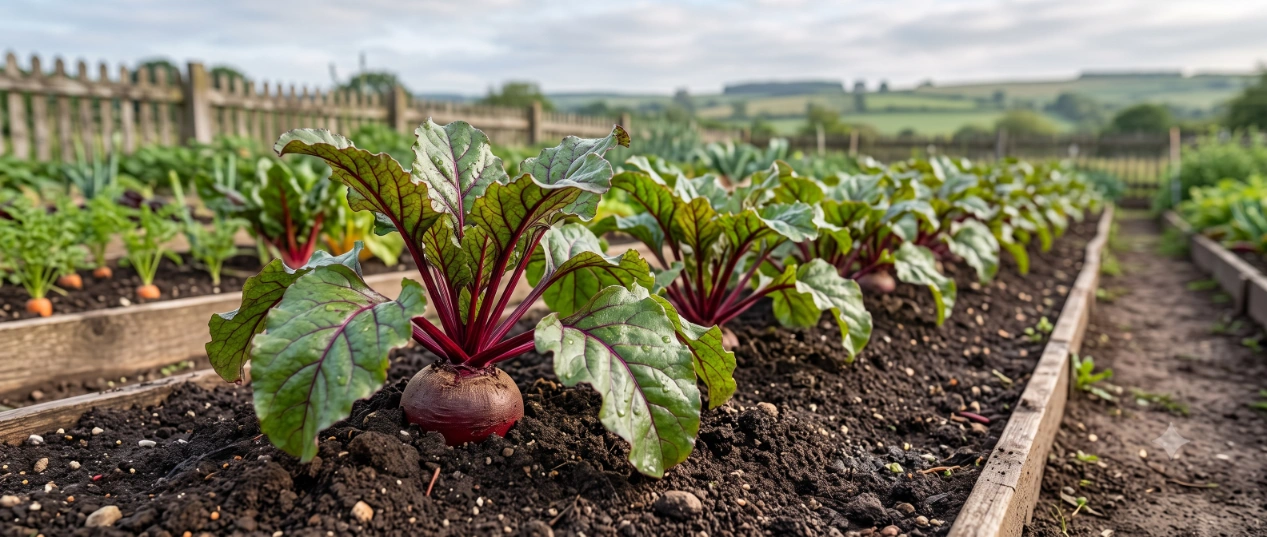
Beetroot looks like a simpler cousin of carrot -- another biennial root grown from direct-sown seed -- but its seed-saving picture is genuinely different underneath. It's wind-pollinated rather than insect-pollinated, it shares a species with chard (so the two cross freely), and as a result it needs isolation distances measured in miles rather than metres. Nutritionally it's in the same bracket as carrot too: a moderate, colourful addition to the diet rather than a calorie staple.
Water need
Needs even, consistent moisture -- irregular watering is the main cause of woody texture and the concentric white "zoning" rings inside the root.
Calories at a glance
430 kcal/kg -- moderate, in the same bracket as carrot and well below true calorie staples like potatoes (scale is log-based across all 55 crops in the calculator).
Temperature Range by Month
Month on the bottom, temperature up the side. The pale green background is what the plant can survive at all -- fatal above or below it, labelled directly on the chart where that applies to your zone. The coral band is its ideal range, and only fades in during the months this zone would actually have the crop in the ground -- reusing the exact same sowing/harvesting data as the calendar further down the page. The blue line is real monthly climate data (not a modelled estimate) for a representative rural/agricultural location in this zone -- a small farming town or agricultural research station rather than a major city, to avoid the warmer bias city weather stations have. For the actual verdict on how well this crop does in your zone, see the badge at the top of the page -- that's based on the site's own researched yield figures, not this chart.
Quick Start: Sowing to Harvest
- Sow direct. Each beetroot "seed" is actually a dried fruit containing several true seeds, so clusters usually germinate as more than one seedling -- sow direct and thin to the strongest single seedling per cluster once they're large enough to handle.
- Thin to final spacing. Thin to around 10cm apart for full-size roots, sooner rather than later -- crowded beetroot produces small, misshapen roots.
- Tend through the season. Keep watering even and consistent -- irregular moisture causes the concentric white "zoning" rings and woody texture beetroot is prone to. Avoid heavy nitrogen feeding, which favours leafy top growth over the root.
- Harvest at the size you want. Pull roots any time from golf-ball size upward -- beetroot doesn't need to reach full size to be worth eating, and smaller roots are typically more tender.
- Lift and store for the long term. If storing rather than eating fresh, lift before a hard freeze, twist (don't cut) the tops off to about 2.5cm, and layer the unwashed roots in slightly damp sand in a cool shed or cellar.
Sowing & Harvesting Calendar
Pick your zone under "Temperature Range by Month" above and this updates too. The Sow row: green is the normal safe sowing window, amber is pushing the season by roughly a month either side with basic outdoor protection (cold frame, fleece, cloche), blue is an even earlier under-glass start. In warmer zones, notice two separate sow windows rather than one continuous block -- a spring batch and a late-summer batch, the same succession-sowing pattern seen on carrot's page.
Calories & Yield
Beetroot is, like carrot, a nutrition crop rather than a calorie staple -- about 430 kcal per kg. Subtropical and Mediterranean zones give the best yields; Arid is the only zone it doesn't handle at all.
| Climate Zone | Yield per plant | Calories per plant | Viability |
|---|---|---|---|
| Tropical / Humid | 0.3 kg | 129 kcal | Viable |
| Subtropical | 0.4 kg | 172 kcal | Viable -- best yield |
| Mediterranean | 0.4 kg | 172 kcal | Viable -- best yield |
| Temperate Maritime | 0.35 kg | 151 kcal | Viable |
| Temperate Continental | 0.35 kg | 151 kcal | Viable |
| Cool / Boreal | 0.25 kg | 108 kcal | Viable |
| Arid / Semi-Arid | -- | -- | Not viable |
| Highland / Alpine | 0.25 kg | 108 kcal | Viable |
Figures per plant sown, from the site's own crop database.
Varieties Worth Knowing
Beetroot varieties fill genuinely different niches -- bolt-resistance, storage life, colour, or dual-purpose leaves -- so the right one depends on what you're growing it for. All the varieties below are open-pollinated (OP), meaning seed saved from them breeds true and is worth keeping under this site's seed-saving approach; none are F1 hybrids.
Seed Saving -- Quick Guide
Beetroot, chard and perpetual spinach are all the same species (Beta vulgaris) grown for different parts of the plant -- letting any two flower nearby produces an unpredictable cross instead of true seed from either.
SERVINGS, NOT DAILY CALORIES This works out plate-sized servings of beetroot from your seed during its fresh harvest window only, not your group's full daily calorie needs. For that, use the main calculator.
BIENNIAL Beetroot is a biennial, not an annual -- it doesn't produce seed in its first year. Roots grow in year one, a few overwintered roots flower and set seed in year two, and that seed is only ready to sow in year three. If you're starting from scratch with no ongoing seed supply, that means having enough seed on hand for both year one's and year two's sowing up front. Plan for roughly double the seed quantity below if that's your situation.
Estimated for your selected zone above, using this site's own germination, loss and yield figures for beetroot -- a helping is roughly what you'd put on a plate as part of a meal with other veg. Treat it as a planning estimate, not a promise.
Storage & Preservation
The site's own crop data models beetroot as a dig-and-store crop, the same as carrot: lifted before hard freeze, twisted free of their tops, and layered in slightly damp sand in a cool shed or cellar kept just above freezing, where they'll keep for roughly 4-6 months.
Don't wash the roots before storing -- introduced moisture is the main cause of rot -- and trim the tops to about 2.5cm rather than cutting into the root itself. Beyond fresh storage, beetroot also pickles, ferments and freezes well (cooked and peeled first) if you want to process a surplus.
Growing Beetroot Without Bought Inputs
Beetroot has genuinely fewer serious pest problems than most root vegetables on this site -- leaf miner is the main one to plan around, its larvae tunnelling visible pale blotches into the leaves.
A fine mesh cover from sowing onward is the single most effective input-free defence against leaf miner -- it excludes the adult fly before it can lay eggs, with no spray or identification needed.
Removing affected leaves promptly limits how far an existing leaf miner infestation spreads -- the roots themselves are unaffected even when the tops show damage, so this is a cosmetic and preventative step rather than a rescue for the harvest.
Consistent watering does double duty here -- besides preventing woody, zoned roots, even moisture also reduces the stress that makes plants more attractive to pests generally.
Frequently Asked Questions
Does beetroot cross-pollinate with other crops in this database?
Yes -- chard and perpetual spinach. All three are the same species (Beta vulgaris), so any of them flowering nearby will cross with beetroot grown for seed. Unlike carrot, beetroot is wind-pollinated, not insect-pollinated, which is why it needs a much larger isolation distance.
Can wild sea beet cross-pollinate my garden beetroot?
Yes, and it's a genuine risk for coastal growers specifically. Sea beet (Beta vulgaris subsp. maritima) is the wild ancestor of all cultivated beets and chards, grows prolifically on shingle, cliffs and upper beaches along Atlantic and Mediterranean coasts, and shares the same wind-pollinated system, so it doesn't need to be deliberately planted to cross with beetroot grown for seed nearby. If you're saving beetroot seed near a coastline, check for flowering sea beet within your isolation distance, not just cultivated relatives in neighbouring gardens.
How far apart do beetroot varieties actually need to be for seed saving?
Further than most crops on this site -- wind carries beet pollen a long way. A commonly cited home-garden minimum is around 800m (half a mile), and commercial seed growers often use 2-5 miles between varieties. A hedge or other physical windbreak between plots can meaningfully cut the effective distance needed.
How cold and hot can beetroot survive?
Roughly -6°C to 30°C (21°F to 86°F), with the best root colour and shape developing in the 15-25°C ideal range. Above about 27°C, roots tend to bolt, lose colour and become misshapen -- heat is a quality problem here more than a survival one.
How long does beetroot store after harvest?
Around 4-6 months layered in slightly damp sand in a cool shed or cellar, kept just above freezing -- similar to carrot. Trim the tops to about 2.5cm and don't wash the roots first, since introduced moisture is the main cause of rot in storage.
Is beetroot a good calorie crop for self-sufficiency?
Similar to carrot -- moderate rather than a true staple, at around 430 kcal per kg. Worth growing for variety, colour and nutrition alongside calorie-dense staples rather than instead of them.
How long does beetroot seed stay viable?
Around 4-6 years under cool, dark, dry storage -- notably longer-lived than carrot seed. Still worth testing older seed before relying on a full planting.
Do I need pesticides to grow beetroot?
No. Leaf miner is the main pest to watch for -- its larvae tunnel visible blotches into the leaves -- and a fine mesh cover from sowing excludes the adult fly without any spray needed. Beetroot generally has fewer serious pest problems than carrot.