
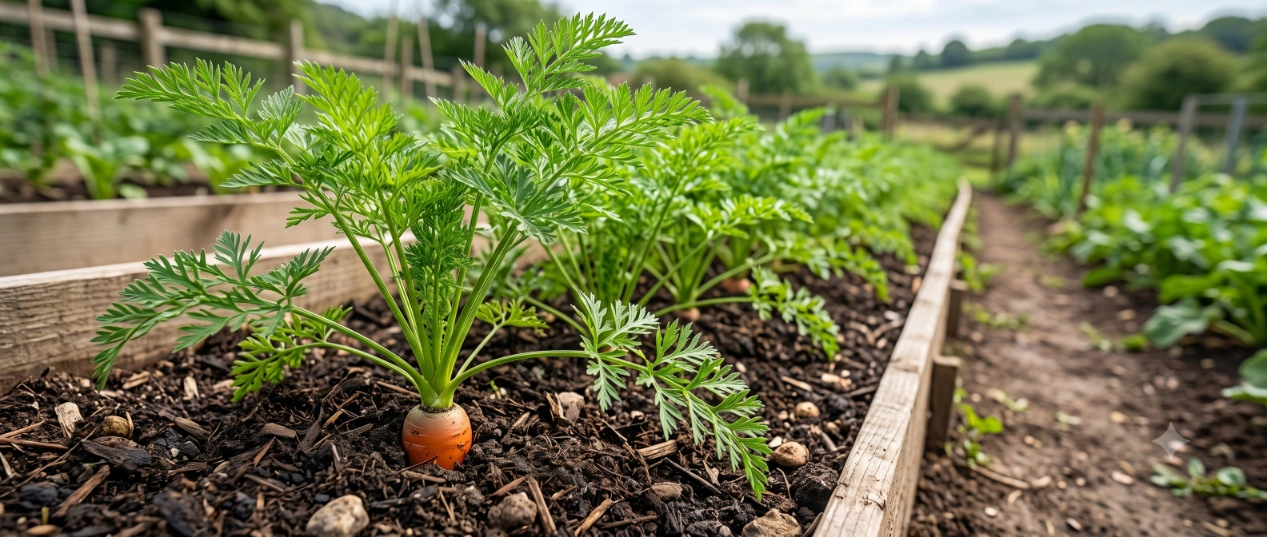
A genuinely simple crop to save seed from, at least by this site's standards -- carrot has no cultivated cross-pollination partners at all in this database, since none of the other umbellifers grown here (parsnip, celeriac) are close enough botanically to cross with it. The real risk to seed purity is wild carrot, better known as Queen Anne's Lace, not another vegetable in the garden. Beyond seed-saving, carrot's real value is vitamin A and genuinely good storage life -- not a calorie staple, but a solid, reliable source of variety through a long winter.
Water need
Needs even, consistent moisture -- drought stress is the main cause of small, woody or poorly-flavoured roots.
Calories at a glance
410 kcal/kg -- moderate, ahead of most leafy brassicas but well below true calorie staples like potatoes (scale is log-based across all 55 crops in the calculator).
Temperature Range by Month
Month on the bottom, temperature up the side. The pale green background is what the plant can survive at all -- fatal above or below it, labelled directly on the chart where that applies to your zone. The coral band is its ideal range, and only fades in during the months this zone would actually have the crop in the ground -- reusing the exact same sowing/harvesting data as the calendar further down the page. The blue line is real monthly climate data (not a modelled estimate) for a representative rural/agricultural location in this zone -- a small farming town or agricultural research station rather than a major city, to avoid the warmer bias city weather stations have. For the actual verdict on how well this crop does in your zone, see the badge at the top of the page -- that's based on the site's own researched yield figures, not this chart.
Quick Start: Sowing to Harvest
- Sow direct. Carrots don't transplant well -- disturbing the taproot causes forking and distorted roots -- so sow seed directly where it's going to grow, into loose, stone-free soil that gives roots room to grow straight.
- Thin carefully. Thin seedlings to their final spacing as early as possible. Do it on a still evening and remove the thinnings from the bed -- bruised carrot foliage releases a scent that carrot fly can detect from a distance.
- Tend through the season. Keep moisture even and consistent -- drought stress is the main cause of small, woody or forked roots. Protect young seedlings from frost; they're far more vulnerable to cold than the mature roots will be.
- Harvest as needed. Pull roots once they reach a useful size. Mature roots tolerate much colder conditions than seedlings do, so in milder zones there's no rush to lift the whole bed at once.
- Lift and store for the long term. If storing rather than eating fresh, lift before a hard freeze, twist off the tops, and layer the roots in slightly damp sand in a cool shed or cellar -- a sand clamp keeps carrots for months.
Sowing & Harvesting Calendar
Pick your zone under "Temperature Range by Month" above and this updates too. The Sow row: green is the normal safe sowing window, amber is pushing the season by roughly a month either side with basic outdoor protection (cold frame, fleece, cloche), blue is starting seed indoors or under glass for an even earlier transplant -- though note step 1 above: carrot doesn't actually transplant well, so treat "under glass" here as an early-cover option outdoors rather than literally starting indoors. In warmer zones, notice two separate sow windows rather than one continuous block -- a spring batch and a late-summer batch, not a single long season.
Calories & Yield
Carrot is a nutrition and vitamin A crop, not a calorie staple -- about 410 kcal per kg, ahead of most leafy brassicas but a fraction of what potato provides. The crop database recommends Nantes-type varieties specifically for Maritime zones, though that's a variety-suitability note rather than a claim about highest yield -- Subtropical and Mediterranean actually edge it out on the numbers below.
| Climate Zone | Yield per plant | Calories per plant | Viability |
|---|---|---|---|
| Tropical / Humid | 0.2 kg | 82 kcal | Viable |
| Subtropical | 0.3 kg | 123 kcal | Viable |
| Mediterranean | 0.3 kg | 123 kcal | Viable |
| Temperate Maritime | 0.25 kg | 103 kcal | Viable -- recommended variety type |
| Temperate Continental | 0.25 kg | 103 kcal | Viable |
| Cool / Boreal | 0.2 kg | 82 kcal | Viable |
| Arid / Semi-Arid | -- | -- | Not viable |
| Highland / Alpine | 0.2 kg | 82 kcal | Viable |
Figures per plant sown, from the site's own crop database.
Varieties Worth Knowing
Carrot varieties fill genuinely different niches -- soil tolerance, storage life, root shape, or colour -- so the right one depends on what you're growing it for and what your soil is like. All the varieties below are open-pollinated (OP), meaning seed saved from them breeds true and is worth keeping under this site's seed-saving approach; none are F1 hybrids.
Seed Saving -- Quick Guide
Carrot's real risk isn't another vegetable in this database -- it's wild carrot (Queen Anne's Lace), the same species growing wild in hedgerows and verges in many regions. It's also biennial, so saving true seed takes a two-year cycle: roots grow in year one, a few overwintered roots flower in year two.
SERVINGS, NOT DAILY CALORIES This works out plate-sized servings of carrot from your seed during its fresh harvest window only, not your group's full daily calorie needs. For that, use the main calculator.
BIENNIAL Carrot is a biennial, not an annual -- it doesn't produce seed in its first year like most other crops on this site. Instead, roots grow in year one, a few overwintered roots flower and set seed in year two, and that seed is only ready to sow in year three. If you're starting from scratch with no ongoing seed supply, that means having enough seed on hand for both year one's and year two's sowing up front, since you won't have any seed of your own to sow again until year three. Plan for roughly double the seed quantity below if that's your situation.
Estimated for your selected zone above, using this site's own germination, loss and yield figures for carrot -- a helping is roughly what you'd put on a plate as part of a meal with other veg. Treat it as a planning estimate, not a promise.
Storage & Preservation
The site's own crop data models carrot as a dig-and-store crop: lifted before hard freeze, twisted free of their tops, and layered in slightly damp sand in a cool shed or cellar -- a traditional sand clamp -- where they'll keep for roughly 4-6 months, varying by zone from as little as 3 weeks in the least favourable zones up to around 24 weeks in the best.
Many growers successfully do it the other way round instead -- mulching heavily and leaving some roots standing in the ground through winter, since mature carrots are genuinely frost-hardy underground. Either approach works; which suits you better depends on your zone's winter severity and whether you'd rather manage storage space or garden space. Beyond fresh storage, carrots also freeze and ferment well if you want to process a surplus.
Growing Carrots Without Bought Inputs
Carrot's signature pest is carrot fly, not the caterpillars and flea beetle that trouble brassicas -- its larvae tunnel into roots and it's a different problem needing a different defence.
A physical barrier is the single most effective input-free defence -- fine mesh or even a solid barrier around 60cm tall, since carrot fly flies low and mostly can't get over it. No spray or identification needed.
Careful thinning matters more here than for most crops -- bruised carrot foliage releases a scent that attracts carrot fly from a distance, so thin on a still evening and remove the thinnings from the bed rather than leaving them nearby.
Companion planting with alliums (onions, leeks, chives) is a classic pairing for carrot specifically -- their scent helps mask carrots from the fly, and carrots are said to return the favour against onion fly.
Crop rotation reduces carrot fly larvae overwintering in the soil near last year's crop, and helps avoid a build-up of other soil-borne problems too.
Frequently Asked Questions
Will carrot cross-pollinate with parsnip, celeriac or other crops in my garden?
No -- carrot has no cultivated cross-partners anywhere in this site's crop database. Parsnip and celeriac share the same plant family as carrot (Apiaceae) but are different genera, and crossing requires the same species, not just the same family. You can flower carrot for seed without worrying about anything else you're growing.
If not other vegetables, what actually threatens carrot seed purity?
Wild carrot, also known as Queen Anne's Lace -- the same species as cultivated carrot, so it crosses freely if it's flowering nearby. It's common as a roadside and hedgerow wildflower in many regions, so it's worth checking for it within isolation distance before relying on a seed crop being pure.
How cold and hot can carrot survive, and why do seedlings need more protection than mature roots?
Survivable range is roughly -8°C to 30°C (18°F to 85°F), but that hides a big gap: seedlings are frost-tender and only reliably survive a light frost, while mature roots, insulated by the soil around them, tolerate genuinely hard freezes and are commonly overwintered under mulch. Treat young plantings as fragile and established roots as tough.
Can I leave carrots in the ground over winter instead of digging them up?
Many growers do, under a thick mulch, and mature roots are genuinely hardy enough for it. This site's own crop data models the other method instead -- digging and storing in a sand clamp -- since that's what its own description specifies, but leaving some in the ground under mulch is a real, workable alternative if your zone's winters allow it.
How long do carrots store after digging?
Around 4-6 months layered in slightly damp sand in a cool shed or cellar (a sand clamp), though the exact figure varies a lot by zone -- from as little as 3 weeks in the least favourable zones up to around 24 weeks in the best-storing ones.
Is carrot a good calorie crop for self-sufficiency?
Moderate rather than a true staple -- about 410 kcal per kg, ahead of most leafy brassicas but well below potato. Its real strength is vitamin A, not calories, so it's worth growing for nutrition and variety alongside calorie-dense staples rather than instead of them.
How long does carrot seed stay viable?
Typically shorter-lived than brassica seed -- often listed around 3 years under cool, dark, dry storage, though this varies by source and isn't as tightly documented as some other figures on this site. Testing old seed before a full planting is the safest approach regardless of the exact number.
Do I need pesticides to grow carrots?
No. Carrot fly is the main pest to plan around, and a simple physical barrier -- fine mesh or a solid barrier at least 60cm tall around the bed, since the fly flies low -- excludes it without any spray needed. Careful thinning (see Quick Start) avoids attracting it in the first place.