
A working reference of what's genuinely available to build a heap with in a cool or boreal climate, and what belongs nowhere near it. Nothing here relies on anything you can't gather, grow or produce yourself, in keeping with this guide's whole approach to self-sufficiency.
Good Carbon Inputs
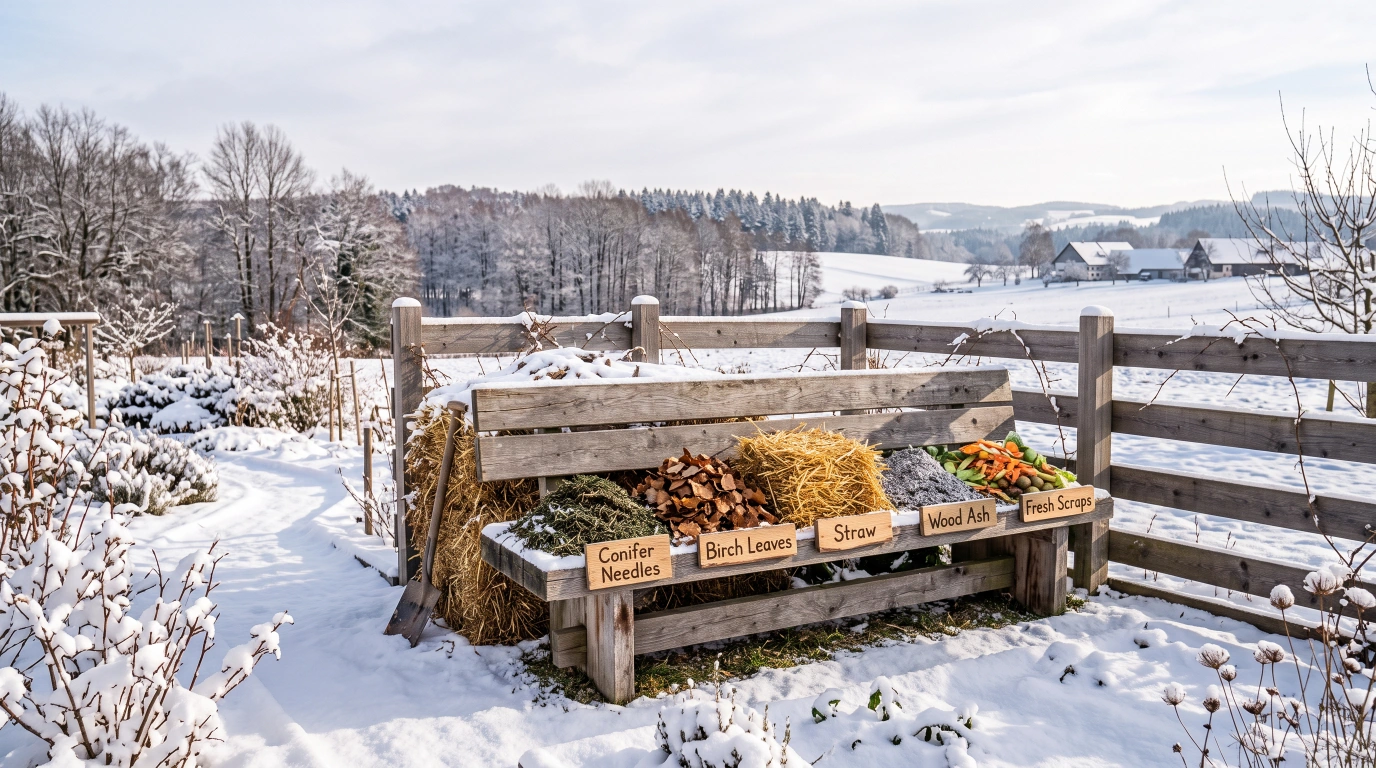
- Conifer needles -- genuinely abundant, but somewhat acidic and slow to break down. Use in moderation alongside other browns, or compost separately for a slower "duff"-style product rather than relying on them as a main carbon source.
- Dried birch or aspen leaves -- an excellent, easy-to-gather brown, especially in autumn when there's a large, low-effort supply available before the freeze.
- Straw -- good bulk carbon that also doubles as a genuinely useful insulating material (see Chapter 3).
- Cardboard -- shred before use and keep it dry until then; an easy, reliable brown when other material is scarce.
- Wood ash, in strict moderation -- a free and abundant byproduct of wood-burning heat in this climate, but strongly alkaline, so it needs careful, limited use (see Chapter 6 for full detail).
Good Nitrogen Inputs
- Fresh kitchen scraps -- available year-round but genuinely abundant only during the growing season; stockpile carbon so it's ready when the surplus arrives (see Chapter 4).
- Grass clippings -- a strong nitrogen source through the short growing season; use fresh rather than letting it mat down into an airless layer.
- Fresh garden weeds -- pull before seed set and add while still fresh and soft.
- Manure, where available -- a genuinely valuable local resource if livestock are kept; strength varies with the animal and any bedding mixed in.
- Urine -- a concentrated, genuinely free source of nitrogen year-round, independent of the growing season; always dilute before applying (see Chapter 8).
Materials to Avoid
Not everything that could theoretically go into a heap should. Some materials are genuine no-gos, others are fine in small amounts but cause real problems if overdone. If something needs to be kept out of a heap, pile it separately or, where appropriate, refer to biochar production (Chapter 9) as an alternative use, rather than treating it as waste with nowhere to go.
| Material | Tier | Why |
|---|---|---|
| Meat, fish, cooked food, dairy | 1 -- avoid entirely | Attracts wildlife looking for food in a harsh climate, a real concern with bears, foxes and similar depending on region |
| Diseased plant material | 1 -- avoid entirely | A heap here may not reliably reach temperatures high enough to kill pathogens |
| Pet or dog faeces | 1 -- avoid entirely | Can carry pathogens harmful to humans; keep well away from food-bound compost |
| Perennial weed roots and seeds | 1 -- avoid entirely | May survive a heap that never reliably heats due to the cold; extra caution warranted here |
| Large quantities of conifer needles alone | 2 -- use with caution | Genuinely slow and acidic in bulk; fine as a minor component, shouldn't dominate a heap |
| Large quantities of wood ash | 2 -- use with caution | Useful in small amounts but can push soil too alkaline and harm some plants if overused |
Tier 1 materials should stay out of the heap entirely. Tier 2 materials are genuinely useful inputs, but only when kept to a modest share of the overall mix.
Frequently Asked Questions
Can I use conifer needles as my main carbon source?
Not as the main source, no. Conifer needles are genuinely abundant here and fine as a minor component, but they're somewhat acidic and slow to break down, so a heap that's dominated by them can turn acidic and sluggish. Use them in moderation alongside other browns, or compost a needle-heavy batch separately for a slower, duff-style product rather than relying on them for the bulk of your carbon.
Why is wood ash listed as both a good input and something to use with caution?
Because both are true. In small amounts, wood ash is a genuinely useful, free and abundant input in a climate where wood-burning for heat is close to universal. But it's strongly alkaline, and large quantities can push soil too alkaline and harm some plants if overused. Since ash is so plentiful here it's tempting to add it heavily, so it deserves a clear, distinct caution rather than being treated as harmless simply because there's plenty of it.
What should never go in a cool or boreal compost heap?
Meat, fish, cooked food and dairy top the list, since they attract wildlife looking for food in a harsh climate, a real practical concern with bears, foxes and other animals depending on the region. Diseased plant material, pet or dog faeces, and perennial weed roots or seeds should also stay out, and perennial weeds deserve extra caution here specifically, since a heap that never reliably heats due to the cold may not kill them the way a consistently hot heap would elsewhere.