
This climate genuinely has one clearly favourable extended season and one clearly difficult one, rather than a smoothly graduated four-season calendar. It's also the reverse emphasis of a tropical climate's wet/dry pattern: there, the wet season is the demanding one; here, it's the dry season. Successful composting means front-loading effort into the favourable stretch and protecting what's built through the difficult one.
Autumn: The Season Begins
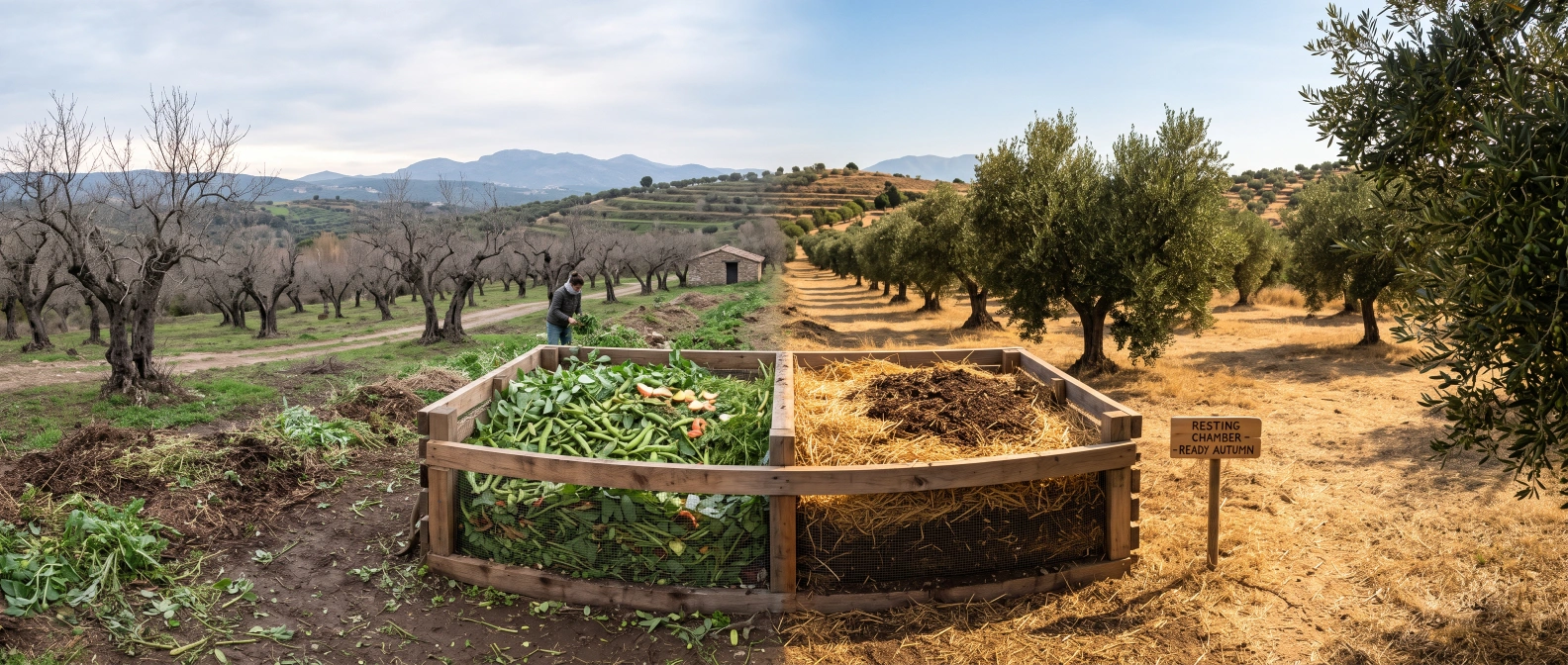
The first rains mark the real start of the composting year here. This is when to start actively feeding a heap hard again after summer's slowdown, sow winter green manures (see Chapter 12), and it's a natural changeover point for the two-chamber system (see Chapter 3): starting a fresh chamber as material and moisture both pick up, while the chamber that carried the summer through stays resting or gets harvested.
Winter: The Main Active Season
Winter is when a heap should be working well with the least intervention needed of almost any point in the year. Fresh material is abundant, and rain generally supplies adequate natural moisture without much watering effort. This is the season to lean on, not manage cautiously, building mass and letting the heap do the bulk of its work while conditions are doing most of the job.
Spring: The Last Good Window
Still active and growing, spring is the last good stretch to build up heap mass and finish batches before things dry out. Green manures are typically cut around now, before the summer drought sets in (see Chapter 12). Treat spring as a genuine deadline, not an open-ended continuation of winter, since the window closes faster here than in a climate with a longer transitional season.
Summer: The Difficult Season
Drought management takes over as the main task through summer (see Chapter 11). Activity slows and may nearly stop despite best efforts, and that's an acceptable outcome for a properly prepared heap. This is also when the two-chamber system's resting chamber comes into its own, since material that's already well-decomposed by the time drought sets in rides out summer far better than a freshly-built heap would.
Frequently Asked Questions
Is Mediterranean seasonal composting the same rhythm as a tropical wet-season/dry-season pattern?
No, it's essentially the reverse emphasis. In a tropical climate, the wet season is the demanding one, heavy rain risks waterlogging and nutrient leaching. Here, it's the dry season, summer, that's difficult, while the wet season from autumn through spring is the genuinely favourable, active stretch. The two climates share a two-season structure but the hard season falls on opposite sides of the calendar.
Which season should get the most composting effort here?
Autumn through spring, the mild wet season. This is when rain and fresh plant material are both genuinely abundant, and a heap needs comparatively little intervention to work well. Front-loading effort, feeding hard, building mass, finishing batches, into this extended favourable season is what makes the difficult summer manageable rather than a crisis.
Does the two-chamber system matter for seasonal management here?
Yes, significantly. Autumn is a natural changeover point, starting a fresh chamber as the rains and material both pick up. By the time summer arrives, having a chamber that's already well-decomposed to rest through the dry months, while a newer chamber gets built up again once autumn returns, fits this climate's real seasonal rhythm better than almost any single-heap approach.