
This is arguably the single most important chapter in the whole guide for this zone, though its scope is genuinely bounded: two to four months of summer, not a year-round concern. Get this right and everything built through the mild wet season survives intact. Get it wrong and a heap that was working beautifully in spring can sit dead and dry for the entire summer, undoing months of careful feeding.
Why Summer Specifically
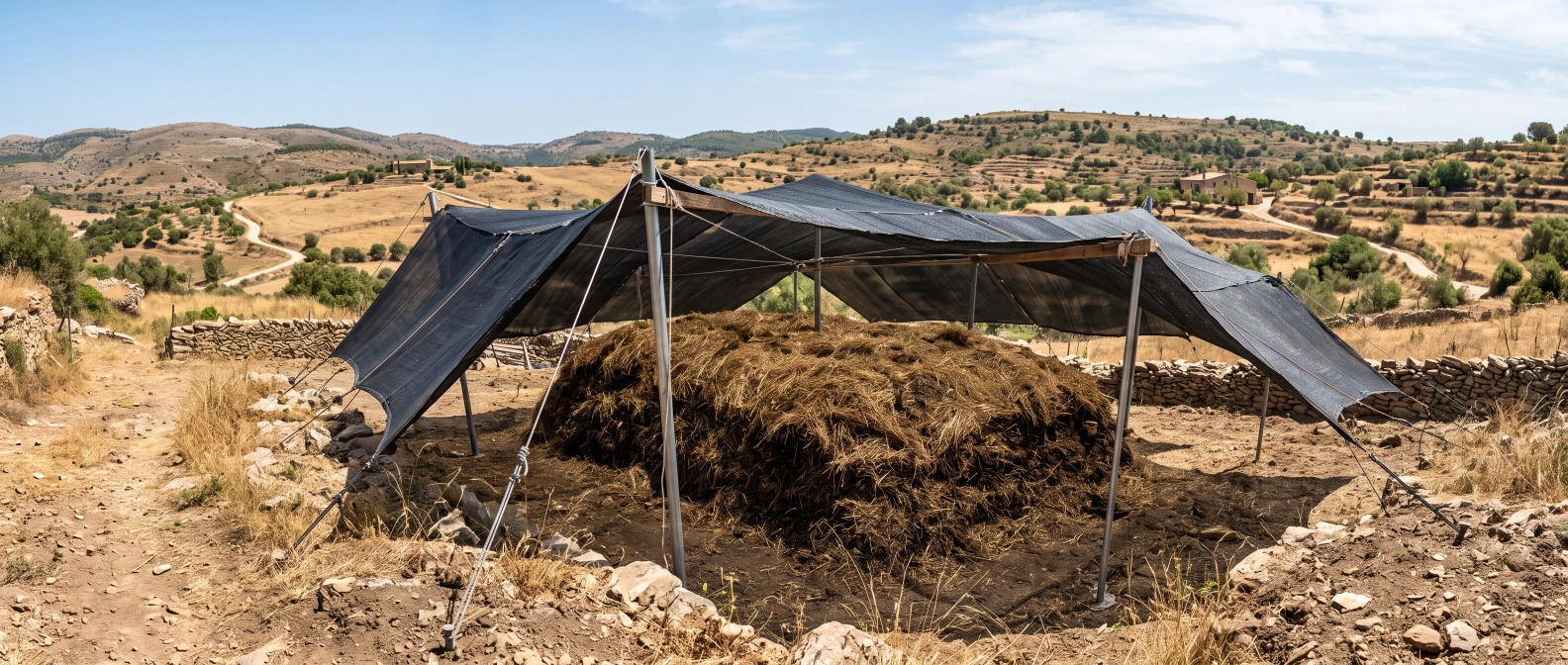
Through autumn, winter and spring, a heap here typically builds up good moisture and abundant fresh material, fed by real rain and a genuine flush of plant growth. Then summer arrives: two to four months with essentially no meaningful rainfall, combined with strong sun and often real heat. That combination is more than enough to dry out an unprotected heap, and once dry, composting microbes go dormant or die off, the process stalls, and it doesn't restart on its own.
The cost of getting this wrong isn't a minor setback. A heap that dries out in early summer can sit inert for the entire season, meaning months of accumulated progress simply stop rather than continuing at a reduced pace. Preventing that outcome, not managing constant scarcity the way an arid climate must, is the actual job of this chapter.
Pre-Summer Preparation
The real work happens before the dry season sets in, not during it. As the wet season winds down, this is the time to apply a thick mulch cap, straw, dry leaves, or similar coarse material, over whatever's in the heap. A good cap, several centimetres deep, dramatically slows surface evaporation and is the single highest-leverage thing done to prepare for summer.
Check moisture is genuinely good going into summer, using the standard squeeze test: a handful should feel like a wrung-out sponge, damp but not dripping. A heap that starts summer already dry has essentially no buffer left. And make sure shade is properly in place, whether that's shade cloth rigged over the heap or a genuinely shaded site chosen from the start (see Chapter 2); a heap in full summer sun loses moisture far faster than one that's shaded through the hottest part of the day.
Getting all three of these done before the rain actually stops, rather than scrambling once the heap is already drying out, is what separates a heap that sails through summer from one that has to be rescued partway through it.
Watering Through Summer
With good mulch and shade in place, occasional deep watering is usually enough to carry a heap through, roughly every couple of weeks depending on local heat and how exposed the site is, rather than the far more constant vigilance an arid climate demands. The goal here is bridging a defined dry season, not managing permanent scarcity, and that changes the whole watering strategy.
Check with the squeeze test rather than sticking to a rigid schedule, since local intensity, wind and how well the mulch cap is holding all affect how fast a heap dries out. When watering is needed, water deeply rather than a light surface sprinkle, which mostly evaporates before it reaches material that needs it. A slow, thorough soak that actually penetrates the mulch cap and reaches into the heap is worth far more than frequent shallow watering.
Accepting a Summer Slowdown
Even a well-prepared heap, properly mulched, shaded and watered occasionally, may still slow considerably over summer. That's a reasonable outcome, not a failure, similar in spirit to a boreal heap accepting winter dormancy, though far shorter here, typically weeks rather than months of the year. The point isn't to force full summer activity against the climate; it's to keep the heap protected and intact so it resumes properly once autumn rain arrives.
This is also where the two-chamber system (see Chapter 3) earns its place particularly well in this climate. A chamber that's already well-decomposed by the time drought sets in is far more resilient to summer conditions than a freshly-built heap would be, since finished or near-finished material holds together and retains moisture better than raw, actively-heating material. Timing the two-chamber changeover so the resting chamber carries the bulk of the summer load, while the active chamber gets built up again once autumn rain returns, is the practical toolkit for surviving the one part of the year that genuinely threatens a heap here.
Frequently Asked Questions
Why is summer the danger period for a heap here, rather than any other season?
Because a heap typically builds up good moisture and material through the mild wet season, then faces two to four months with essentially no meaningful rain. An unprotected heap can dry out completely across that stretch and effectively stop working for the whole summer, losing months of progress that then has to be rebuilt once autumn rain returns.
How much watering does a heap actually need through summer here?
Usually far less than an arid climate needs. Occasional deep watering, roughly every couple of weeks depending on local heat and how well the heap is mulched and shaded, is often enough, since the goal is bridging a defined dry season rather than managing permanent scarcity. Check with the squeeze test rather than watering on a fixed schedule, and water deeply rather than little and often.
Is it a problem if my heap barely does anything over summer?
Not necessarily. A well-prepared heap, mulched, shaded and watered occasionally, may still slow considerably over summer, and that's a reasonable outcome rather than a failure, similar in spirit to a boreal heap accepting winter dormancy, just far shorter. What matters is that it's protected and ready to resume properly once autumn rain returns, not that it keeps working at full pace through the driest months.