
The biology of composting doesn't change with climate: microbes need carbon for energy and nitrogen for growth, and the target ratio is the same everywhere, roughly 25-30 parts carbon to 1 part nitrogen by weight. What changes completely in a tropical or humid climate is which half of that equation is easy and which is hard, and it's the reverse of what most composting guides assume.
Nitrogen Is Abundant, Carbon Is Precious
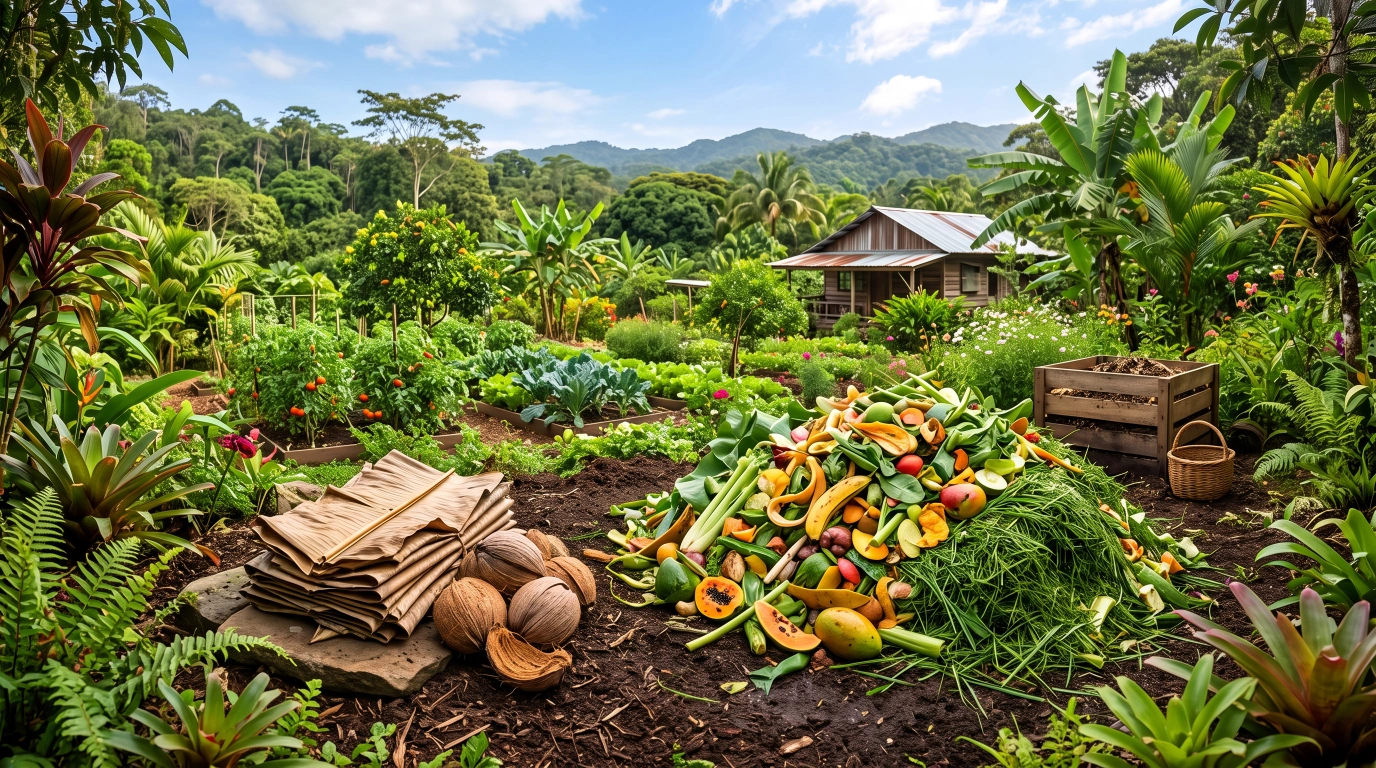
Fast, near-continuous plant growth means nitrogen-rich green material is everywhere: fresh kitchen scraps, grass clippings, fast-growing weeds, legume trimmings and banana leaves picked while still green all pile up with almost no effort. That's the easy half of the ratio, solved almost as a side effect of living here.
Carbon is the hard half, and this is the inverse of the usual composting problem. Dry, carbon-rich material is genuinely scarce, not because nothing carbon-rich grows here, but because almost nothing stays dry long enough to become proper brown material naturally. A fallen banana leaf that would dry into a crisp brown husk in a temperate autumn instead rots down within days in this heat and humidity. Dry carbon has to be actively made, by deliberately drying material, not simply gathered.
A heap built mostly on fresh green material, with only a token amount of dry carbon mixed in, will quickly turn wet, compacted and anaerobic, because there's nothing structural in the mix to hold air pockets open while the nitrogen-rich material breaks down.
Carbon vs Nitrogen at a Glance
A representative spread of materials genuinely available in a tropical or humid climate, from the most carbon-heavy to the most nitrogen-heavy. The full input list, with practical notes on using each one, is in the next chapter.
| Material | Type | Approx C:N Ratio | Notes |
|---|---|---|---|
| Cardboard (plain, kept dry) | C | ~400:1 | Shred first; keep out of rain until use |
| Dried coconut fronds | C | ~100-150:1 | Chop or crush; slow to break down whole |
| Coconut husk / coir | C | ~75-100:1 | Tough, needs shredding; genuinely abundant near coconut palms |
| Dried banana leaves | C | ~50-60:1 | Must be deliberately sun-dried, doesn't happen on its own |
| Rice hulls / dried crop residue | C | ~60-100:1 | Good bulk carbon where grown locally; keep dry |
| Legume green manure trimmings | N | ~15:1 | Abundant fast-growing nitrogen source (see Chapter 12) |
| Fresh kitchen scraps | N | ~15:1 | Reliably plentiful year-round in this climate |
| Fresh-cut grass | N | ~15-20:1 | Fast-growing and continuous; use before it mats down |
| Fresh weeds | N | ~15-20:1 | Pull before seed set; near-constant supply |
| Banana pseudostem (fresh) | N | ~20-30:1 | High moisture; chop small (see Chapter 6) |
Ratios are approximate -- real material varies with freshness, moisture content and exact species. Treat them as a guide to relative balance, not a figure to measure precisely.
Working By Volume, Not Weight
You don't need to weigh anything to get this right in practice. Dry carbon material is typically bulkier and lighter than fresh green material, so working by volume naturally lands close to the target ratio: roughly two buckets or barrowloads of dry carbon (dried banana leaves, coconut husk, cardboard) to every one bucket of fresh greens (kitchen scraps, grass clippings, weeds).
The practical challenge here is rarely getting that ratio precisely right, it's actually having two full buckets of dry carbon ready when you need them. Since fresh greens accumulate on their own, deliberately dry and stockpile carbon material ahead of time so it's there when you're building or topping up a heap, rather than reaching for more greens when a batch turns slimy (see below).
Troubleshooting: The Slimy, Anaerobic Heap
The most common failure in this climate is a heap that's gone wet, slimy and smelly, usually within days of being built. This is almost always the result of far too much fresh green material and not nearly enough dry carbon to balance it, compounded by rain adding even more moisture on top.
Adding more fresh green material never fixes this, since greens are exactly what's already in excess. The actual fix is to go looking for dry carbon deliberately: sun-dry banana leaves or coconut husk in advance, keep a stockpile of cardboard somewhere dry and ready before you need it, and treat the search for dry carbon as an ongoing task rather than something to solve after the heap has already turned slimy.
Frequently Asked Questions
What's the ideal carbon-to-nitrogen ratio in a tropical climate?
The target is the same everywhere, roughly 25-30 parts carbon to 1 part nitrogen by weight. What's different in a tropical or humid climate is which half of that ratio is easy to reach. Nitrogen-rich green material is abundant here thanks to fast, near-continuous plant growth, while dry, carbon-rich brown material is genuinely scarce, because almost nothing stays dry long enough to become proper brown material naturally.
Why does my heap keep turning slimy and smelly?
This is the most common failure mode in this climate, and it's almost always too much fresh green material with too little dry carbon to balance it. A heap that's mostly nitrogen-rich and wet quickly runs out of oxygen and turns anaerobic, which is where the slime and smell come from. Adding more fresh greens only makes it worse. The fix is deliberately seeking out and stockpiling dry carbon in advance, not just adding more of what's already abundant.
Why is dry carbon material so hard to find when so much is growing here?
Because almost everything growing in this climate is soft, moist and fast-decomposing rather than dry and woody. Material that would dry into straw or dead leaves in a cooler or drier climate simply rots down here before it ever gets the chance. Genuine dry carbon, banana leaves left to dry in the sun, coconut husk, cardboard kept out of the rain, has to be actively sought out and stockpiled ahead of time rather than gathered as needed.
Do I need to weigh my compost inputs to get the ratio right?
No -- working by volume rather than weight is accurate enough in practice, because dry carbon material is typically bulkier and lighter than fresh green material. The rule of thumb is roughly two buckets or barrowloads of dry carbon to every one bucket of fresh greens. In this climate the practical task isn't measuring that ratio precisely, it's actually having two full buckets of dry carbon on hand, since that's the half that has to be deliberately dried and stockpiled rather than simply gathered.