
If this guide had only one structural chapter to get right for a tropical or humid climate, it would be this one. A single downpour here can deliver more rain than a temperate climate sees in a week, and an uncovered heap doesn't just get a bit wetter for it, it floods. Everything in this chapter exists to keep that from happening without shutting off the airflow a fast-decomposing heap needs just as badly.
Why a Roof Is Non-Negotiable Here
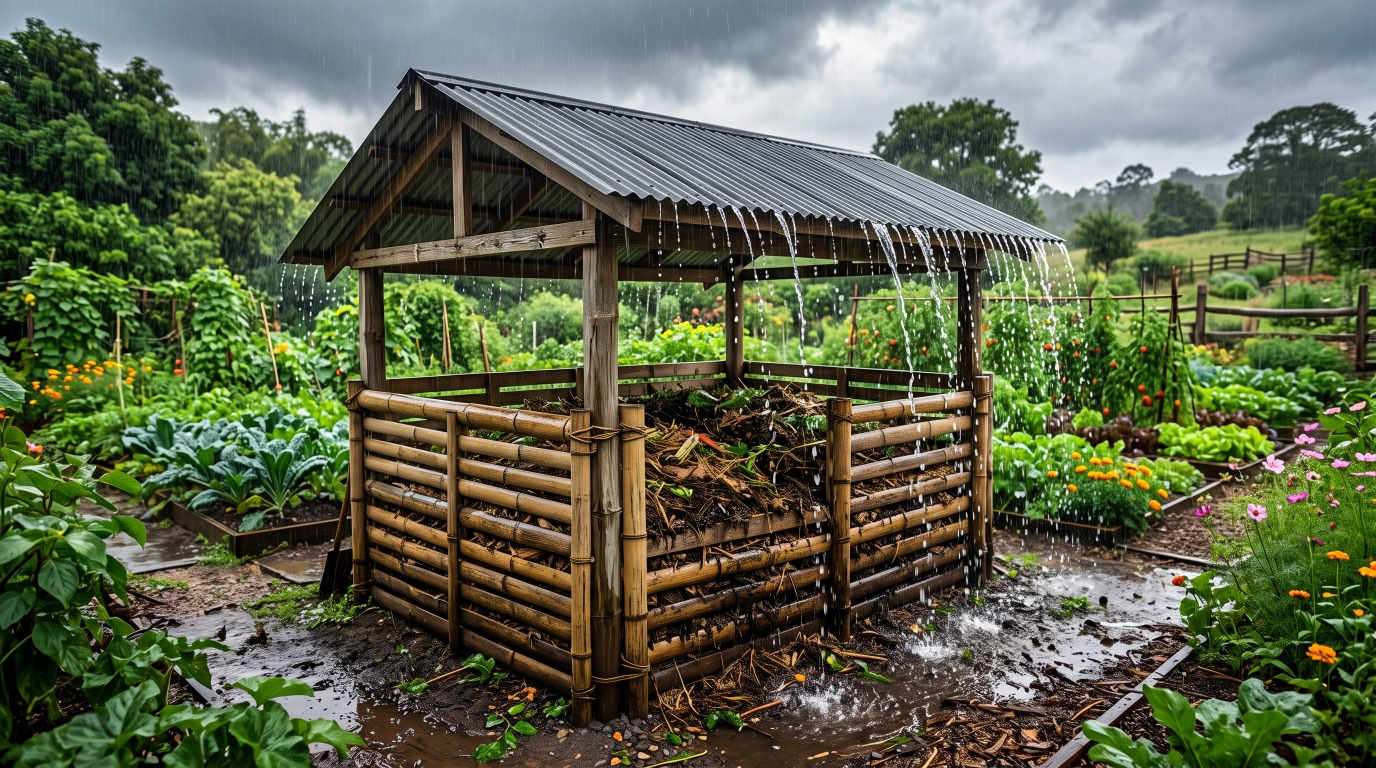
In a drier or cooler climate, a compost heap left uncovered through a rain shower usually just gets damp, and that moisture can even be welcome. In a tropical or humid climate, the same lack of cover through one intense downpour can push a heap from properly moist to fully waterlogged in under an hour. Once that happens the air pockets aerobic bacteria depend on fill with water, decomposition slides toward slow, smelly, anaerobic breakdown, and dissolved nutrients wash straight out through the bottom before they ever reach your soil (see Chapter 11).
A roof isn't a nice-to-have refinement here the way it might be treated in a milder climate's guide, it's the single feature that determines whether the system works at all through a wet season.
Simple, Low-Cost Roofing
The roof doesn't need to be elaborate. A pitched thatch roof, a sheet of corrugated metal, or even a well-secured tarp all work, provided two things are true: it's genuinely pitched, not flat, so water runs off rather than pooling on top of the heap, and it extends well beyond the edges of the bin itself. A generous overhang, at least as wide as the depth of the bin below it, matters more than the roofing material chosen, since wind-driven rain will find its way under a roof that stops right at the walls.
Whatever material is used, slope it so water sheds away from the heap and off to one side of the structure, never toward a low point directly above it.
Raised Platform Construction
Roofing handles water from above, but a raised base handles what happens from below and to the sides. Building the heap on bamboo, pallets or stacked blocks lets excess moisture drain away from underneath rather than collecting in the base of the pile, and it opens airflow from below the same way slatted walls open it from the side. This platform work sits alongside the site and structural choices covered in Chapter 2, roofing is what protects the heap once the site and base are already right.
Breathable Walls and Managing Runoff
Walls that block rain but not air
Slatted bamboo or timber side walls, angled to break driving rain without sealing the heap off, are the better choice over solid panelling. The goal is to stop rain that's blowing in sideways during a storm while still letting air move freely through the heap the rest of the time, since airflow is what keeps a fast-decomposing tropical heap from overheating or slipping anaerobic in still, trapped conditions.
A gutter or channel to carry runoff away
Even a good roof sheds a large volume of water somewhere, and if that water lands right at the base of the structure it will pool there or seep sideways into the heap through the lower walls, undoing the protection the roof provides. A simple gutter along the roof edge, or just a shallow channel dug around the structure, carries that runoff a safe distance away instead.
Enclosed Bin vs. Roofed Open-Sided Structure
A fully enclosed bin gives the most rain protection, but it restricts airflow and carries a real risk of overheating or turning anaerobic in trapped, still air, exactly the failure mode this climate is most prone to. An open-sided structure under a good roof gives up a little of that rain protection in exchange for much better airflow, and simply needs more careful siting and wall angling to keep driving rain out. For most situations in this climate, the roofed-and-open-sided approach is the better default, and it's the one this guide recommends building toward.
Frequently Asked Questions
Is a roof really necessary, or is a tarp cover enough for occasional rain?
A roof is necessary, not optional, in this climate. A single tropical downpour can deliver more rain than a temperate climate sees in an entire week, and an uncovered heap doesn't just get damp in that kind of event, it floods. A properly pitched roof with a generous overhang, whether thatch, corrugated sheet or a well-secured tarp, is the single most important structural feature of any tropical compost system.
Should a tropical compost bin be fully enclosed or open-sided?
A roofed, open-sided structure with slatted or breathable walls is the better default for most situations. A fully enclosed bin gives more rain protection but restricts airflow and carries some risk of overheating or turning anaerobic in trapped, still air. An open-sided design under a good roof gives better airflow and needs more careful siting to keep driving rain out, which is a trade worth making.
What's the point of guttering or a drainage channel around a compost structure?
Without one, water shed by the roof lands right at the base of the structure and either pools there or seeps sideways into the heap through the lower part of the walls, undoing the protection the roof was supposed to provide. A simple gutter or a shallow channel dug around the structure carries that runoff away to a safe distance instead, keeping the base of the heap genuinely dry rather than just shielded from above.