
A full working reference of what a tropical or humid climate genuinely offers for composting, sorted by carbon and nitrogen, plus a clear line on what to keep out of the heap altogether. Everything here is something you can grow, gather or produce yourself, there's no assumption of a bag from a shop or a bin collected from the roadside.
Good Carbon Inputs
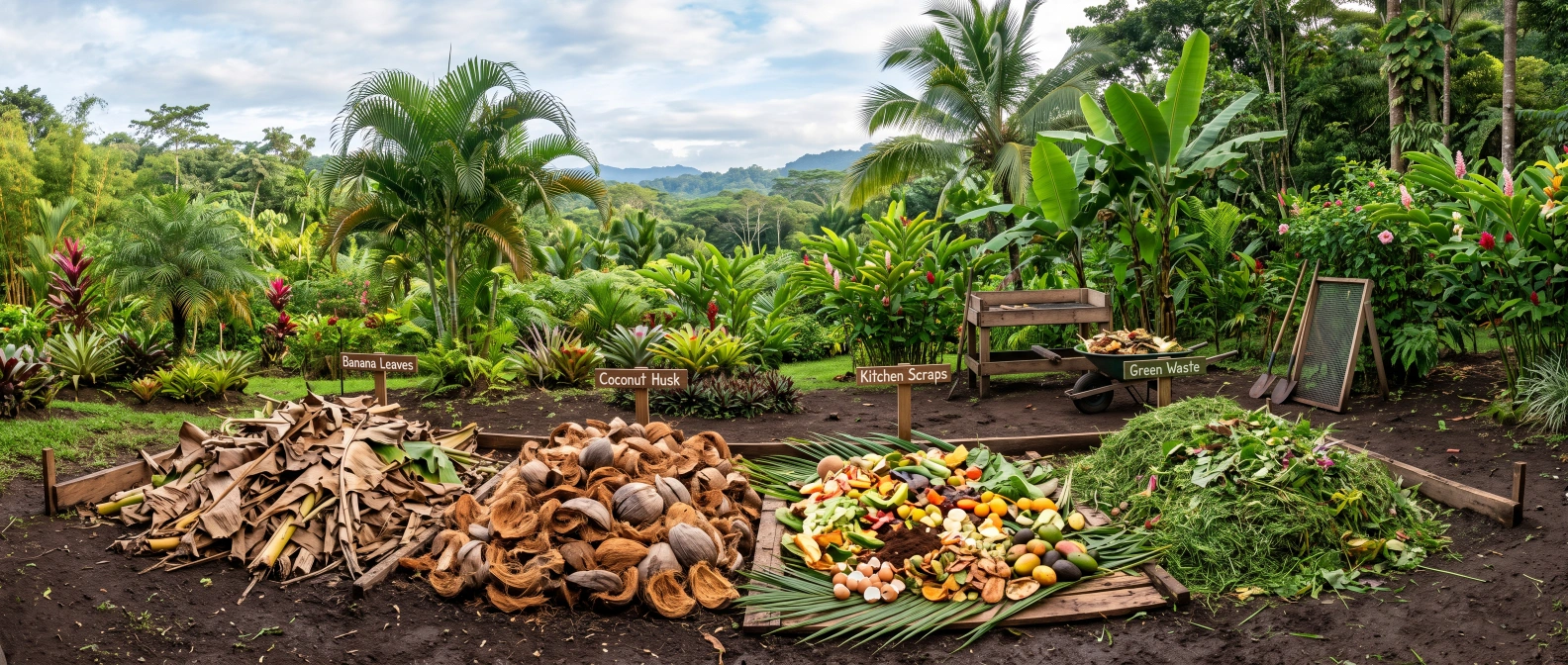
- Dried banana leaves -- must be deliberately sun-dried before use, since a fresh-fallen leaf rots rather than dries in this climate; the single most accessible brown material for most growers here.
- Coconut husk and coir -- tough and slow to break down whole, but genuinely abundant near coconut palms and a reliable structural carbon source once shredded.
- Dried coconut fronds -- chop or crush before adding; a good bulk carbon source anywhere coconut palms are grown.
- Rice husks or other dried crop residue -- wherever locally grown, a useful dry bulk carbon input; keep it under cover until it's mixed in.
- Cardboard -- shred first, and store it somewhere completely dry until you're ready to use it, since it will absorb ambient humidity and lose its structural value if left exposed.
Good Nitrogen Inputs
- Fresh kitchen scraps -- reliably plentiful year-round; the everyday backbone of nitrogen input for most households in this climate.
- Fresh-cut grass and weed cuttings -- fast-growing and near-continuous; use promptly before a thick layer mats down and goes anaerobic on its own.
- Banana pseudostem and plantain waste -- high in moisture and genuinely useful nitrogen once chopped small; see Chapter 6 for handling this material in detail.
- Legume trimmings -- fast-growing tropical legumes provide some of the richest green nitrogen available in this climate.
- Urine -- a concentrated, always-available nitrogen source; see Chapter 8 for safe dilution and use.
Materials to Avoid
Not everything belongs in the heap, and in this climate the consequences of getting this wrong show up fast. Some materials are a firm no under any circumstances; others are usable but need extra preparation first.
| Material | Tier | Why / What To Do Instead |
|---|---|---|
| Meat, fish, cooked food, dairy | 1 -- Avoid entirely | Attracts rats and flies fast in tropical heat; pile separately, never in the main heap |
| Diseased plant material | 1 -- Avoid entirely | Disease and fungal pressure is high here; pile separately or use biochar/burning (Chapter 9) |
| Pet or dog faeces | 1 -- Avoid entirely | Pathogen risk; keep out of any heap destined for food-growing beds |
| Perennial weed roots, invasive vine cuttings | 1 -- Avoid entirely | Can resprout from small fragments in warm, moist conditions; pile separately and dry out fully first |
| Mature coconut husk, dense woody prunings | 2 -- Use with caution | Genuinely useful carbon, but shred or chop first or it will take a long time even here |
| Heavily waxed or oily fronds | 2 -- Use with caution | Resists breakdown; shred small and mix thin rather than layering thick |
Frequently Asked Questions
Why is meat, fish or cooked food such a firm no in this climate specifically?
Heat accelerates decomposition of these materials into an attractive, foul-smelling state within hours rather than days, and pest and disease pressure is already higher in a tropical climate than in a cooler one. Together that means meat, fish, cooked food and dairy draw rats, flies and other pests to a heap far faster here, so these stay out entirely rather than being added in small amounts.
Can tough material like mature coconut husk or woody prunings still be composted here?
Yes, and it's genuinely useful as one of the more reliable dry carbon sources in this climate, but it needs to be shredded or chopped small first. Left whole, even the fast decomposition this climate offers won't break it down in any reasonable time, since its toughness is exactly what makes it useful as structural carbon in the first place.
What should be done with diseased plant material instead of composting it?
Pile it separately from the main heap rather than mixing it in. Disease and fungal pressure is higher in a tropical climate than in most others covered in this guide, and a home compost heap won't reliably reach the sustained temperatures needed to kill off many pathogens, so diseased material composted alongside healthy waste risks spreading the problem back into your growing beds. Burning it or converting it to biochar (see Chapter 9) is the safer route.