
A temperate coastal guide would point you toward seaweed here, but most of the humid tropics is nowhere near a coast: the Amazon and Congo basins, inland Southeast Asia, and countless upland smallholdings sit hundreds of kilometres from the sea. What's genuinely universal across the tropics instead is banana and coconut waste, byproducts of two of the most widely grown food plants on the planet, and this chapter treats them as the representative case for a wider category: whatever locally abundant crop residue is piling up around you.
Banana Pseudostem & Leaves
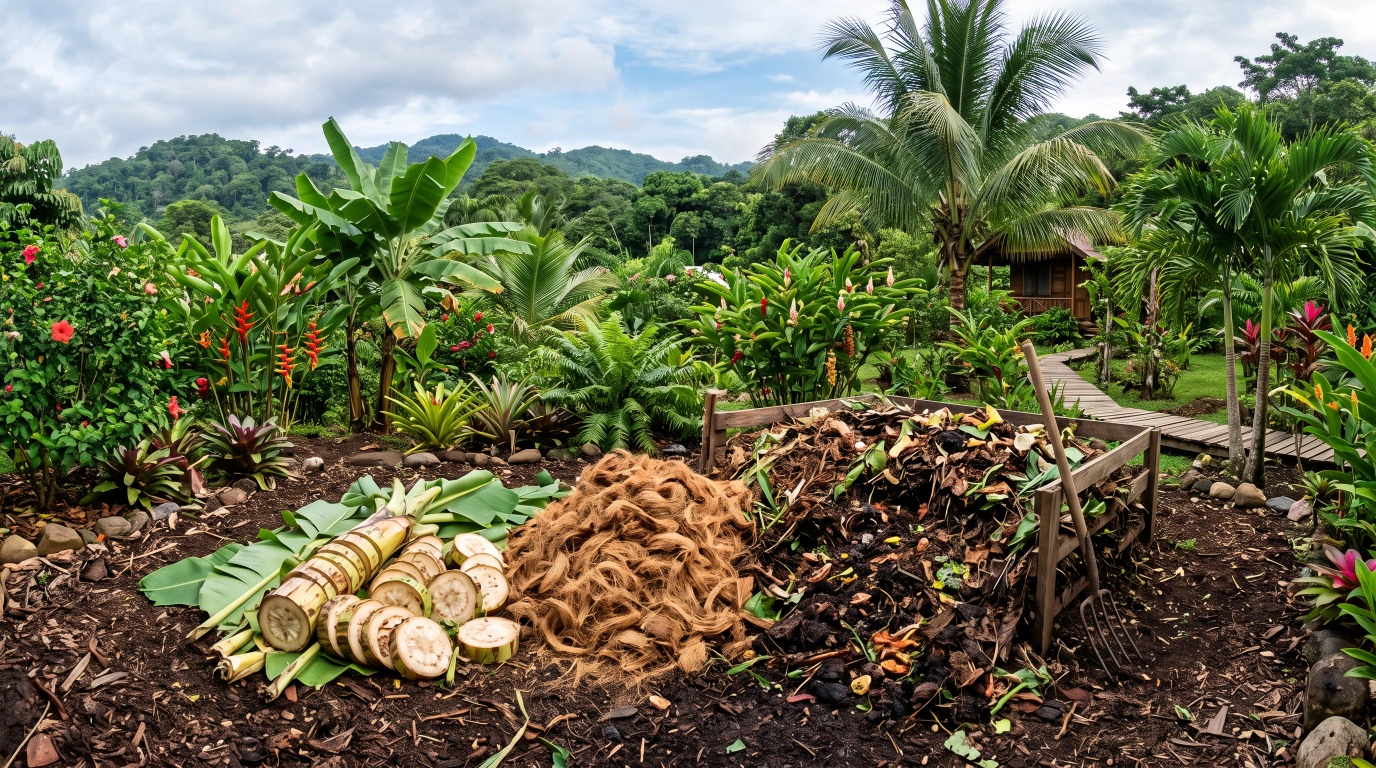
The pseudostem is the soft, fibrous false trunk left standing once the fruit bunch has been harvested, not a true woody stem at all but tightly layered leaf sheaths. It's extremely high in moisture and potassium, breaks down fast once chopped into manageable pieces, and is routinely left to rot in the field or discarded entirely, despite being a genuinely valuable input that most gardens elsewhere would never have access to.
Green banana leaves are nitrogen-rich and compost quickly alongside other fresh green material. Left to dry first, though, they become one of the few reliable dry carbon sources available in this climate, a genuine find given how scarce true dry carbon is here (see Chapter 4). Deliberately setting aside a stack of leaves to dry in the sun, rather than composting them fresh, is worth doing precisely because so little else in a tropical garden dries out before it rots.
Plantain and other tropical fruit trimmings, peels, stalks and spoiled fruit generally, follow the same pattern as banana material: soft, moist, fast-breaking-down green matter that adds bulk and nitrogen without needing any special handling.
Coconut Husk, Coir & Shell
Whole coconut husk is dense with lignin and extremely slow to break down as a solid piece, it can sit in a heap for a year or more with barely a visible change. Chopped or shredded, the same fibrous material, coir, becomes genuinely useful: a long-lasting carbon source that resists collapsing into mush the way soft green material does, and one of the best materials available anywhere for improving a soil's water retention once it's worked in.
The hard shell underneath the husk is a different case again. It barely breaks down through ordinary composting at all, even shredded, so rather than fighting it, the more useful destination for coconut shell is biochar production, where its density becomes an advantage instead of an obstacle (see Chapter 9).
Where coconuts aren't grown locally, the same three-way split, soft fast-rotting husk fibre used shredded, hard slow-rotting shell diverted to biochar, still applies to whatever the local equivalent is, palm husk, hard nut shells, or dense fruit stones from whatever tree crop dominates nearby.
Where Banana and Coconut Aren't the Local Crop
This chapter isn't a requirement to grow bananas or coconuts specifically, it's a representative example of a broader, genuinely universal principle: every tropical smallholding sits near an abundant, locally dominant crop residue, and that residue is almost always the single best free compost input available. The specific plant changes, the underlying opportunity doesn't.
- Cassava peelings -- moist, fast-breaking-down, a staple byproduct across much of Africa and parts of Asia and Latin America.
- Sugarcane bagasse -- the fibrous pulp left after juicing, slower to break down and useful as a carbon-rich bulking material.
- Rice straw and husk -- straw composts readily as a carbon source, husk breaks down more slowly but still contributes bulk and drainage.
Frequently Asked Questions
Why banana and coconut waste instead of seaweed in this guide?
Because most tropical growing regions, the Amazon and Congo basins, inland Southeast Asia, are nowhere near a coast, while banana and coconut byproducts turn up almost everywhere in the tropics regardless of distance from the sea. Seaweed is a genuinely excellent input where it's available, but it simply isn't the near-universal local resource here that it is in a coastal temperate climate.
What makes banana pseudostem such a valuable compost input?
The pseudostem is the soft, fibrous false trunk left standing after the fruit bunch is harvested, and it's extremely high in moisture and potassium. It's often discarded as waste despite breaking down fast and contributing a nutrient most other tropical inputs don't supply in the same quantity, making it a genuinely valuable and frequently overlooked material.
What if I don't grow bananas or coconuts?
The same principle applies to whatever locally dominant crop is grown in quantity nearby, cassava peelings, sugarcane bagasse, rice straw and similar residues fill the same role. This chapter is representative of a broader category, abundant, locally dominant crop residue, not a requirement to grow bananas or coconuts specifically.