
This is arguably the single most important chapter in the whole guide for this zone. Torrential tropical rain doesn't just risk waterlogging a compost heap, it actively dissolves and carries away nutrients, both from a poorly protected heap and from the wider soil around it. Understanding why, and building the habits that slow and capture that loss instead of surrendering to it, changes almost everything else in this guide from a set of separate tips into one coherent strategy.
Why Leaching Defines This Climate
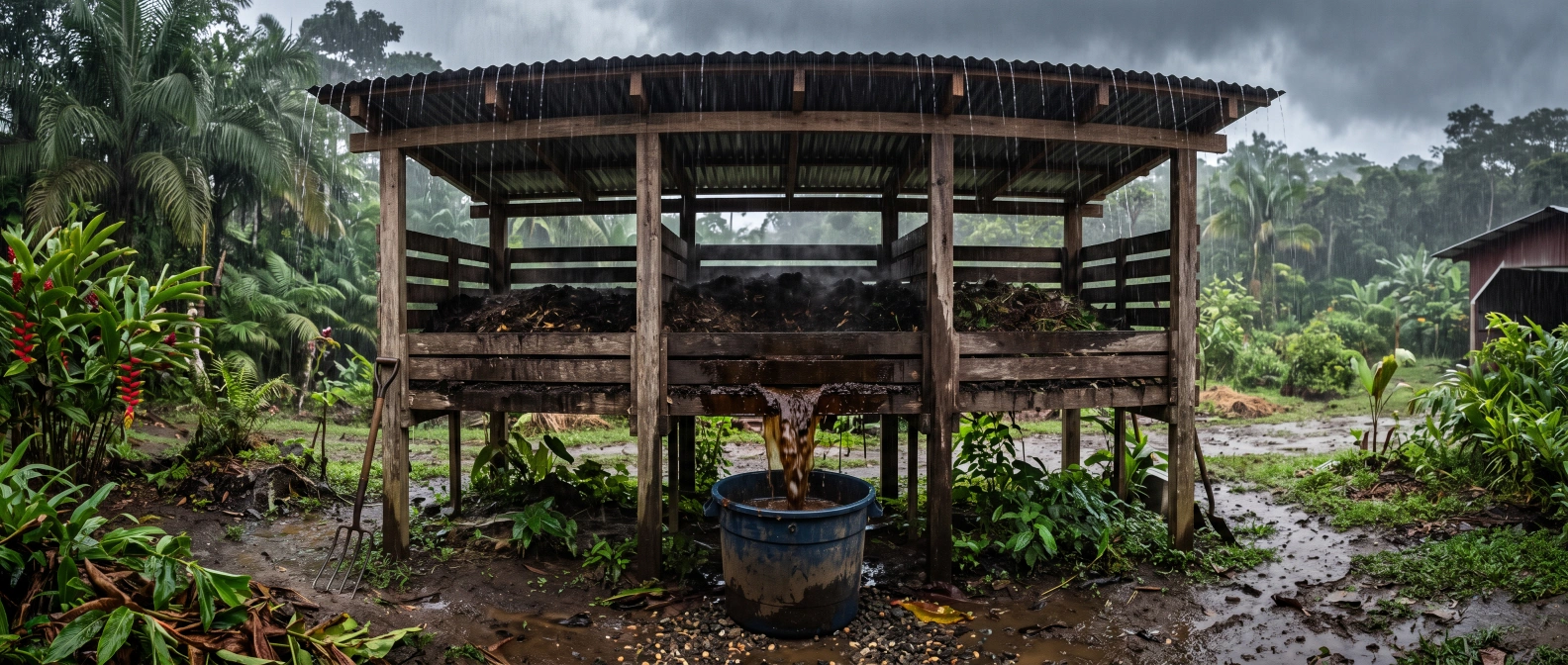
Lush vegetation, low-fertility soil: not a contradiction
Much of the humid tropics has naturally low-fertility soil despite supporting some of the most abundant plant growth on earth, and leaching is the reason. Nutrients here cycle through living plants rather than accumulating in the soil, because anything not immediately taken up by a plant root is dissolved and washed away by the next downpour. The fertility isn't missing, it's constantly in motion, which means anything you produce, whether compost or the soil's own nutrient reserves, is under the same relentless pressure to be captured and used fast, or lost.
Protecting the heap itself, from every direction at once
A roof, covered in Chapter 3, stops direct rain from hitting the heap, but that solves only half the problem. Water draining through a heap from below or the sides, because it's sitting in a puddle or against wet ground, can strip nutrients just as effectively as rain falling straight onto it. This is why roofing and raising the heap on a well-drained base are treated as a single combined technique throughout this guide, not as alternatives, they close off two separate routes nutrients would otherwise take out of the heap.
Mulch: Slowing Water Down Everywhere, Not Just at the Heap
The same leaching problem plays out across every bed in the garden, not just at the compost heap, and the same solution applies at that scale too. A thick mulch layer on garden beds absorbs the force of a downpour and slows water's path into and through the soil, giving plant roots and soil organisms more chance to capture nutrients before they wash past root depth. This connects directly to the no-dig, permanently mulched approach covered in Chapter 18, where a stable mulch layer is treated as protective infrastructure for the soil, not just a weed-suppression convenience.
Catching Nutrient-Laden Runoff Instead of Losing It
Where practical, a simple catchment or collection setup beneath a covered heap can turn water draining off it from a loss into a resource, diluted and used as a liquid feed rather than left to soak away unused. This is worth setting up deliberately rather than treating as an afterthought, and pairs directly with the liquid feeding approaches in Chapter 16. The broader principle behind all of this: water retention and capture strategies that make sense in a dry climate get inverted here into water-slowing and nutrient-capture strategies, because the resource genuinely under pressure in this climate is nutrients, not water itself.
Frequently Asked Questions
Why is leaching such a severe problem in a tropical or humid climate?
Because torrential rain doesn't just risk waterlogging a heap, it actively dissolves and carries nutrients away, both from a poorly protected compost heap and from the wider soil. This is exactly why so much of the humid tropics has naturally low-fertility soil despite lush vegetation, the nutrients are cycling through living plants rather than accumulating in the soil, since anything not immediately taken up by a plant root gets washed away.
Isn't a roof enough to stop a compost heap losing nutrients to rain?
Not on its own. A roof stops direct rain hitting the heap, but it can still lose nutrients to water draining through it from below or the sides if it isn't also raised and well-drained. Roofing and raised, well-drained construction work together, not as alternatives to each other.
What's the general principle for adapting dry-climate water techniques to a wet tropical climate?
Invert them. A dry climate's techniques are built around retaining and capturing scarce water. Here the resource under pressure is nutrients, not water, so the same instinct becomes about slowing water down and capturing nutrients before they wash past root depth, rather than about holding onto water itself.