
A working reference of what's genuinely available to build a heap with in a Mediterranean climate, and what belongs nowhere near it. Nothing here relies on anything you can't gather, grow or produce yourself, in keeping with this guide's whole approach to self-sufficiency.
Good Carbon Inputs
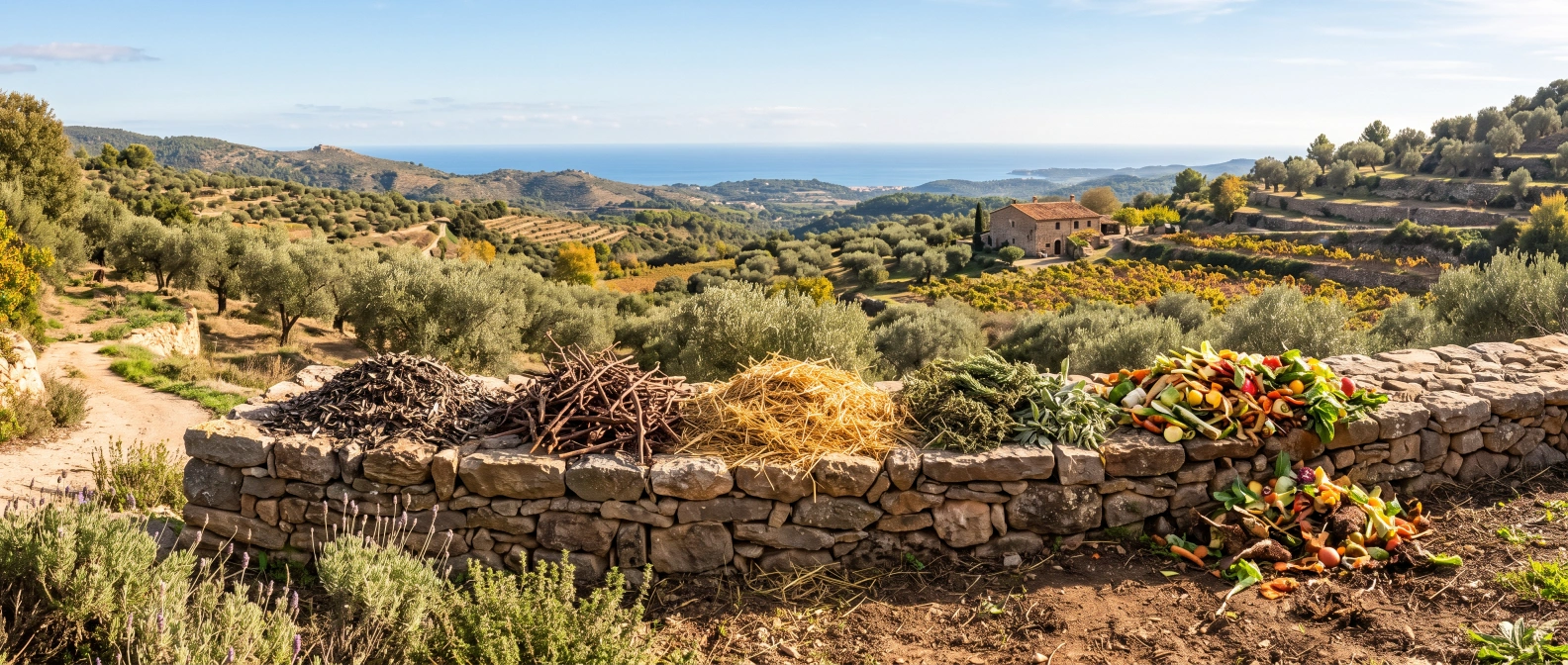
- Dried olive leaves -- abundant after pruning and harvest; shred or crush lightly to speed breakdown.
- Grape and vine prunings -- genuinely tough and woody. Shred first, whole prunings decompose very slowly (see Chapter 6).
- Straw -- excellent bulk carbon wherever grain is grown locally, and useful as a mulch material too.
- Dried aromatic herb trimmings, in moderation -- rosemary, lavender and thyme are useful browns, but their essential oils genuinely slow bacterial breakdown. Keep them a minor component rather than a main carbon source.
- Cardboard -- shred before use and keep it dry until then; a reliable brown to bridge the gap between pruning seasons.
Good Nitrogen Inputs
- Fresh kitchen scraps -- available year-round, genuinely abundant with the household routine, and a reliable nitrogen source in every season.
- Wet-season grass and garden clippings -- a strong nitrogen source through the mild growing months; use fresh rather than letting it mat down into an airless layer.
- Legume winter cover crop trimmings -- cut before the dry season sets in for a genuinely strong nitrogen boost (see Chapter 12).
- Manure, where available -- a genuinely valuable local resource if livestock are kept; strength varies with the animal and any bedding mixed in.
- Urine -- a concentrated, genuinely free source of nitrogen year-round, independent of the seasonal flush; always dilute before use (see Chapter 8).
Materials to Avoid
Not everything that could theoretically go into a heap should. Some materials are genuine no-gos, others are fine in small amounts but cause real problems if overdone. If something needs to be kept out of a heap, pile it separately or, where appropriate, refer to biochar production (Chapter 9) as an alternative use, rather than treating it as waste with nowhere to go.
| Material | Tier | Why |
|---|---|---|
| Meat, fish, cooked food, dairy | 1 -- avoid entirely | Attracts pests and creates genuine odour problems |
| Diseased plant material, especially olive knot and other orchard diseases | 1 -- avoid entirely | A heap here may not reliably reach temperatures high enough to kill pathogens common in this climate's orchards |
| Pet or dog faeces | 1 -- avoid entirely | Can carry pathogens harmful to humans; keep well away from food-bound compost |
| Perennial weed roots and seeds | 1 -- avoid entirely | May survive a heap that doesn't heat consistently all the way through |
| Large quantities of unshredded olive or grape prunings | 2 -- use with caution | Genuinely slow whole; chip or shred first or they can sit largely unchanged for a very long time |
| Large quantities of aromatic herb trimmings (rosemary, lavender, thyme) | 2 -- use with caution | Essential oils genuinely slow bacterial breakdown; fine as a minor component, shouldn't dominate a heap |
Tier 1 materials should stay out of the heap entirely. Tier 2 materials are genuinely useful inputs, but only when kept to a modest share of the overall mix.
Frequently Asked Questions
Can I compost grape and olive prunings whole?
Not effectively, no. Whole woody prunings are genuinely slow to break down and can take a very long time sitting largely unchanged in a heap. Chip or shred them first, whether with a dedicated shredder or simply cutting them into short lengths by hand, and they become a genuinely excellent bulk carbon source instead of a heap-clogging obstacle.
Why are dried herb trimmings listed as both a good input and something to use with caution?
Because both are true. Rosemary, lavender and thyme trimmings are a genuinely useful, free carbon source in this climate, but their essential oils genuinely slow bacterial breakdown, similar to the caution given for eucalyptus in other climates' guides. Fine as a minor component of a heap, they shouldn't be allowed to dominate it, or the whole heap's decomposition can slow down alongside them.
What should never go in a Mediterranean compost heap?
Meat, fish, cooked food and dairy top the list, along with diseased plant material. This deserves particular care here, since olive knot and other diseases common in this climate's orchards should never go in the heap, as an inconsistently heating pile may not kill the pathogens. Pet or dog faeces and perennial weed roots or seeds should also stay out for the same reason, they can survive a heap that doesn't heat evenly all the way through.