
A tropical or humid climate -- the hot, wet lowlands near the equator, from Southeast Asia and the Amazon and Congo basins to coastal West Africa, the Caribbean and the Pacific islands -- gives composting more raw speed than almost anywhere else on earth, and also its most relentless adversary. Understanding these properly, not just as a list of tips but as the actual biology behind them, is the foundation everything else in this guide builds on.
The Challenges
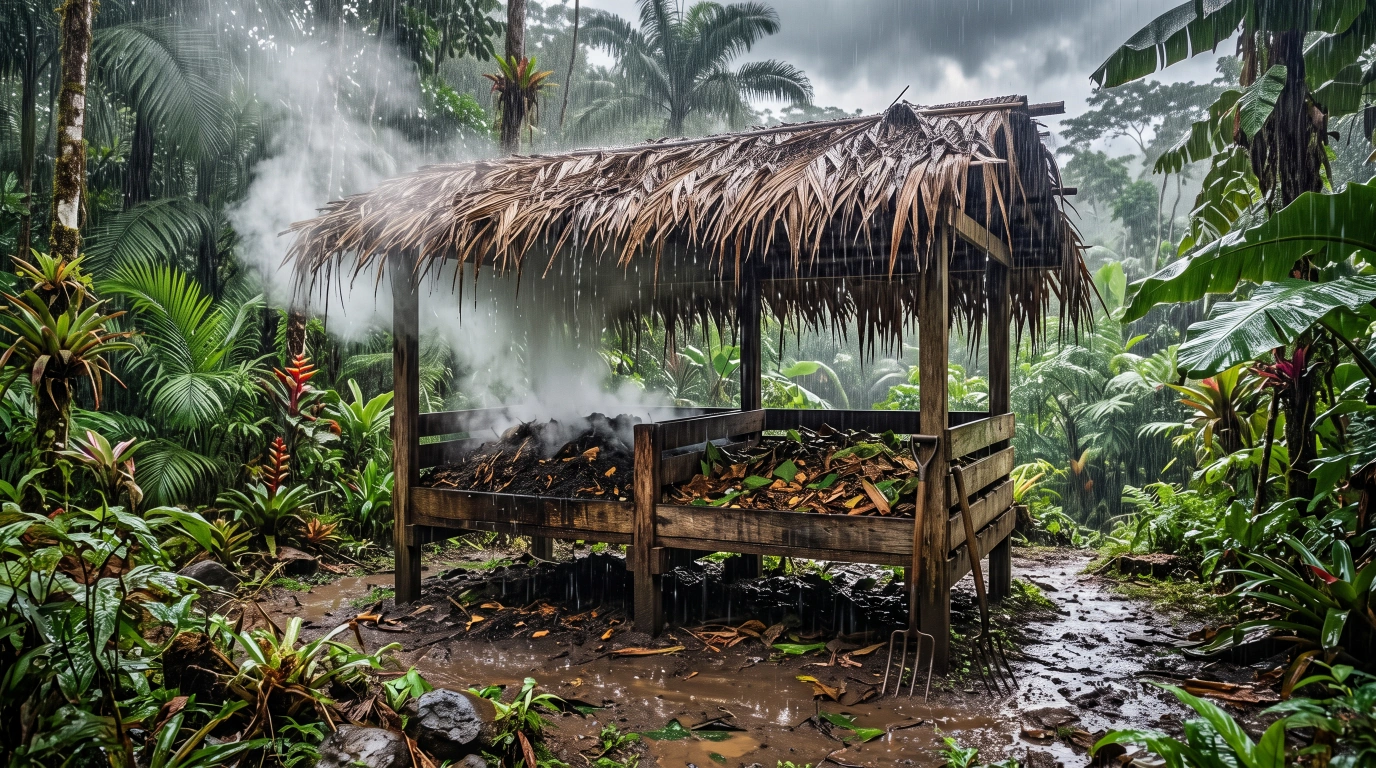
Torrential rain can waterlog a heap in hours
Tropical rain arrives as short, intense downpours rather than the steady drizzle of a cooler climate, and an uncovered heap can go from properly moist to fully waterlogged in a single storm. Once the air pockets aerobic bacteria depend on fill with water, the heap slides toward slow, smelly anaerobic decomposition, and the same rain that caused the problem carries dissolved nutrients straight out through the bottom before they ever reach your soil. This is why raised, roofed, well-drained systems run through almost every chapter in this guide (see Chapter 3).
Dry carbon material is genuinely scarce despite abundant growth
This is the inverse of the usual composting problem. Nitrogen-rich green material is everywhere, thanks to fast, near-continuous plant growth, but the dry, woody, carbon-rich material that balances it is genuinely hard to find, because almost everything growing here rots down before it ever has the chance to dry out. Straw and dead leaves, taken for granted in a temperate or arid garden, simply don't accumulate the same way. Deliberately seeking out dry carbon, banana leaves left to dry, coconut husk, cardboard, becomes an active task rather than something lying around waiting to be used.
High disease pressure demands real caution
Heat speeds up pathogen die-off, but it also means a much wider range of disease organisms and pests are already active in this climate than in a cooler one, so guidance that would be adequate elsewhere needs to be more conservative here, not less. This matters most in handling humanure safely (Chapter 7), where higher background disease pressure is exactly why this guide doesn't treat faster theoretical composting as licence to cut corners.
Native soils are often already heavily leached
Much of the humid tropics sits on soil that has already lost a large share of its natural fertility to the same relentless rain a compost heap has to be protected from, which is exactly why Chapter 19 treats consistent, well-protected composting as a genuine rebuilding project rather than simple maintenance.
The Advantages
- Extremely fast decomposition once drainage is under control -- microbial activity roughly doubles for every 10°C of warmth within a heap's normal operating range, and tropical heat sits near the top of it almost year-round.
- Abundant nitrogen-rich green material from fast, near-continuous plant growth -- the resource most other climates in this guide have to work hard to find enough of.
- Fast pathogen die-off in sustained heat, once a heap is properly built and protected from the waterlogging that would otherwise undermine it (see Chapter 7).
- Genuinely universal access to tropical plant waste -- banana pseudostems, coconut husk and coir, plantain trimmings -- provide a free, locally abundant compost input almost everywhere in this zone (see Chapter 6).
Frequently Asked Questions
Why does rain matter so much more here than in other climates?
Tropical rain isn't the steady drizzle of a temperate climate, it arrives as short, intense, torrential downpours capable of delivering more water in an hour than a cool climate sees in a week. An uncovered heap can be pushed from properly moist to fully waterlogged in a single storm, forcing out the air pockets aerobic bacteria depend on and washing dissolved nutrients straight through and out the bottom. This is why raised, roofed, well-drained systems run through almost every chapter in this guide rather than being an optional extra.
Why is decomposition so much faster in a tropical climate?
Microbial activity roughly doubles for every 10°C rise in temperature within the range compost heaps normally operate, and tropical heat sits at the high end of that range almost year-round. Combined with consistently high humidity, which keeps material from drying out the way it can elsewhere, the conditions for microbial activity are close to ideal for most of the year, once excess water is drained away rather than left to pool.
Does a tropical or humid climate actually have any advantages for composting?
Genuinely, yes, and they matter as much as the challenges. Extremely fast decomposition and pathogen die-off once drainage is under control, abundant nitrogen-rich green material from fast, near-continuous plant growth, and genuinely universal access to tropical plant waste like banana pseudostems and coconut husk, one of the most reliable free compost inputs anywhere in this guide.