
An arid or semi-arid climate -- the dry interior of continents, desert-fringe regions and drought-prone drylands, from the US Southwest and the Sahel to inland Australia and the Karoo -- presents almost the opposite set of challenges to a cool, wet climate. Understanding these properly, not just as a list of tips but as the actual biology behind them, is the foundation everything else in this guide builds on.
The Challenges
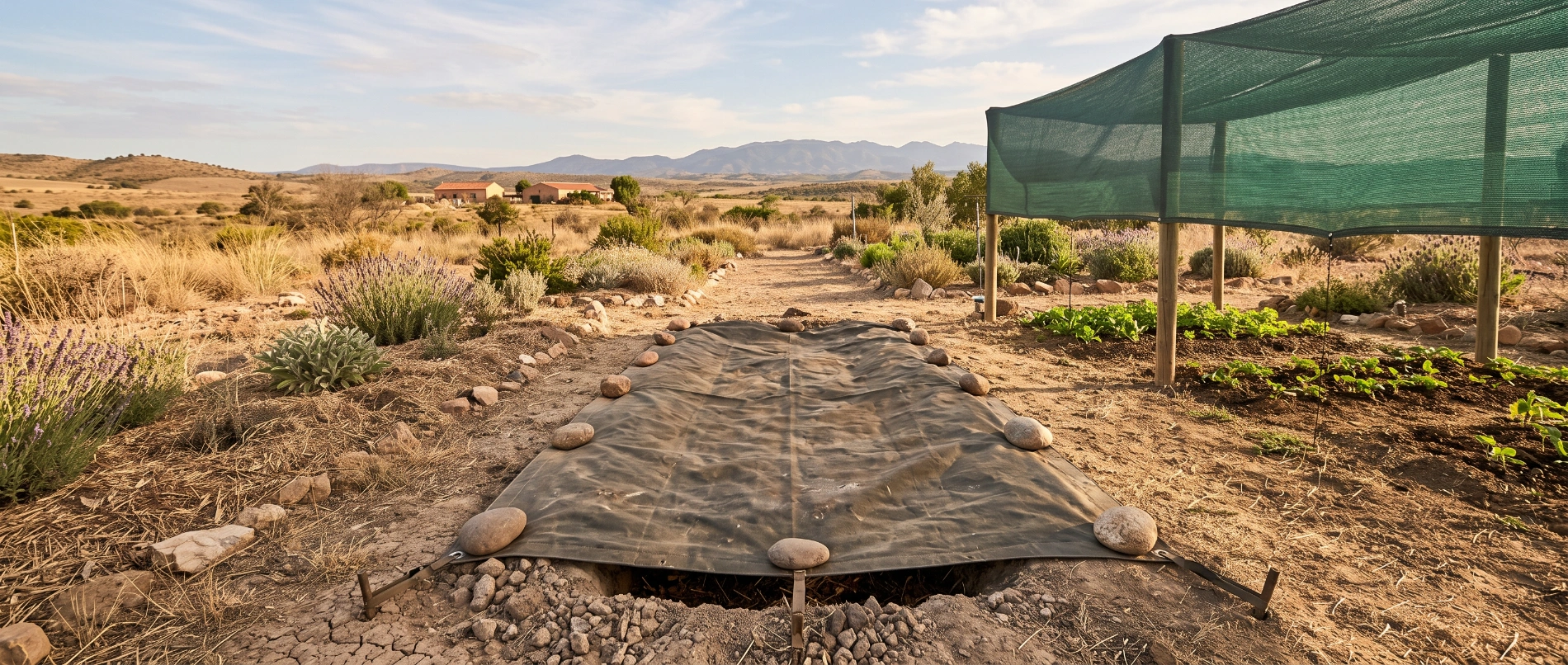
Rapid moisture loss is the defining problem
Composting microbes need consistent moisture, roughly the dampness of a wrung-out sponge, throughout the material they're working on. In a hot, dry, often windy climate, an exposed above-ground heap can lose that moisture to evaporation within days, especially at the surface and edges where most of the biological activity actually happens. Once a heap dries out, activity doesn't just slow -- it stops, and it stays stopped until someone deliberately rewets it. This single fact is why this guide leans so heavily on working below ground, in trenches and pits, rather than above it (see Chapter 3).
Scarce nitrogen-rich material makes balance genuinely hard
Dryland vegetation is naturally carbon-heavy -- dry grass, crop stalks, woody prunings and straw are all abundant, but the moist, nitrogen-rich "green" material that balances them (fresh kitchen scraps, lush weeds, grass clippings) is comparatively scarce, especially outside a short growing season. A heap fed almost entirely on dry carbon breaks down extremely slowly, if at all, no matter how much heat or moisture it gets. This is why manures, not seaweed or abundant fresh greens, become the backbone nitrogen source in most dryland composting traditions (see Chapter 6).
Extreme heat can overheat a heap past the point of usefulness
Composting bacteria have an upper limit -- once internal heap temperatures climb much past 65-70°C, the organisms doing the work start dying off rather than thriving, and the heap can stall in a different way to a dried-out one. In peak summer in a genuinely hot arid climate, a large dark heap in full sun can reach these temperatures from ambient heat and microbial activity combined. Shade and heap size become tools for controlling this rather than only for capturing warmth, unlike in a cool climate (see Chapter 11).
Little organic matter in the native soil to begin with
Desert and dryland soils are typically low in organic matter and biological activity compared to soils in wetter climates, simply because there's been less plant growth and decay feeding them over time. This means the first few seasons of composting here are doing genuinely foundational work rather than topping up an already-functioning system, which is exactly why Chapter 19 treats consistent, patient composting as a multi-year soil-building project rather than a quick fix.
The Advantages
- Fast decomposition and pathogen die-off once moisture is under control -- microbial activity roughly doubles for every 10°C of warmth within a heap's normal operating range, so heat does a genuine share of the work for free.
- Low fungal and mould risk compared to wetter climates, since there's rarely enough ambient humidity to support the mould growth that can trouble heaps elsewhere.
- Abundant sun makes passive solar heating and sun-scalding weed seed practical, genuinely useful techniques rather than gimmicks (see Chapter 14).
- Livestock and manure are often locally abundant in dryland pastoral regions -- sheep, goat, cattle and poultry manure provide a reliable nitrogen source that many wetter, more arable-focused climates actually lack (see Chapter 6).
Frequently Asked Questions
Why does a compost heap dry out so fast in an arid climate?
Composting microbes need moisture in roughly the range of a wrung-out sponge to function, and an above-ground heap in a hot, dry, often windy climate can lose that moisture to evaporation faster than any reasonable watering schedule replaces it. Once a heap drops much below that level, microbial activity slows sharply and eventually stops almost entirely -- and unlike a heap that's gone anaerobic from too much water, a dried-out heap doesn't restart on its own once conditions change back. It needs deliberate rewetting, which is exactly why this guide leans so heavily on below-ground methods and cover materials to prevent the problem in the first place.
Is it true that heat makes composting faster in a dry climate?
Yes, once moisture is under control. Microbial activity roughly doubles for every 10°C rise in temperature within the range compost heaps normally operate, so a well-managed heap in a hot climate can reach peak temperature and finish decomposing considerably faster than the same heap would in a cool one. The catch is that heat also accelerates moisture loss, so the advantage only holds if water is actively managed alongside it -- heat without moisture control just produces a heap that dries out faster, not one that composts faster.
Does an arid or semi-arid climate have any real advantages for composting?
Genuinely, yes. Heat drives faster decomposition and faster pathogen die-off once water is under control, dry conditions mean very little fungal or mould risk compared to wetter climates, abundant sun makes passive solar heating and sun-scalding weed seed practical techniques, and livestock manure is often locally abundant in dryland pastoral regions, providing a reliable nitrogen source many wetter climates actually lack.