
An activator is anything added specifically to kickstart microbial activity and get a heap heating properly, usually a concentrated source of nitrogen. This climate's real four-season cycle, covered in Chapter 1, gives activator strategy here a genuinely two-ended shape, not the single front-loaded push that suits a boreal or Mediterranean climate.
Urine -- Free, Always Available, Year-Round
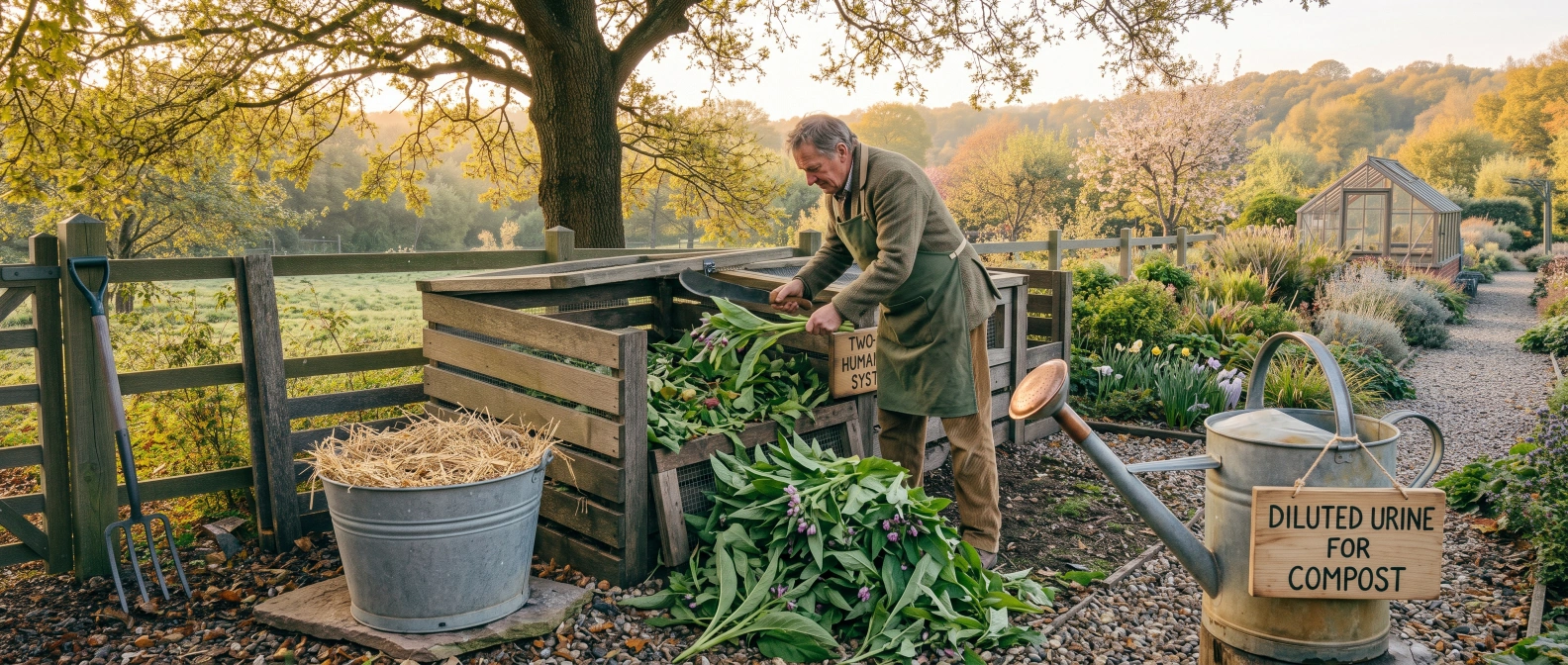
Urine is a free, always-available, high-nitrogen liquid input that works year-round, not tied to a particular season the way plant-based activators are. Dilute roughly 1:10 with water before applying, poured evenly over a heap that needs a nitrogen boost to get moving or keep moving. It's a genuinely simple, reliable tool regardless of which end of the year a pile happens to be at.
Comfrey & Nettles -- Classic Chop-and-Drop Activators
Comfrey and nettles are the classic chop-and-drop plant activators, deep-rooted, fast-growing and genuinely nitrogen-rich when cut fresh. Both grow well through this climate's real, long growing season, more reliably productive here across a longer stretch of the year than in a Mediterranean climate's drought-limited summer or a boreal climate's short window. Chop the leaves and stems and layer them directly into the heap wherever it needs a boost, no processing required.
A Genuinely Two-Ended Strategy
This is the key strategic point specific to this climate, and it's genuinely two-ended, unlike a boreal climate's single "front-load the short season" strategy or a Mediterranean climate's single "front-load the wet season" strategy. This climate's real four-season cycle creates two separate moments where fresh activator material matters most.
Spring: getting a heap moving fast after winter thaw. The chamber that rested over winter (see Chapter 3) needs a kickstart of fresh activator material to get back to full activity, since a dormant pile doesn't simply switch back on as temperatures rise.
Autumn: a final push before the freeze sets in. Adding a concentrated round of activator material in autumn gets as much of that season's material as far along as possible before the winter pause, rather than leaving it to sit half-processed through the freeze. See Chapter 4 for the carbon-to-nitrogen balance these activators feed into, and Chapter 13 for how this fits the wider seasonal calendar.
Frequently Asked Questions
What are the best free compost activators in a temperate continental climate?
Urine is the most reliable, a free, always-available, high-nitrogen liquid input, diluted roughly 1:10 with water before applying, and useful year-round whenever a pile needs a nitrogen boost. Comfrey and nettles are the classic chop-and-drop plant activators, and both genuinely grow well through this climate's real, long growing season, more reliably productive here across a longer stretch of the year than in a Mediterranean climate's drought-limited summer or a boreal climate's short window.
Why is the activator strategy here described as two-ended rather than front-loaded?
Because this climate's real four-season cycle creates two genuinely separate moments where activator material matters most, unlike a boreal climate's single short season or a Mediterranean climate's single wet season. The first is spring, when the chamber that rested over winter needs a kickstart of fresh activator material to get back to full activity. The second is autumn, making a final push of activator material before the freeze sets in, to get that season's material as far along as possible before the winter pause.
Why does the resting winter chamber need a kickstart in spring rather than just warming up on its own?
Because a heap that went dormant over a real hard winter freeze doesn't simply switch back on as temperatures rise. Microbial populations have dropped off during the dormant stretch, and fresh, nitrogen-rich activator material, chopped comfrey or nettles, or diluted urine, gives the pile the boost it needs to build heat and activity back up quickly rather than restarting slowly on its own.